


Planes take off almost every day over Thailand's dried-out rice paddies with a chemical cocktail that scientists -- guided by Thailand's king -- hope will wring the clouds dry and ease a drought that has scorched southeast Asia.
The propeller planes are packed with up to seven people including the pilot, scientists and technicians, all squeezing in around large containers of chemicals ranging from silver iodine to ordinary salt and dry ice.
Flying at about 3,000m over parched fields, dusty dams and thirsty rivers, the planes fly directly into clouds that most pilots avoid so scientists can dump their loads and wait for rain.
Thai agricultural officials say those rainmaking efforts -- known as cloud seeding -- have worked and eased the toughest drought in seven years by 80 percent.
The reported success has led countries from Oman to Cambodia to ask Thailand if the method used here could ease periodic droughts in their countries, but scientists warn that cloud seeding works only in certain circumstances.
Besides, cloud seeding has a history which stretches back more than six decades and results of experiments around Asia have been mixed at best and appear more likely to cushion a drought's impact than break it.
Thailand has used cloud seeding for almost 30 years, led by King Bhumibol Adulyadej, who has his own patented rain-making technique.
Rainmaking begins when the relative humidity exceeds 60 percent. Lower humidity makes the efforts harder, Wathana Sukarnkanaset, director of Thailand's bureau of royal rainmaking and agricultural aviation, tells AFP.
The chemicals are sprayed into clouds to encourage smaller clouds to merge and induce rain. The cocktail causes tiny vapor droplets to coalesce and the water freezes into snow which melts as it falls.
The king's technique uses two aircraft to seed warm and cold clouds at different altitudes to make rain over a wider area than other methods, Wathana said.
Flights by BT-67s, Nomads and Cessna Caravans are held almost daily and last up to two hours, depending on the aircraft's size and the target area.
With Thailand's drought pinching, the air force, police and navy loaned the agricultural ministry additional planes, giving scientists a total of 45 aircraft for cloud seeding, Wathana says.
The rainmaking bureau has 600 staff and a budget of almost one billion baht (US$25 million), though expanded operations this year and rising fuel costs could force them to request more money, Wathana says.
Like much of the rest of the region, Thailand receives lots of rain -- more than 1,200mm a year in most areas and up to 4,000mm in some coastal provinces.
But the rain doesn't fall evenly across the year, causing a cycle of droughts and floods, made worse this year by the exceptionally harsh dry season ahead of the rains that normally begin in mid-May.
"Our technique tries to help distribute rain for the whole season," Wathana says.

With much pomp and circumstance, Cairo is today to inaugurate the long-awaited Grand Egyptian Museum (GEM), widely presented as the crowning jewel on authorities’ efforts to overhaul the country’s vital tourism industry. With a panoramic view of the Giza pyramids plateau, the museum houses thousands of artifacts spanning more than 5,000 years of Egyptian antiquity at a whopping cost of more than US$1 billion. More than two decades in the making, the ultra-modern museum anticipates 5 million visitors annually, with never-before-seen relics on display. In the run-up to the grand opening, Egyptian media and official statements have hailed the “historic moment,” describing the

SECRETIVE SECT: Tetsuya Yamagami was said to have held a grudge against the Unification Church for bankrupting his family after his mother donated about ¥100m The gunman accused of killing former Japanese prime minister Shinzo Abe yesterday pleaded guilty, three years after the assassination in broad daylight shocked the world. The slaying forced a reckoning in a nation with little experience of gun violence, and ignited scrutiny of alleged ties between prominent conservative lawmakers and a secretive sect, the Unification Church. “Everything is true,” Tetsuya Yamagami said at a court in the western city of Nara, admitting to murdering the nation’s longest-serving leader in July 2022. The 45-year-old was led into the room by four security officials. When the judge asked him to state his name, Yamagami, who
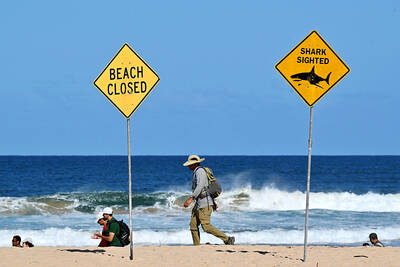
DEADLY PREDATORS: In New South Wales, smart drumlines — anchored buoys with baited hooks — send an alert when a shark bites, allowing the sharks to be tagged High above Sydney’s beaches, drones seek one of the world’s deadliest predators, scanning for the flick of a tail, the swish of a fin or a shadow slipping through the swell. Australia’s oceans are teeming with sharks, with great whites topping the list of species that might fatally chomp a human. Undeterred, Australians flock to the sea in huge numbers — with a survey last year showing that nearly two-thirds of the population made a total of 650 million coastal visits in a single year. Many beach lovers accept the risks. When a shark killed surfer Mercury Psillakis off a northern Sydney beach last
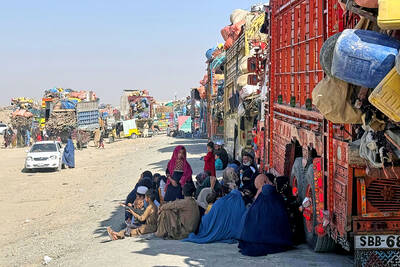
‘NO WORKABLE SOLUTION’: An official said Pakistan engaged in the spirit of peace, but Kabul continued its ‘unabated support to terrorists opposed to Pakistan’ Pakistan yesterday said that negotiations for a lasting truce with Afghanistan had “failed to bring about a workable solution,” warning that it would take steps to protect its people. Pakistan and Afghanistan have been holding negotiations in Istanbul, Turkey, aimed at securing peace after the South Asian neighbors’ deadliest border clashes in years. The violence, which killed more than 70 people and wounded hundreds, erupted following explosions in Kabul on Oct. 9 that the Taliban authorities blamed on Pakistan. “Regrettably, the Afghan side gave no assurances, kept deviating from the core issue and resorted to blame game, deflection and ruses,” Pakistani Minister of


 RSS
RSS