


Prime Minister Paul Martin on Monday scrambled to prevent the downfall of his government amid a kickback scandal in his Liberal Party, as a new poll indicates the opposition Conservative Party would easily win fresh elections if held today.
In what some say have called Canada's version of the Watergate scandal, Martin reiterated he had nothing to do with the ethics fiasco, in which party members are accused of having taken kickbacks from Liberal-friendly agencies hired to promote national unity in the French-speaking province of Quebec, where separatism is popular.
"Not only do I have the moral authority, I have the moral responsibility" to keep the government afloat until the full inquiry into the scandal concludes in the fall, Martin said.
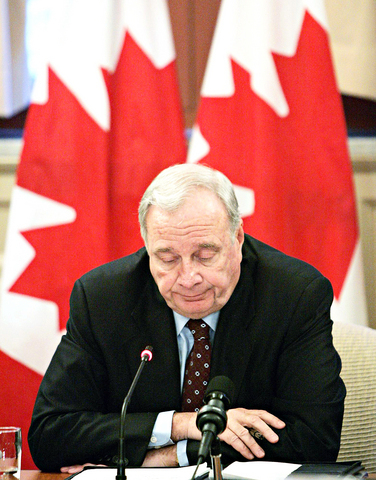
PHOTO: AP
"Canadians are entitled to ask someone to step forward and I'm the prime minister of this country," he said. "I can assure you that anyone who has been implicated is going to be punished."
How long Martin can remain prime minister is anyone's guess and the halls of parliament were rife with speculation about whether new elections were around the corner.
The separatist Bloc Quebecois could introduce a confidence motion by tomorrow, though the more powerful Conservative Party was hedging, knowing most Canadians are not keen for new elections. Parliamentary elections were just held last June.
"There is a depth of anger there. The Liberal Party is in deep, deep trouble," said Richard Simeon, professor of political science at the University of Toronto.
A poll published on Monday by the Toronto Star indicates that only 25 percent of those questioned last week would vote for the Liberals if there were elections held today. The Conservatives were backed by 36 percent, up 10 points from a survey taken in February.
The poll, conducted by EKOS Research Associates, surveyed 1,125 Canadians over voting age between last Thursday and Saturday, with a 2.9 percent margin of error.
However, the poll also indicated 62 percent of Canadians do not want new elections, despite their disgust over the secret fund for federalism.
The scandal, based on a secret program that dates back to the 1990s and the Liberal Party leadership of former prime minister Jean Chretien, erupted anew last Thursday when a judge probing the alleged misuse of public funds lifted a publication ban on testimony by Montreal ad executive Jean Brault.
Brault, who faces fraud charges stemming from the now-defunct program, told the federal inquiry that senior Liberals forced him to secretly divert more than C$1 million (US$818,000) to the party's Quebec wing in exchange for sponsorship contracts.
During his six days of testimony, Brault told of hushed-up payments to Liberals in restaurants, money given to a brother of Chretien, and reluctant contributions strong-armed out of employees.
Brault said he got C$172 million, in government business for his firm.
Chretien and Martin have vehemently denied any personal knowledge of wrongdoing.
The so-called "sponsorship scandal" outraged the public when it was uncovered in 2002, after the auditor general determined that C$100 million from a C$250 million national unity fund went to Liberal-friendly advertising firms. Public anger over the secret fund contributed to the Liberal Party's loss of its majority in Parliament in last year's election.
The program was developed to promote national unity in Quebec following the narrow defeat of a separatist referendum in the French-speaking province in 1995. Advertising agencies with Liberal ties allegedly received millions of dollars in exchange for little or no apparent work.
The scandal led to a deep rift in the Liberal Party, in particular between Chretien and Martin.
Amid desk-pounding and shouting in the House of Commons on Monday, a red-faced Martin reminded his opponents that he had dissolved the program, convened the commission to investigate the project and filed lawsuits against 19 ad agencies to recover government funds.
Even if it is determined that Martin had no knowledge of the misuse of government funds in the name of national unity, he may have to take the fall.
"The problem with corruption, when it occurs -- and Watergate was a good example of this in the United States -- it undermines confidence in not just the people who are involved, but in the institution that they represent," said Wesley Cragg, head of Transparency International Canada, a global anti-corruption coalition. "That's the real worry."

Conjoined twins Lori and George Schappell, who pursued separate careers, interests and relationships during lives that defied medical expectations, died this month in Pennsylvania, funeral home officials said. They were 62. The twins, listed by Guinness World Records as the oldest living conjoined twins, died on April 7 at the Hospital of the University of Pennsylvania, obituaries posted by Leibensperger Funeral Homes of Hamburg said. The cause of death was not detailed. “When we were born, the doctors didn’t think we’d make 30, but we proved them wrong,” Lori said in an interview when they turned 50, the Philadelphia Inquirer reported. The

IN PURSUIT: Israel’s defense minister said the revenge attacks by Israeli settlers would make it difficult for security forces to find those responsible for the 14-year-old’s death Israeli Prime Minister Benjamin Netanyahu on Saturday condemned the “heinous murder” of an Israeli teenager in the occupied West Bank as attacks on Palestinian villages intensified following news of his death. After Benjamin Achimeir, 14, was reported missing near Ramallah on Friday, hundreds of Jewish settlers backed by Israeli forces raided nearby Palestinian villages, torching vehicles and homes, leaving at least one villager dead and dozens wounded. The attacks escalated in several villages on Saturday after Achimeir’s body was found near the Malachi Hashalom outpost. Agence France-Presse correspondents saw smoke rising from burned houses and fields. Mayor Amin Abu Alyah, of the
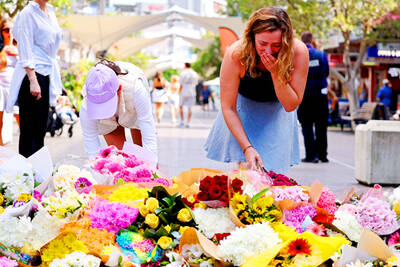
Australian police yesterday said a 40-year-old itinerant with mental illness was behind a Sydney shopping center stabbing rampage that killed six people, including a new mum whose nine-month-old baby is still in hospital with serious wounds. New South Wales Police Assistant Commissioner Anthony Cooke said the assailant — who was shot and killed by a senior police officer at the scene on Saturday — was Queensland man Joel Cauchi. Five women and one male security guard were killed in the attack as Cauchi roved through a packed shopping center in the city’s Bondi Junction neighborhood with a large knife. Twelve more people

A prominent Christian leader has allegedly been stabbed at the altar during a Mass yesterday in southwest Sydney. Bishop Mar Mari Emmanuel was saying Mass at Christ The Good Shepherd Church in Wakeley just after 7pm when a man approached him at the altar and allegedly stabbed toward his head multiple times. A live stream of the Mass shows the congregation swarm forward toward Emmanuel before it was cut off. The church leader gained prominence during the COVID-19 pandemic, amassing a large online following, Officers attached to Fairfield City police area command attended a location on Welcome Street, Wakeley following reports a number


 RSS
RSS