


It is perhaps one of the stranger, if smaller, ripples to spread from the death of a pope in Rome that Protestants in England should begin to wonder what happened to the power of their faith.
But as the funeral of John Paul II takes place, some historians and columnists here have suggested that the English response to his death has shown, in the words of Mark Almond, an Oxford historian, that almost five centuries after its founding, "Protestant England is dead."
Nothing has done more to create that impression than the decision of Prince Charles on Monday to postpone his wedding to Camilla Parker Bowles -- initially set for yesterday -- by one day to permit no lesser personages than Prime Minister Tony Blair and the archbishop of Canterbury, the Most Reverend Rowan Williams, head of the Church of England, to attend the papal burial rather than a royal wedding.
Even Charles himself -- representative of a monarchy that first broke with Rome under King Henry VIII in the 16th century -- is planning to attend the funeral on behalf of his mother, Queen Elizabeth II, the head of state. That makes this country one of the few to be represented at the funeral by church, state and government.
"The funeral of a pope, let us be clear, has never until now been the sort of event deemed to require the attendance of the British prime minister -- or even the archbishop of Canterbury," said Martin Kettle, a columnist in The Guardian. "It is hard not to catch one's breath at the rupture with national history that all this represents," he wrote.
Or, as Almond put it, "Henry VIII must be turning in his Windsor grave."
The roots of all this go back to Henry VIII's repudiation of papal authority to circumvent Roman Catholic strictures on divorce and remarriage. That rejection of papal authority, formalized in the Act of Supremacy in 1534, set the land on a constitutional path that defined the English identity through centuries of stubborn independence and self-confidence.
Of course, much has changed in recent decades, not least the papacy and the British monarchy. But the pope's funeral has cast the contradictions into sharper relief: Prince Charles is still the heir to the throne and thus the future supreme governor of the Church of England, which, in turn, is the established church of England with specific privileges and responsibilities. The church and the monarchy are, thus, still formally linked.
Moreover, when Blair sought the queen's consent on Tuesday to dissolve Parliament to make way for elections on May 5, he was reinforcing the ceremonial bonds linking monarchy, government and Parliament.
But those ties no longer produce the sense of English national identity most manifest in recent times among soccer and other sporting fans festooning themselves with the red and white flag of St. George.
"I think what has happened particularly since the late 1950s has been a decline in what you might call a national Protestant outlook," said Perry Butler, a church historian in London.
He said that "the national Protestantism as a culture which had at its heart a very strong anti-Catholicism only exists in Northern Ireland" and pockets of Britain.
Of course, the Church of England itself -- part of the Anglican Communion with its more than 40 provinces around the world -- has long been in decline, struggling to keep pace with a society that has moved away from its onetime moral precepts on divorce, abortion and homosexuality.
The number of Anglican clergy members has fallen from 18,000 in the late 1960s to about 9,500, Butler said. British society has become multiracial and multicultural. He said that "the Church of England has also been squeezed by the growth of sectarian Protestantism" and other religions, while the number of Roman Catholics has risen to around 10 percent of the population.
Since the death of the previous pope, John Paul I, in 1978, the relationship between Anglicans and the Vatican has changed with the advance of ecumenical diplomacy that has altered the tone, if not the substance, of the debate.
Recall, for instance, the fairy-tale royal wedding at St. Paul's Cathedral, when Charles married Diana in 1981. It is hard to imagine an event of that scale being delayed even for the funeral of "so great a man as Pope John Paul," the columnist Stephen Glover wrote in The Daily Mail. "Prince Charles' register office nuptials, by contrast, are eminently movable."
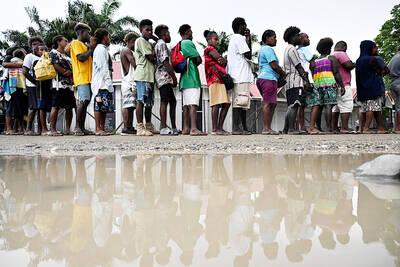
SEEKING CHANGE: A hospital worker said she did not vote in previous elections, but ‘now I can see that maybe my vote can change the system and the country’ Voting closed yesterday across the Solomon Islands in the south Pacific nation’s first general election since the government switched diplomatic allegiance from Taiwan to Beijing and struck a secret security pact that has raised fears of the Chinese navy gaining a foothold in the region. The Solomon Islands’ closer relationship with China and a troubled domestic economy weighed on voters’ minds as they cast their ballots. As many as 420,000 registered voters had their say across 50 national seats. For the first time, the national vote also coincided with elections for eight of the 10 local governments. Esther Maeluma cast her vote in the
Nearly half of China’s major cities are suffering “moderate to severe” levels of subsidence, putting millions of people at risk of flooding, especially as sea levels rise, according to a study of nationwide satellite data released yesterday. The authors of the paper, published by the journal Science, found that 45 percent of China’s urban land was sinking faster than 3mm per year, with 16 percent at more than 10mm per year, driven not only by declining water tables, but also the sheer weight of the built environment. With China’s urban population already in excess of 900 million people, “even a small portion

UNSETTLING IMAGES: The scene took place in front of TV crews covering the Trump trial, with a CNN anchor calling it an ‘emotional and unbelievably disturbing moment’ A man who doused himself in an accelerant and set himself on fire outside the courthouse where former US president Donald Trump is on trial has died, police said yesterday. The New York City Police Department (NYPD) said the man was declared dead by staff at an area hospital. The man was in Collect Pond Park at about 1:30pm on Friday when he took out pamphlets espousing conspiracy theories, tossed them around, then doused himself in an accelerant and set himself on fire, officials and witnesses said. A large number of police officers were nearby when it happened. Some officers and bystanders rushed

HYPOCRISY? The Chinese Ministry of Foreign Affairs yesterday asked whether Biden was talking about China or the US when he used the word ‘xenophobic’ US President Joe Biden on Wednesday called for a hike in steel tariffs on China, accusing Beijing of cheating as he spoke at a campaign event in Pennsylvania. Biden accused China of xenophobia, too, in a speech to union members in Pittsburgh. “They’re not competing, they’re cheating. They’re cheating and we’ve seen the damage here in America,” Biden said. Chinese steel companies “don’t need to worry about making a profit because the Chinese government is subsidizing them so heavily,” he said. Biden said he had called for the US Trade Representative to triple the tariff rates for Chinese steel and aluminum if Beijing was


 RSS
RSS