


Passengers on a historic bus trip between the Pakistani and Indian portions of Kashmir crossed a bridge spanning the de facto border yesterday, the halfway point on a voyage both sides hope will lead to lasting peace on the subcontinent.
Family members kept apart during more than a half-century of bloodshed waited anxiously to receive their loved ones, while Indian officials offered the visitors from the Pakistani Kashmiri capital of Muzaffarabad marigold garlands and bouquets of flowers. One passenger waved a victory sign.
Two buses from Srinagar, the capital of Indian Kashmir, were expected to arrive later at the heavily militarized Line of Control, where a 67-meter long bridge closed since the 1940s connects a winding and rutted road through the Himalayas.
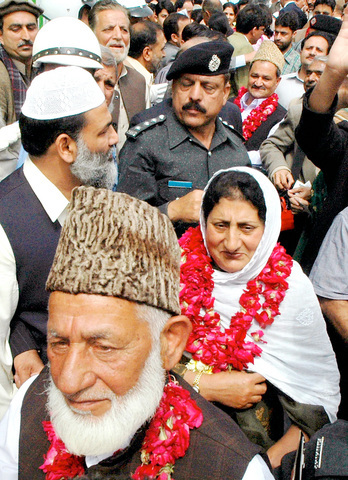
PHOTO: AP
The bus service started a day after an attack in Srinagar by suspected Islamic militants on a guesthouse where passengers were staying.
Six people were injured but the passengers escaped unharmed. Both sides vowed not to let militants disrupt the occasion.
There were no serious reports of violence yesterday, but a small explosion went off near Pattan, a town on the Indian side of the bus route, about 10 minutes after the two buses passed through the area, said Brij Lal, a paramilitary officer who escorted the vehicles. There were no casualties.
"This is the day we have long been waiting for," Indian Prime Minister Manmohan Singh said at a ceremony before the buses left Srinagar. Passengers hugged the Indian leader before hopping on board and Singh told them they were part of "a caravan of peace."
He praised Pakistani President General Pervez Musharraf for helping make the bus service possible.
In Muzaffarabad, hundreds of people crowded rooftops and pressed close together along the road where the bus departed, but the official send-off was more subdued. Neither Musharraf nor Prime Minister Shaukat Aziz attended.
Sikandar Hayyat Khan, the top elected official in Pakistan-controlled Kashmir, asked India to provide security for the travelers.
"Our brave people are going to Srinagar despite the attack there, and I ask the Indian government to provide protection to our people," he said in his speech at a ceremony in Muzaffarabad, the capital of Pakistan-controlled Kashmir.
The bus service runs along a crumbling road that was once the region's main artery.
Workers on both sides have been hastily making repairs since the two countries decided to restart the service last month.
On the Pakistan side of the bridge, a dark green sign reads: "From home to home, we extend a very warm welcome to our Kashmiri brethren."
In Salamabad, in Indian Kashmir just 14km from the Line of Control that divides the region, school children dressed in colorful outfits and rehearsed songs and dances they would perform for the passengers from Muzaffarabad when they stop there for lunch.
Most of the region's militant groups oppose the bus service, which they see as a gimmick rather than a step toward a peace deal they would accept.
Passengers said they were excited and would not be intimidated.
"We are believers in Almighty Allah, and we hope none will harm us. We are ambassadors of peace," said Syed Shahid Bahar, 36, a lawyer whose father migrated from the Indian side of Kashmir in 1949. Bahar's cousins and uncles live in Indian Kashmir and he plans to stay there for 15 days.
Another passenger from Muzaffarabad, Mohammed Amjad Khan, said he was happy he was going to Srinagar despite the threat of attack.
"Once in a life a man has to die, and that time is fixed so I don't worry about that," he said.

Republican US lawmakers on Friday criticized US President Joe Biden’s administration after sanctioned Chinese telecoms equipment giant Huawei unveiled a laptop this week powered by an Intel artificial intelligence (AI) chip. The US placed Huawei on a trade restriction list in 2019 for contravening Iran sanctions, part of a broader effort to hobble Beijing’s technological advances. Placement on the list means the company’s suppliers have to seek a special, difficult-to-obtain license before shipping to it. One such license, issued by then-US president Donald Trump’s administration, has allowed Intel to ship central processors to Huawei for use in laptops since 2020. China hardliners

A top Vietnamese property tycoon was on Thursday sentenced to death in one of the biggest corruption cases in history, with an estimated US$27 billion in damages. A panel of three hand-picked jurors and two judges rejected all defense arguments by Truong My Lan, chair of major developer Van Thinh Phat, who was found guilty of swindling cash from Saigon Commercial Bank (SCB) over a decade. “The defendant’s actions ... eroded people’s trust in the leadership of the [Communist] Party and state,” read the verdict at the trial in Ho Chi Minh City. After the five-week trial, 85 others were also sentenced on

Conjoined twins Lori and George Schappell, who pursued separate careers, interests and relationships during lives that defied medical expectations, died this month in Pennsylvania, funeral home officials said. They were 62. The twins, listed by Guinness World Records as the oldest living conjoined twins, died on April 7 at the Hospital of the University of Pennsylvania, obituaries posted by Leibensperger Funeral Homes of Hamburg said. The cause of death was not detailed. “When we were born, the doctors didn’t think we’d make 30, but we proved them wrong,” Lori said in an interview when they turned 50, the Philadelphia Inquirer reported. The

RAMPAGE: A Palestinian man was left dead after dozens of Israeli settlers searching for a missing 14-year-old boy stormed a village in the Israeli-occupied West Bank US President Joe Biden on Friday said he expected Iran to attack Israel “sooner, rather than later” and warned Tehran not to proceed. Asked by reporters about his message to Iran, Biden simply said: “Don’t,” underscoring Washington’s commitment to defend Israel. “We are devoted to the defense of Israel. We will support Israel. We will help defend Israel and Iran will not succeed,” he said. Biden said he would not divulge secure information, but said his expectation was that an attack could come “sooner, rather than later.” Israel braced on Friday for an attack by Iran or its proxies as warnings grew of


 RSS
RSS