


President Robert Mugabe said that he hoped to stay in power until he was 100 as he celebrated an overwhelming victory in parliamentary elections that all but his supporters and a few African neighbors said were rigged.
The opposition Movement for Democratic Change (MDC) refused to accept the election results, saying Thursday's vote was flawed -- a view shared by the US and Britain. The MDC held talks with southern African observers to point out huge discrepancies in the results but made no attempt to organize mass protests.
"This is a moment of victory for my party and the victory of my party translates itself, naturally, into a victory for our country," the 81-year-old Mugabe declared as results showed that he had cleared the two-thirds majority needed to change the constitution.
His ruling Zimbabwe African National Union-Patriotic Front (ZANU-PF) won 78 seats, while the MDC got 41, according to final results issued on Saturday by the chief election officer. An independent candidate picked up one seat. Under Zimbabwean law, Mugabe has the power to appoint an additional 30 lawmakers in the 150-seat chamber.
The results clear the way for Mugabe to set up a second parliamentary chamber representing traditional chiefs, retired politicians and other eminent Zimbabweans without holding a referendum. Critics charge that the autocratic Mugabe wants to pack the senate with cronies to cement his influence and to pick a successor without elections.
But Mugabe made it plain that he didn't plan on stepping down any time soon.
"When I am a century old," he laughed, responding to a question about his retirement plans.
He was only half joking.
Mugabe, one of Africa's longest-serving rulers, has no obvious heir apparent. His appointment of Joyce Mujuru as the country's first female vice president -- and thus a potential successor -- sparked a power struggle last year.
Parliament speaker Emmerson Mnangagwa, once tipped to take over from Mugabe, lost his seat in Thursday's elections. Jonathan Moyo, the former information minister and architect of Zimbabwe's repressive media laws who was sacked after he challenged Mujuru's appointment, was elected as an independent in a rebuff to Mugabe.
The MDC held crisis talks but came up with no clear plan of action.
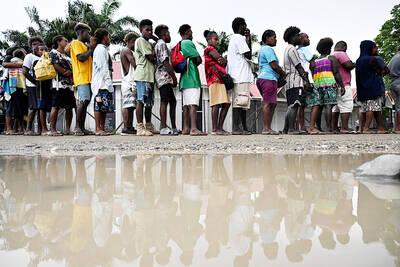
SEEKING CHANGE: A hospital worker said she did not vote in previous elections, but ‘now I can see that maybe my vote can change the system and the country’ Voting closed yesterday across the Solomon Islands in the south Pacific nation’s first general election since the government switched diplomatic allegiance from Taiwan to Beijing and struck a secret security pact that has raised fears of the Chinese navy gaining a foothold in the region. The Solomon Islands’ closer relationship with China and a troubled domestic economy weighed on voters’ minds as they cast their ballots. As many as 420,000 registered voters had their say across 50 national seats. For the first time, the national vote also coincided with elections for eight of the 10 local governments. Esther Maeluma cast her vote in the
Nearly half of China’s major cities are suffering “moderate to severe” levels of subsidence, putting millions of people at risk of flooding, especially as sea levels rise, according to a study of nationwide satellite data released yesterday. The authors of the paper, published by the journal Science, found that 45 percent of China’s urban land was sinking faster than 3mm per year, with 16 percent at more than 10mm per year, driven not only by declining water tables, but also the sheer weight of the built environment. With China’s urban population already in excess of 900 million people, “even a small portion

UNSETTLING IMAGES: The scene took place in front of TV crews covering the Trump trial, with a CNN anchor calling it an ‘emotional and unbelievably disturbing moment’ A man who doused himself in an accelerant and set himself on fire outside the courthouse where former US president Donald Trump is on trial has died, police said yesterday. The New York City Police Department (NYPD) said the man was declared dead by staff at an area hospital. The man was in Collect Pond Park at about 1:30pm on Friday when he took out pamphlets espousing conspiracy theories, tossed them around, then doused himself in an accelerant and set himself on fire, officials and witnesses said. A large number of police officers were nearby when it happened. Some officers and bystanders rushed

HYPOCRISY? The Chinese Ministry of Foreign Affairs yesterday asked whether Biden was talking about China or the US when he used the word ‘xenophobic’ US President Joe Biden on Wednesday called for a hike in steel tariffs on China, accusing Beijing of cheating as he spoke at a campaign event in Pennsylvania. Biden accused China of xenophobia, too, in a speech to union members in Pittsburgh. “They’re not competing, they’re cheating. They’re cheating and we’ve seen the damage here in America,” Biden said. Chinese steel companies “don’t need to worry about making a profit because the Chinese government is subsidizing them so heavily,” he said. Biden said he had called for the US Trade Representative to triple the tariff rates for Chinese steel and aluminum if Beijing was


 RSS
RSS