


A daunting task awaits the successor of John Paul II, who will be the 265th pope in the 2,000 year history of the Roman Catholic Church.
A famous Italian saying about conclaves holds that "he who goes in as pope comes out a cardinal." The idea behind the saying is that someone who is widely tipped as a candidate in fact loses his chances of being elected. In reality, of the past five papal elections, Vatican experts note, only one -- Karol Wojtyla in 1978 -- was a clear surprise, if only because most had assumed the next pope would be an Italian.
One way of predicting whom the next pope might be involves drawing up a portrait of an ideal candidate, and then match names to go with it. John Allen, a Rome-based correspondent for the National Catholic Reporter, argues that Pope John Paul II leaves behind "a more united world and a more divided church. John Paul II directed much of his energies towards the outside world rather than on the inner workings of the Church."
At the same time, demands for "collegiality" and "subsidiarity," two terms used to describe the need for lower-ranking clergy to be given a greater say in church government, are increasingly being voiced. Although many believe the papacy should be returned to an Italian, Allen argues that the church needs a man capable of arousing interest in all corners of the world, particularly where converts are needed.
"They won't elect an Italian because that would mean withdrawing to put the house in order at a time when there is a need for expansion," Giacomo Galeazzi, a Vatican expert in Rome argues.
Both Allen and Galeazzi believe the next pope could easily be a foreigner, even a non-European. American candidates won't be in contention, Allen says, because that would give rise to suspicion of being influenced by the US.
Galeazzi notes that after the terrorist attacks of Sept. 11, 2001, there is even more need for a pope that comes from a developing country. He cites Asia, where political instability could favor the Church in the future, and Latin America, where the Church has been doing particularly well.
Much has been written about the possibility that the next pope could be black, such as Cardinal Francis Arinze of Nigeria. But as one Vatican expert in Rome once noted: "If even such a modern country as the United States has not had a black President yet, how can you expect a deeply conservative body like the Church to elect a black pope?"
Several experts also dispute the view that the next pope will be as conservative as John Paul II.
"History teaches us that cardinals appointed by conservative popes don't necessarily elect a conservative," says Allen.
Father Richard McBrien, a professor of Theology at the University of Notre Dame, Indiana, argues that "History shows that the longer a pope remains in office, the less likely it is that he will be followed by a photo-copy of himself."
Like many Vatican experts, McBrien believes that after the lengthy papacy of Karol Wojtyla, cardinals will be looking for "a transitional pope."
Nearly half of China’s major cities are suffering “moderate to severe” levels of subsidence, putting millions of people at risk of flooding, especially as sea levels rise, according to a study of nationwide satellite data released yesterday. The authors of the paper, published by the journal Science, found that 45 percent of China’s urban land was sinking faster than 3mm per year, with 16 percent at more than 10mm per year, driven not only by declining water tables, but also the sheer weight of the built environment. With China’s urban population already in excess of 900 million people, “even a small portion

UNSETTLING IMAGES: The scene took place in front of TV crews covering the Trump trial, with a CNN anchor calling it an ‘emotional and unbelievably disturbing moment’ A man who doused himself in an accelerant and set himself on fire outside the courthouse where former US president Donald Trump is on trial has died, police said yesterday. The New York City Police Department (NYPD) said the man was declared dead by staff at an area hospital. The man was in Collect Pond Park at about 1:30pm on Friday when he took out pamphlets espousing conspiracy theories, tossed them around, then doused himself in an accelerant and set himself on fire, officials and witnesses said. A large number of police officers were nearby when it happened. Some officers and bystanders rushed
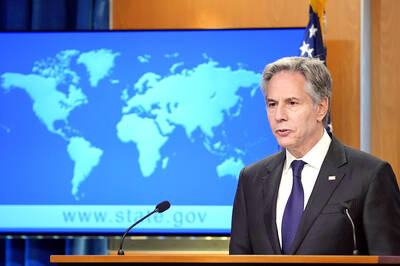
Beijing is continuing to commit genocide and crimes against humanity against Uyghurs and other Muslim minorities in its western Xinjiang province, U.S. Secretary of State Antony Blinken said in a report published on Monday, ahead of his planned visit to China this week. The State Department’s annual human rights report, which documents abuses recorded all over the world during the previous calendar year, repeated language from previous years on the treatment of Muslims in Xinjiang, but the publication raises the issue ahead of delicate talks, including on the war in Ukraine and global trade, between the top U.S. diplomat and Chinese

HYPOCRISY? The Chinese Ministry of Foreign Affairs yesterday asked whether Biden was talking about China or the US when he used the word ‘xenophobic’ US President Joe Biden on Wednesday called for a hike in steel tariffs on China, accusing Beijing of cheating as he spoke at a campaign event in Pennsylvania. Biden accused China of xenophobia, too, in a speech to union members in Pittsburgh. “They’re not competing, they’re cheating. They’re cheating and we’ve seen the damage here in America,” Biden said. Chinese steel companies “don’t need to worry about making a profit because the Chinese government is subsidizing them so heavily,” he said. Biden said he had called for the US Trade Representative to triple the tariff rates for Chinese steel and aluminum if Beijing was


 RSS
RSS