


The arrival of hundreds of terror suspects at this remote US naval outpost in the Caribbean not only lifted it from obscurity but produced a population boom and a flood of things to keep its new residents happy -- a miniature golf course, Starbucks coffee, a go-kart track and music concerts.
The non-detainee population at Guantanamo has surged from about 2,600 to about 9,500 since the military brought the first prisoners captured in the US-led war against Afghanistan here three years ago. Overnight, a base that had been little more than a sleepy refueling stop for ships gained worldwide fame.
The base's administrators shifted gears quickly from tearing down structures to renovating and building new ones in a rush to provide an adequate working and living quarters for 2,200 troops involved in the detention operation, as well as their family members, contract workers, interrogators and other supporting officials.
Uncertainty shrouds the future of the prison camp, amid court rulings that have undermined the government's argument that 545 detainees from 40 countries are beyond the reach of US courts and are not entitled to the same protections prisoners of war get under the Geneva Conventions. But construction continues under the assumption that most detainees aren't leaving soon.
"As long as there is a global war on terror [the detention mission] is here for the long run," said base commander Navy Captain Les McCoy, who doesn't oversee the prison operation but must take its future into account while running the rest of the base. "The Navy realized it hadn't paid attention to Guantanamo. Now they are looking at us."
Two permanent prison camps that can hold 320 people are meant to replace four temporary prisons, suggesting the military hopes gradually to release or transfer many prisoners through parole hearings or negotiations with their home governments. One prison was completed last year, while work has started on US$35 million facility.
With nearly every building on the base in use, finding adequate housing for soldiers and other support staff has been a headache. Many officers live in housing that was boarded up, overrun with rodents called "banana rats" and on the brink of demolition before the detainees arrived.
Enlisted soldiers are less comfortable, crowded into windowless trailers where each barely has a corner to himself. "Camp America," as the trailer park is known, is closer to the prison camp than the social center of the base, which famously has the only McDonald's in Cuba.
The military hopes eventually to move those soldiers to more permanent housing "downtown," said Commander Anne Marie Reese, an engineer overseeing construction for the detention mission.
"Everyone wants to feel like they are going home after work," Reese said. "Whether we can achieve that 100 percent remains to be seen."
Stuck between the Caribbean sea and a 27km fence that separates it from the rest of communist Cuba, Guantanamo is one of the most isolated US naval stations in the world. The parched land and blistering heat reinforces a sleepy atmosphere.
The population surge has meant more parties, sold-out country and rock concerts and -- the latest excitement -- Starbucks coffee.
A stone's throw away from the barbed wire prison camp, soldiers crowd around one of the four kiosks offering mochas, creamices and iced lattes.
Some 1,400 cups a day have been sold since Starbucks arrived earlier this month.
"Oddly enough, it did lift my morale," said petty officer Barry Tate, arriving for his first cup of the day at another kiosk near the movie theater. "I didn't expect to see it and here it was. It reminds me of home."
Mini-golf hasn't been much of a hit, probably because the course is covered in brown grass and has no obstacles.
But not for long, promises Craig Basel, the official in charge of recreation at the base. By summer, obstacles will include replicas of guard towers and banana rats, he said.

Republican US lawmakers on Friday criticized US President Joe Biden’s administration after sanctioned Chinese telecoms equipment giant Huawei unveiled a laptop this week powered by an Intel artificial intelligence (AI) chip. The US placed Huawei on a trade restriction list in 2019 for contravening Iran sanctions, part of a broader effort to hobble Beijing’s technological advances. Placement on the list means the company’s suppliers have to seek a special, difficult-to-obtain license before shipping to it. One such license, issued by then-US president Donald Trump’s administration, has allowed Intel to ship central processors to Huawei for use in laptops since 2020. China hardliners

DISADVANTAGE: Erin O’Toole, who led the Conservatives during the election campaign in 2021, estimated that the interference cost his party as many as nine legislative seats Canada’s domestic spy agency on Monday concluded that China interfered in the past two elections, an official probe heard, the firmest evidence so far of suspected Chinese meddling in Canadian politics. Canadian Prime Minister Justin Trudeau’s Liberal Party won both the elections, held in 2019 and 2021. Under pressure from opposition lawmakers unhappy about media reports on China’s possible role, Trudeau set up a commission into foreign interference. The commission was shown a slide on Monday containing an extract of a briefing in February last year from the Canadian Security Intelligence Service (CSIS). “We know that the PRC [People’s Republic of China] clandestinely
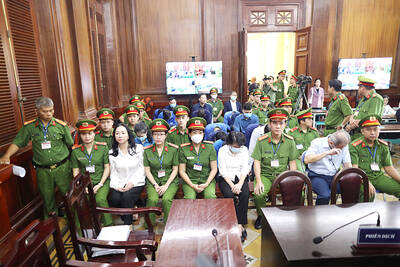
A top Vietnamese property tycoon was on Thursday sentenced to death in one of the biggest corruption cases in history, with an estimated US$27 billion in damages. A panel of three hand-picked jurors and two judges rejected all defense arguments by Truong My Lan, chair of major developer Van Thinh Phat, who was found guilty of swindling cash from Saigon Commercial Bank (SCB) over a decade. “The defendant’s actions ... eroded people’s trust in the leadership of the [Communist] Party and state,” read the verdict at the trial in Ho Chi Minh City. After the five-week trial, 85 others were also sentenced on

‘DELUSIONAL’: Targeting the families of Hamas’ leaders would not push the group to change its position or to give up its demands for Palestinians, Ismail Haniyeh said Israeli aircraft on Wednesday killed three sons of Hamas’ top political leader in the Gaza Strip, striking high-stakes targets at a time when Israel is holding delicate ceasefire negotiations with the militant group. Hamas said four of the leader’s grandchildren were also killed. Ismail Haniyeh’s sons are among the highest-profile figures to be killed in the war so far. Israel said they were Hamas operatives, and Haniyeh accused Israel of acting in “the spirit of revenge and murder.” The deaths threatened to strain the internationally mediated ceasefire talks, which appeared to gain steam in recent days even as the sides remain far


 RSS
RSS