


Guards at the Ministry of Science and Technology opened fire Sunday on a crowd of protesting government employees here, killing one and wounding three. The shootings came as General John Abizaid, the senior US commander in the region, warned that delays in forming a government in Iraq could contribute to a rise in violence.
The protesters worked as guards at an old government-owned uranium storage site south of Baghdad, and went to the ministry to collect their wages and ammunition. After discovering that their salaries had been reduced, the group of about 50 workers staged an impromptu demonstration, Interior Ministry officials said.
It was unclear why the demonstrators were fired upon.
On Sunday, negotiations to form a government continued but no progress was apparent. Abizaid said that the longer it took to form a government in Iraq, the more uncertainty there would be, and "the more uncertainty, the greater chance for escalated violence."
The general, speaking on CNN's <
In addition, the number of non-Iraqis being detained at the three major US detention centers in Iraq has been rising since September, with 325 foreign prisoners from 16 countries currently being held military said.
Most of the foreign fighters are continuing to enter through Syria, with far smaller numbers coming across the Saudi and Iranian borders, Abizaid said. He accused the Syrian government of not cracking down on rebel sympathizers who help ferry the fighters into Iraq.
"The Syrians are not doing everything we've asked them to do," Abizaid said, echoing a repeated criticism Bush administration officials have leveled at the Syrian government. "The Syrians know there are facilitation cells in places like Damascus and Aleppo and Homs and Hamah. Their security services can find those facilitation cells. They can dismantle those cells."
He continued: "They certainly can go after the people that we've identified to them by name that are former members of the regime that are coordinating actions inside Syria. I won't go so far as to say these groups have the active support of the Syrian government, but the Syrians certainly aren't doing enough to shut off their support to the insurgency."
As Abizaid spoke of the growing uncertainty in Iraq because of the lack of a new government, more problems emerged in the political negotiations, which have dragged on for nearly two months.
A schism has begun to develop in the Shiite bloc with some politicians, including those backed by Muqtada al-Sadr, the young firebrand cleric, saying they are unhappy with the bloc's choice for prime minister, the conservative head of the Dawa Islamic Party, Ibrahim al-Jaafari.
That split could be exploited by the Kurds and by Ayad Allawi, the interim prime minister, to push for a more secular candidate to succeed Allawi.
In Najaf, the top UN envoy in Iraq met Sunday with Grand Ayatollah Ali al-Sistani, the cleric who helped form the Shiite alliance that won a slight majority of the 275 seats in the new national assembly. At a press conference after the meeting, the envoy, Ashraf Qazi, said he had asked for the ayatollah's thoughts about the political situation but had not offered any suggestions.
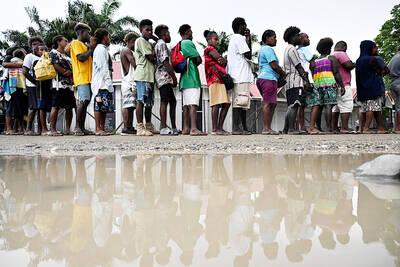
SEEKING CHANGE: A hospital worker said she did not vote in previous elections, but ‘now I can see that maybe my vote can change the system and the country’ Voting closed yesterday across the Solomon Islands in the south Pacific nation’s first general election since the government switched diplomatic allegiance from Taiwan to Beijing and struck a secret security pact that has raised fears of the Chinese navy gaining a foothold in the region. The Solomon Islands’ closer relationship with China and a troubled domestic economy weighed on voters’ minds as they cast their ballots. As many as 420,000 registered voters had their say across 50 national seats. For the first time, the national vote also coincided with elections for eight of the 10 local governments. Esther Maeluma cast her vote in the
Nearly half of China’s major cities are suffering “moderate to severe” levels of subsidence, putting millions of people at risk of flooding, especially as sea levels rise, according to a study of nationwide satellite data released yesterday. The authors of the paper, published by the journal Science, found that 45 percent of China’s urban land was sinking faster than 3mm per year, with 16 percent at more than 10mm per year, driven not only by declining water tables, but also the sheer weight of the built environment. With China’s urban population already in excess of 900 million people, “even a small portion

UNSETTLING IMAGES: The scene took place in front of TV crews covering the Trump trial, with a CNN anchor calling it an ‘emotional and unbelievably disturbing moment’ A man who doused himself in an accelerant and set himself on fire outside the courthouse where former US president Donald Trump is on trial has died, police said yesterday. The New York City Police Department (NYPD) said the man was declared dead by staff at an area hospital. The man was in Collect Pond Park at about 1:30pm on Friday when he took out pamphlets espousing conspiracy theories, tossed them around, then doused himself in an accelerant and set himself on fire, officials and witnesses said. A large number of police officers were nearby when it happened. Some officers and bystanders rushed

HYPOCRISY? The Chinese Ministry of Foreign Affairs yesterday asked whether Biden was talking about China or the US when he used the word ‘xenophobic’ US President Joe Biden on Wednesday called for a hike in steel tariffs on China, accusing Beijing of cheating as he spoke at a campaign event in Pennsylvania. Biden accused China of xenophobia, too, in a speech to union members in Pittsburgh. “They’re not competing, they’re cheating. They’re cheating and we’ve seen the damage here in America,” Biden said. Chinese steel companies “don’t need to worry about making a profit because the Chinese government is subsidizing them so heavily,” he said. Biden said he had called for the US Trade Representative to triple the tariff rates for Chinese steel and aluminum if Beijing was


 RSS
RSS