


Iran is quietly building a stockpile of thousands of high-tech small arms and other military equipment -- from armor-piercing snipers' rifles to night-vision goggles -- through legal weapons deals and a UN anti-drug program, according to an internal UN document, arms dealers and Western diplomats.
The buying spree is raising Bush administration fears that the arms could end up with militants in Iraq. Tehran also is seeking approval for a UN-funded satellite network that Iran says it needs to fight drug smugglers, stoking US worries it could be used to spy on Americans in Iraq or Afghanistan -- or any US reconnaissance in Iran itself.
embargo
The US has a strict embargo on most trade with Iran, which it accuses of supporting terrorist organizations and trying to build nuclear arms.
It also has imposed sanctions on dozens of companies worldwide over the past decade for supplying Tehran with equipment it can use either for nuclear or conventional warfare.
Much of the military hardware has been hard to hide -- sales of tanks and anti-ship missiles by Belarus and China, or helicopters and artillery pieces from Russia have been well documented by US authorities and international nongovernment agencies.
Other weapons are smuggled and may be revealed only by chance -- such as the consignment of 12 nuclear-capable cruise missiles delivered by Ukrainian arms dealers to Iran four years ago but divulged by Ukrainian opposition officials only recently.
The smaller weapons and related material Iran is amassing may not be as eye-catching. But they are of US concern because of their origin -- through UN-funded programs or technically advanced Western countries -- and because they could harm US troops in Iraq, Afghanistan -- or ultimately Iran, which President Bush has not been ruled out as a military target.
Iran says it needs the satellite network, high-tech small arms bought on the European arms market and night-vision goggles, body armor and advanced communications gear through the UN program to fight drug smugglers pouring in from neighboring Afghanistan.
``We need assistance,'' Pirouz Hosseini, Iran's chief delegate to UN organizations in Vienna told The Associated Press, dismissing US fears as ``a political stance not based on realities.''
But such high-resolution satellite imagery could reveal what US troops in neighboring Iraq and Afghanistan are doing on the ground -- or what the US is seeing as it spies from outer space for evidence of illicit Iranian nuclear activity.
And with Iran suspected of backing insurgents in Iraq, Washington fears some of the equipment bought in Europe or delivered as part of the UN-backed, anti-drug fight could be used against US troops there, say Western diplomats here who are familiar with US concerns.
Austrian officials with access to counterintelligence information told AP that Iranian diplomats in European capitals routinely focus on securing arms deals. Like the Western diplomats, the officials spoke on condition of anonymity because of the sensitivity of the case.
exportation
Just four months ago, US and Austrian authorities arrested two Iranians in Vienna on charges of trying to illegally export thousands of sophisticated American night-vision systems for Tehran's military -- a powerful force in the region.
In a more recent -- and legal -- deal, Iran last month took delivery of hundreds of high-powered armor-piercing snipers' rifles with scopes from an Austrian firm, as part of a consignment for 2,000 of the weapons.
Confirming the sale, Wolfgang Fuerlinger, head of Steyr Mannlicher GmbH, told reporters that US Embassy officials had expressed concerns the arms could make their way to Iraq for use against American troops.

Republican US lawmakers on Friday criticized US President Joe Biden’s administration after sanctioned Chinese telecoms equipment giant Huawei unveiled a laptop this week powered by an Intel artificial intelligence (AI) chip. The US placed Huawei on a trade restriction list in 2019 for contravening Iran sanctions, part of a broader effort to hobble Beijing’s technological advances. Placement on the list means the company’s suppliers have to seek a special, difficult-to-obtain license before shipping to it. One such license, issued by then-US president Donald Trump’s administration, has allowed Intel to ship central processors to Huawei for use in laptops since 2020. China hardliners
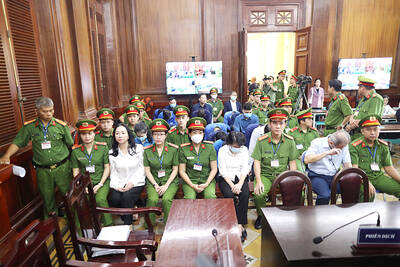
A top Vietnamese property tycoon was on Thursday sentenced to death in one of the biggest corruption cases in history, with an estimated US$27 billion in damages. A panel of three hand-picked jurors and two judges rejected all defense arguments by Truong My Lan, chair of major developer Van Thinh Phat, who was found guilty of swindling cash from Saigon Commercial Bank (SCB) over a decade. “The defendant’s actions ... eroded people’s trust in the leadership of the [Communist] Party and state,” read the verdict at the trial in Ho Chi Minh City. After the five-week trial, 85 others were also sentenced on

‘DELUSIONAL’: Targeting the families of Hamas’ leaders would not push the group to change its position or to give up its demands for Palestinians, Ismail Haniyeh said Israeli aircraft on Wednesday killed three sons of Hamas’ top political leader in the Gaza Strip, striking high-stakes targets at a time when Israel is holding delicate ceasefire negotiations with the militant group. Hamas said four of the leader’s grandchildren were also killed. Ismail Haniyeh’s sons are among the highest-profile figures to be killed in the war so far. Israel said they were Hamas operatives, and Haniyeh accused Israel of acting in “the spirit of revenge and murder.” The deaths threatened to strain the internationally mediated ceasefire talks, which appeared to gain steam in recent days even as the sides remain far
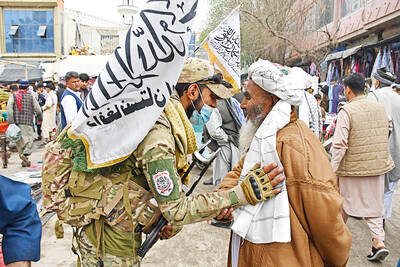
The Taliban’s reclusive supreme leader made a rare public appearance yesterday, an Afghan government spokesman said, leading thousands of worshipers in prayers marking Eid al-Fitr. Hibatullah Akhundzada has made only a handful of public appearances since inheriting the leadership of the Taliban in 2016 and leading the movement back to power with the withdrawal of US forces in 2021. Taliban government spokesman Zabihullah Mujahid said prayer in the largest mosque in Kandahar was “performed under the leadership of the supreme leader.” In a statement on X, he said the early-morning service “was attended by thousands of compatriots” in the southern province considered the


 RSS
RSS