


Shopkeepers and residents on one of Baghdad's main streets pulled out their own guns and killed three insurgents when hooded men began shooting at passers-by, giving a rare victory to civilians increasingly frustrated by the violence bleeding Iraq.
The clash on Tuesday in the capital's southern Doura neighborhood erupted when militants in three cars sprayed bullets at shoppers, Interior Ministry officials said. Three people -- a man, a woman and a child -- were wounded.
The motive was unclear, but there have been previous attacks in the ethnically mixed neighborhood. Earlier in the day, gunmen in the same quarter killed a policeman as he drove to work, police Lieutenant Colonel Hafidh Al-Ghrayri said.
A forceful citizen response is rare, but not unheard of in a country where conflict has become commonplace and the law allows each home to have a weapon. Earlier this month, police said townsmen in Wihda, 40km south of Baghdad, attacked a group of militants believed planning to raid the town and killed seven.
Tuesday's gunbattle came as a seven-member US congressional delegation paid a one-day visit to Baghdad, and the man expected to serve as the next prime minister, Shiite politician Ibrahim al-Jaafari, reportedly told the group he is in no hurry for US troops to leave Iraq.
Senator Barbara Boxer, a Democrat from California who strongly opposed the war, said al-Jaafari didn't seem as "upbeat as our people, who seem to be very excited about the quality of the Iraqi police force."
"My sense was he was certainly in no rush to hand over security to his new police force," she said.
Senator Lamar Alexander, a Tennessee Republican, agreed, saying that "it's too early to declare success." But Senator Richard Durbin, an Illinois Democrat, expressed "quiet optimism" about Iraq's future.
Iraq's current prime minister, Iyad Allawi, urged the new National Assembly to speed negotiations on forming a coalition government "so as to resume the operation of rebuilding Iraq in all fields."
Seeking to seal a political deal, the Shiite clergy's spiritual leader in Iraq, Grand Ayatollah Ali al-Sistani, was expected to meet yesterday with Jalal Talabani, the Kurdish leader likely to become the country's next president.
Elections on Jan. 30 gave the biggest bloc of seats to a Shiite alliance backed by al-Sistani, but it doesn't have enough votes to select a Cabinet on its own and is negotiating for the support of the Kurds, the second-largest group in the National Assembly.
The Kurds want an agreement to return the oil-rich northern city of Kirkuk to the autonomous Kurdish region as soon as the government is installed. But an official from al-Sistani's office said the ayatollah wants that issue dealt with in the constitution to be drafted by the assembly.
Ousted dictator Saddam Hussein had Kurds forcibly removed from Kirkuk and the surrounding area and moved in Iraqi Arabs to strengthen his control of oil fields.
In other violence on Tuesday, Iraqi commandos backed by US ground and air fire attacked an apparent insurgent training camp near Lake Tharthar in eastern Iraq, killing an undetermined number of militants and capturing 20, the US military said. Seven commandos were reported dead and six wounded.
And in the northern city of Mosul, the deputy police commander, Colonel Wathiq Ali, said 17 militants were killed and 14 captured late Monday during an assassination attempt on police officials.
Also in Mosul, a roadside bomb that exploded near a US patrol killed four civilians. It wasn't immediately clear if the troops suffered casualties.
In the southern city of Kut, morgue officials said they had received a half dozen corpses of Iraqi army soldiers, each with bound hands and bullet-riddled heads and torsos. Six Iraqi soldiers were reported kidnapped on Monday in Anbar Province, west of Baghdad, police said.
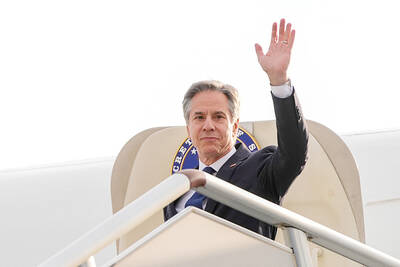
‘IN A DIFFERENT PLACE’: The envoy first visited Shanghai, where he attended a Chinese basketball playoff match, and is to meet top officials in Beijing tomorrow US Secretary of State Antony Blinken yesterday arrived in China on his second visit in a year as the US ramps up pressure on its rival over its support for Russia while also seeking to manage tensions with Beijing. The US diplomat tomorrow is to meet China’s top brass in Beijing, where he is also expected to plead for restraint as Taiwan inaugurates president-elect William Lai (賴清德), and to raise US concerns on Chinese trade practices. However, Blinken is also seeking to stabilize ties, with tensions between the world’s two largest economies easing since his previous visit in June last year. At the
Nearly half of China’s major cities are suffering “moderate to severe” levels of subsidence, putting millions of people at risk of flooding, especially as sea levels rise, according to a study of nationwide satellite data released yesterday. The authors of the paper, published by the journal Science, found that 45 percent of China’s urban land was sinking faster than 3mm per year, with 16 percent at more than 10mm per year, driven not only by declining water tables, but also the sheer weight of the built environment. With China’s urban population already in excess of 900 million people, “even a small portion

UNSETTLING IMAGES: The scene took place in front of TV crews covering the Trump trial, with a CNN anchor calling it an ‘emotional and unbelievably disturbing moment’ A man who doused himself in an accelerant and set himself on fire outside the courthouse where former US president Donald Trump is on trial has died, police said yesterday. The New York City Police Department (NYPD) said the man was declared dead by staff at an area hospital. The man was in Collect Pond Park at about 1:30pm on Friday when he took out pamphlets espousing conspiracy theories, tossed them around, then doused himself in an accelerant and set himself on fire, officials and witnesses said. A large number of police officers were nearby when it happened. Some officers and bystanders rushed
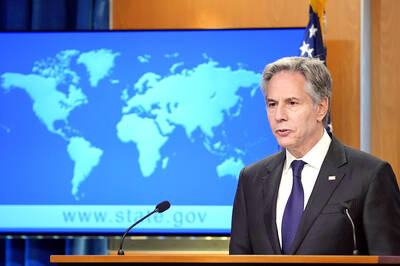
Beijing is continuing to commit genocide and crimes against humanity against Uyghurs and other Muslim minorities in its western Xinjiang province, U.S. Secretary of State Antony Blinken said in a report published on Monday, ahead of his planned visit to China this week. The State Department’s annual human rights report, which documents abuses recorded all over the world during the previous calendar year, repeated language from previous years on the treatment of Muslims in Xinjiang, but the publication raises the issue ahead of delicate talks, including on the war in Ukraine and global trade, between the top U.S. diplomat and Chinese


 RSS
RSS