


China's decision to shorten the term of Hong Kong's next leader had observers Sunday warning of trouble ahead, saying the move had damaged the city's autonomy and would likely face a legal challenge.
Caretaker chief executive Donald Tsang (曾蔭權) declared Saturday that a replacement for leader Tung Chee-hwa (董建華), whose early resignation last week triggered a succession debate, would serve only the two years remaining of the out-going leader's term.
The next chief executive will be chosen on July 10 by the city's 800-member Beijing-approved election committee.
Although Tsang said the decision was made by his government, it is widely believed the acting leader was simply doing the bidding for China, which has ruled the territory since its 1997 handover from British colonial rule.
The move has angered many in this southern enclave who say it flouts the Basic Law constitution adopted in 1997, which provides for the chief executive to serve for five years.
"It means that the new chief executive will start off with a term of office that is unconstitutional," wrote the Sunday China Morning Post in an editorial.
"Political expediency has been allowed to prevail over the rule of law," it added. "It is, in this sense, a sad day for Hong Kong."
Tsang's announcement, in his first speech as the acting head of the city of 6.8 million, was described a "U-turn" in the Basic Law by the press.
Media have attached particular significance to the conspiratorial tone of the language used by justice secretary Elsie Leung (梁愛詩) who said the government had "adjusted its understanding" of the law to let the decision pass.
China is believed to prefer a shortened term partly to maintain the election timetable set out by the Basic Law but also because it has no firm favorites to succeed Tung.
While Tsang is thought to be the prime candidate to win selection in July, the veteran civil servant's background as a loyalist of the former British administration has raised concerns among hardliners in the Communist Party.
A short term would give China the chance to test him out before appointing him on a more permanent basis.
Many see Saturday's hasty announcement that forced an unpopular decision on to Hong Kong without offering room for debate.
"It is a hot potato and in doing it this way, Tsang has shown that China just wants to get the matter over and done with," said China watcher Sung Lap-kung of Hong Kong City University.
Sung agreed with legal experts who warn the decision could lead to a constitutional crisis if opponents to a shortened term, including opposition legislators fighting for full democracy here, launched a judicial review.
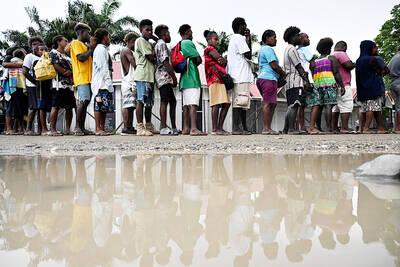
SEEKING CHANGE: A hospital worker said she did not vote in previous elections, but ‘now I can see that maybe my vote can change the system and the country’ Voting closed yesterday across the Solomon Islands in the south Pacific nation’s first general election since the government switched diplomatic allegiance from Taiwan to Beijing and struck a secret security pact that has raised fears of the Chinese navy gaining a foothold in the region. The Solomon Islands’ closer relationship with China and a troubled domestic economy weighed on voters’ minds as they cast their ballots. As many as 420,000 registered voters had their say across 50 national seats. For the first time, the national vote also coincided with elections for eight of the 10 local governments. Esther Maeluma cast her vote in the
Nearly half of China’s major cities are suffering “moderate to severe” levels of subsidence, putting millions of people at risk of flooding, especially as sea levels rise, according to a study of nationwide satellite data released yesterday. The authors of the paper, published by the journal Science, found that 45 percent of China’s urban land was sinking faster than 3mm per year, with 16 percent at more than 10mm per year, driven not only by declining water tables, but also the sheer weight of the built environment. With China’s urban population already in excess of 900 million people, “even a small portion
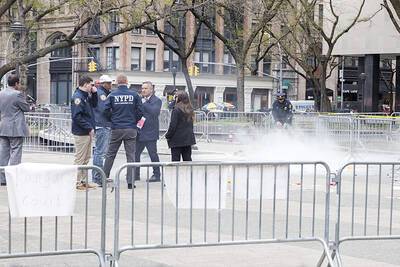
UNSETTLING IMAGES: The scene took place in front of TV crews covering the Trump trial, with a CNN anchor calling it an ‘emotional and unbelievably disturbing moment’ A man who doused himself in an accelerant and set himself on fire outside the courthouse where former US president Donald Trump is on trial has died, police said yesterday. The New York City Police Department (NYPD) said the man was declared dead by staff at an area hospital. The man was in Collect Pond Park at about 1:30pm on Friday when he took out pamphlets espousing conspiracy theories, tossed them around, then doused himself in an accelerant and set himself on fire, officials and witnesses said. A large number of police officers were nearby when it happened. Some officers and bystanders rushed

HYPOCRISY? The Chinese Ministry of Foreign Affairs yesterday asked whether Biden was talking about China or the US when he used the word ‘xenophobic’ US President Joe Biden on Wednesday called for a hike in steel tariffs on China, accusing Beijing of cheating as he spoke at a campaign event in Pennsylvania. Biden accused China of xenophobia, too, in a speech to union members in Pittsburgh. “They’re not competing, they’re cheating. They’re cheating and we’ve seen the damage here in America,” Biden said. Chinese steel companies “don’t need to worry about making a profit because the Chinese government is subsidizing them so heavily,” he said. Biden said he had called for the US Trade Representative to triple the tariff rates for Chinese steel and aluminum if Beijing was


 RSS
RSS