


Philippine authorities yesterday launched a criminal investigation after at least 27 schoolchildren died in a mass food-poisoning in the central island of Bohol.
Blood and food samples and traces from a cooking oil container were sent to Manila for analysis after the tragedy, blamed on cassava sweets sold outside the children's school.
A special investigating team, including doctors and toxicologists, was meeting in Bohol and the Justice Department's National Bureau of Investigation (NBI) was looking into the case.
A health official said the sweets may have been infected by pesticide, rather than cyanide, which can occur in cassava if it is not prepared correctly.
"Based on the signs and symptoms, it points to organophosphate poisoning," said regional health assistant director Susana Madarieta, adding that the sick children did not show signs of cyanide poisoning.
At least 27 children died and 103 others, mostly young people, were hospitalized on Wednesday after eating caramelized cassava sweets bought from street vendors at the gates of the San Jose Elementary School in this remote, impoverished town.
The deaths and illnesses of so many children, aged seven to 13, has traumatized this small town of about 27,000 people which was ill-prepared to deal with so many sick and dying.
NBI district officer Renato Mandawe said in a radio interview that the agency had already spoken to some of the parents and was waiting to interview the surviving children.
The investigators are also considering autopsies of some of the deceased even though many were already laid to rest in a mass burial on Thursday.
"We will document this for possible prosecution," Mandawe said, stressing they could file charges of "possible negligence, reckless imprudence resulting in multiple homicide and physical injuries."
"But our investigation is not yet finished so we cannot determine the appropriate crime," he added.
Two street vendors were identified as having sold food to the children before they became ill. One vendor is in hospital herself after consuming some of her own snacks while the other is under NBI custody to protect her from possible revenge attacks.
Madarieta said it was still unclear how pesticides could have infected the cassava, suggesting it may have happened during the preparation process or when farmer sprayed trees growing above the tubers.
Cassava or manioc is a tropical food crop widely grown around the Asian region. In many impoverished Philippine towns, like Mabini, it is a substitute for rice, the staple cereal.
It is traditionally boiled, or processed as an ingredient for native cakes and delicacies in the Philippines. The most popular form among school children is deep-fried cassava coated with sugar.
Education Secretary Florencio Abad said in a radio interview that he would order restrictions on schoolchildren buying food from street vendors, saying they should use school canteens instead.
But he conceded that San Jose Elementary School did not have a canteen for its 267 students and that the two vendors had been selling food to the children for years without incident.

Republican US lawmakers on Friday criticized US President Joe Biden’s administration after sanctioned Chinese telecoms equipment giant Huawei unveiled a laptop this week powered by an Intel artificial intelligence (AI) chip. The US placed Huawei on a trade restriction list in 2019 for contravening Iran sanctions, part of a broader effort to hobble Beijing’s technological advances. Placement on the list means the company’s suppliers have to seek a special, difficult-to-obtain license before shipping to it. One such license, issued by then-US president Donald Trump’s administration, has allowed Intel to ship central processors to Huawei for use in laptops since 2020. China hardliners
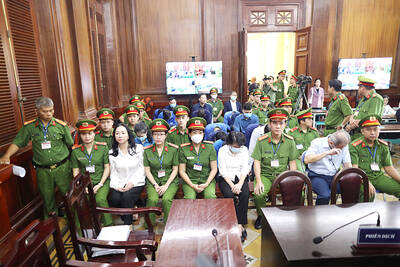
A top Vietnamese property tycoon was on Thursday sentenced to death in one of the biggest corruption cases in history, with an estimated US$27 billion in damages. A panel of three hand-picked jurors and two judges rejected all defense arguments by Truong My Lan, chair of major developer Van Thinh Phat, who was found guilty of swindling cash from Saigon Commercial Bank (SCB) over a decade. “The defendant’s actions ... eroded people’s trust in the leadership of the [Communist] Party and state,” read the verdict at the trial in Ho Chi Minh City. After the five-week trial, 85 others were also sentenced on

Conjoined twins Lori and George Schappell, who pursued separate careers, interests and relationships during lives that defied medical expectations, died this month in Pennsylvania, funeral home officials said. They were 62. The twins, listed by Guinness World Records as the oldest living conjoined twins, died on April 7 at the Hospital of the University of Pennsylvania, obituaries posted by Leibensperger Funeral Homes of Hamburg said. The cause of death was not detailed. “When we were born, the doctors didn’t think we’d make 30, but we proved them wrong,” Lori said in an interview when they turned 50, the Philadelphia Inquirer reported. The
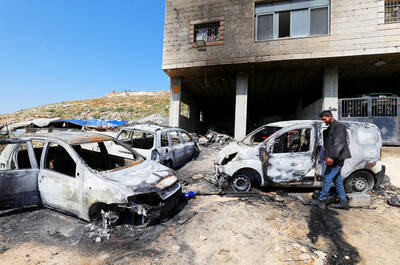
RAMPAGE: A Palestinian man was left dead after dozens of Israeli settlers searching for a missing 14-year-old boy stormed a village in the Israeli-occupied West Bank US President Joe Biden on Friday said he expected Iran to attack Israel “sooner, rather than later” and warned Tehran not to proceed. Asked by reporters about his message to Iran, Biden simply said: “Don’t,” underscoring Washington’s commitment to defend Israel. “We are devoted to the defense of Israel. We will support Israel. We will help defend Israel and Iran will not succeed,” he said. Biden said he would not divulge secure information, but said his expectation was that an attack could come “sooner, rather than later.” Israel braced on Friday for an attack by Iran or its proxies as warnings grew of


 RSS
RSS