


Once it was the mighty Jordan river, a crossroads of civilizations and continents, and a favorite of pilgrims seeking baptism in its waters. Now just about the only thing that flows for large parts of the year, keeping the river alive, is sewage.
Decades of competition for water have turned the lower Jordan river, running between the Sea of Galilee and the Dead Sea, into little more than a drainage ditch.
Dams and pumping stations have diverted almost 90 percent of the river's water to leave parts of the surrounding valley and the Dead Sea on the brink of ecological disaster.
Yesterday, Israel's environment minister and Jordanian royalty met on a small island in the river to discuss the crisis. But the only area of agreement between them was that the most obvious solution -- restoring the original water supply -- is not even up for discussion.
The Jordan river provides Israel with nearly one-third of its water supply, and Jordan relies on dams to sustain agriculture in the area.
Demand
With demand ever increasing for the most precious commodity in the region, neither country is prepared to give up a drop.
"Unfortunately, environmental policies are governed by politics," said Jordan's Prince Hassan Bin Talal, brother of the late king.
"We're talking about a 112km zone of crisis. We don't have a comprehensive peace but I don't see why we have to continue with the policy of mutually assured destruction of the environment and resources," he said.
Fifty years ago, 1.3 billion cubic meters of water flowed through the lower Jordan each year. Today, environmentalists say that if 200 million cubic meters travel the lower Jordan then it is a good year, and nearly half of that is raw sewage from Palestinian villages and Jewish settlements, the effluent from commercial fish farms and other untreated waste water.
"Ironically, it is sewage that is maintaining what little biodiversity there is along the Jordan," said Gidon Bromber, head of Friends of the Earth Middle East (FoEME) in Tel Aviv. "Right now the river is so desperate, the sewage is the only thing keeping the river flowing at times. It feeds life there."
But at the lower end of the Jordan the pollutants spill into the Dead Sea, compounding an environmental crisis there that has seen the famed sea's level drop 25m since Israel dammed the river and industries began sucking water out.
Commitments
FoEME, a cross-border group, brought officials from Amman and Jerusalem together yesterday to press them to meet commitments made under their 1994 peace treaty to rescue the Jordan, which marks out their common border and is the lowest river in the world.
"Is it a competition -- who can damage the river more than the other?" asked Munqeth Mehyar, director of FoEME in Amman. "This could be understood in a state of war but not now. Did we have to take all the water?"
In the hope of reminding the participants of the peace treaty commitments, the meeting took place on Peace Island, a bump of land that splits the river and which became a symbol of an end to conflict after Israel handed it back to Jordan under the peace treaty.
The Jordan river crisis is the direct consequence of decades of conflict.
"Each side tried to grab as much of the resources as they can without any consideration of the consequences," Bromber said. "It started in the 1960s with Israel ceasing the flow of the upper Jordan into the lower Jordan. Syria tried to build a dam at the same time to stop water coming down the Jordan river. Jordan in the 70s built a canal to capture the main tributary into the river. It escalated from there."

Republican US lawmakers on Friday criticized US President Joe Biden’s administration after sanctioned Chinese telecoms equipment giant Huawei unveiled a laptop this week powered by an Intel artificial intelligence (AI) chip. The US placed Huawei on a trade restriction list in 2019 for contravening Iran sanctions, part of a broader effort to hobble Beijing’s technological advances. Placement on the list means the company’s suppliers have to seek a special, difficult-to-obtain license before shipping to it. One such license, issued by then-US president Donald Trump’s administration, has allowed Intel to ship central processors to Huawei for use in laptops since 2020. China hardliners
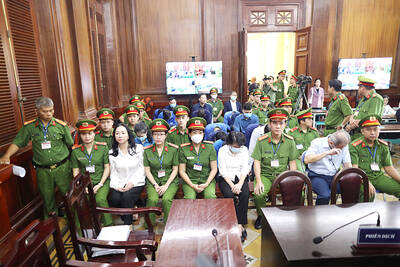
A top Vietnamese property tycoon was on Thursday sentenced to death in one of the biggest corruption cases in history, with an estimated US$27 billion in damages. A panel of three hand-picked jurors and two judges rejected all defense arguments by Truong My Lan, chair of major developer Van Thinh Phat, who was found guilty of swindling cash from Saigon Commercial Bank (SCB) over a decade. “The defendant’s actions ... eroded people’s trust in the leadership of the [Communist] Party and state,” read the verdict at the trial in Ho Chi Minh City. After the five-week trial, 85 others were also sentenced on

‘DELUSIONAL’: Targeting the families of Hamas’ leaders would not push the group to change its position or to give up its demands for Palestinians, Ismail Haniyeh said Israeli aircraft on Wednesday killed three sons of Hamas’ top political leader in the Gaza Strip, striking high-stakes targets at a time when Israel is holding delicate ceasefire negotiations with the militant group. Hamas said four of the leader’s grandchildren were also killed. Ismail Haniyeh’s sons are among the highest-profile figures to be killed in the war so far. Israel said they were Hamas operatives, and Haniyeh accused Israel of acting in “the spirit of revenge and murder.” The deaths threatened to strain the internationally mediated ceasefire talks, which appeared to gain steam in recent days even as the sides remain far
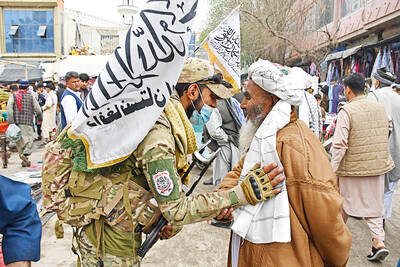
The Taliban’s reclusive supreme leader made a rare public appearance yesterday, an Afghan government spokesman said, leading thousands of worshipers in prayers marking Eid al-Fitr. Hibatullah Akhundzada has made only a handful of public appearances since inheriting the leadership of the Taliban in 2016 and leading the movement back to power with the withdrawal of US forces in 2021. Taliban government spokesman Zabihullah Mujahid said prayer in the largest mosque in Kandahar was “performed under the leadership of the supreme leader.” In a statement on X, he said the early-morning service “was attended by thousands of compatriots” in the southern province considered the


 RSS
RSS