


President Carlos Mesa submitted his resignation to Congress on Monday after warning that a wave of protests against his 15-month-old government may soon leave Bolivia's largest cities isolated by road blockades.
Legislators could decide as early as Tuesday whether to accept the resignation, which followed several days of street protests calling for a privatized water company to immediately stop operating and demanding higher taxes on oil companies.
"I cannot continue to govern with threats that strangle the country," Mesa wrote in his letter, referring to plans announced by opposition leader Evo Morales to stage a nationwide blockade of roads, a traditional form of protest in Bolivia.
Should the chamber accept Mesa's resignation, his successor according to the constitution would be Senate President Hormando Vaca Diez. The next presidential election is set for June 2007, but some politicians have suggested it may be held earlier as a result of the recent turmoil.
Mesa took office in October 2003, succeeding President Gonzalo Sanchez de Lozada, who was also forced to resign in the wake of street protests. That unrest took the lives of at least 56 people. Mesa has ruled as an independent because he is not a member of a political party.
His presidency also has been weakened by constant street protests, including a strong campaign for regional autonomy by Bolivia's wealthiest province, protests demanding lower fuel prices and calls for increases in taxes levied on foreign oil companies.
The protests have forced Mesa to repeatedly make concessions to a variety of labor, indigenous and social groups.
Finally, in his resignation letter, he said he cannot continue to govern facing "irrational demands that threaten to set everything on fire."
Recent protests have demanded the immediate end of operations of the French-owned water utility that supplies La Paz and the neighboring city of El Alto and an increase in the tax on the sales of private oil companies from 18 percent to 50 percent.
Critics accuse the water company of failing to serve the city's poorer neighborhoods, a highly charged political issue in Bolivia that has echoed throughout South America, where governments have experimented with privatizing former state services to attract foreign investment -- bringing a backlash from the poor.
Following a previous protest, the Bolivian government rescinded a contract with the company, Aguas del Illimani, a branch of Lyonnaise des Eaux of France, but agreed to a gradual phase out of its operations to avoid suspending the service.
Ordering the utility to immediately hand over control of the waterworks would force the government to pay a steep breach of contract fine, officials said.
Regarding the oil tax, Mesa said Sunday in a speech that any increase would be opposed by the "international community." An aide clarified Monday that the EU and US could cut assistance if the tax was raised.
At the same time, Mesa said he was unwilling to use force to stop the protests.
He warned that roadblocks would quickly isolate Bolivia's largest cities, and officials said shortages of food, fuel and other essential items would be inevitable. He also said he would not resort to soldiers or the police to clear the roads, because that would leave victims.
Presidential chief of Staff Jose Galindo carried the resignation letter to the Congress building across the street from the presidential palace, which was surrounded by hundreds of people who had gathered in support of the president. Galindo said the resignation was "a painful decision made by the president."
In Washington, State Department spokesman Richard Boucher voiced support for Mesa and noted that his fate is in the hands of the Bolivian Congress.

Republican US lawmakers on Friday criticized US President Joe Biden’s administration after sanctioned Chinese telecoms equipment giant Huawei unveiled a laptop this week powered by an Intel artificial intelligence (AI) chip. The US placed Huawei on a trade restriction list in 2019 for contravening Iran sanctions, part of a broader effort to hobble Beijing’s technological advances. Placement on the list means the company’s suppliers have to seek a special, difficult-to-obtain license before shipping to it. One such license, issued by then-US president Donald Trump’s administration, has allowed Intel to ship central processors to Huawei for use in laptops since 2020. China hardliners
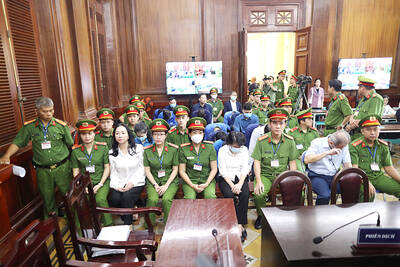
A top Vietnamese property tycoon was on Thursday sentenced to death in one of the biggest corruption cases in history, with an estimated US$27 billion in damages. A panel of three hand-picked jurors and two judges rejected all defense arguments by Truong My Lan, chair of major developer Van Thinh Phat, who was found guilty of swindling cash from Saigon Commercial Bank (SCB) over a decade. “The defendant’s actions ... eroded people’s trust in the leadership of the [Communist] Party and state,” read the verdict at the trial in Ho Chi Minh City. After the five-week trial, 85 others were also sentenced on

‘DELUSIONAL’: Targeting the families of Hamas’ leaders would not push the group to change its position or to give up its demands for Palestinians, Ismail Haniyeh said Israeli aircraft on Wednesday killed three sons of Hamas’ top political leader in the Gaza Strip, striking high-stakes targets at a time when Israel is holding delicate ceasefire negotiations with the militant group. Hamas said four of the leader’s grandchildren were also killed. Ismail Haniyeh’s sons are among the highest-profile figures to be killed in the war so far. Israel said they were Hamas operatives, and Haniyeh accused Israel of acting in “the spirit of revenge and murder.” The deaths threatened to strain the internationally mediated ceasefire talks, which appeared to gain steam in recent days even as the sides remain far
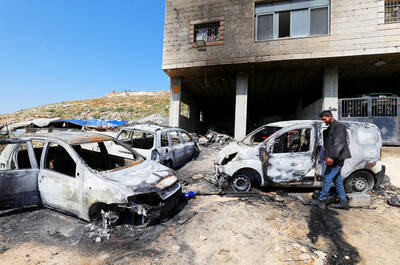
RAMPAGE: A Palestinian man was left dead after dozens of Israeli settlers searching for a missing 14-year-old boy stormed a village in the Israeli-occupied West Bank US President Joe Biden on Friday said he expected Iran to attack Israel “sooner, rather than later” and warned Tehran not to proceed. Asked by reporters about his message to Iran, Biden simply said: “Don’t,” underscoring Washington’s commitment to defend Israel. “We are devoted to the defense of Israel. We will support Israel. We will help defend Israel and Iran will not succeed,” he said. Biden said he would not divulge secure information, but said his expectation was that an attack could come “sooner, rather than later.” Israel braced on Friday for an attack by Iran or its proxies as warnings grew of


 RSS
RSS