


Prime Minister Tony Blair's plans for a new anti-terrorism law suffered a major setback Monday, as Parliament's upper chamber insisted that a government minister should not have the power to impose sweeping controls on terrorist suspects.
In a crucial House of Lords vote, peers voted by 249 to 119 to amend the Prevention of Terrorism Bill so that only courts can restrict a suspect's movements, impose curfews and other controls.
The vote was a blow to the government's plans to give a minister the power to act swiftly against suspects without the need for a trial.
Blair insists the new measures are necessary to protect Britain from the threat of terrorist attack. Opponents argue, however, that they would erode civil liberties.
The government may try to overturn the Lords amendments when the legislation returns to the House of Commons later this week, but will face dissent there also from the main opposition parties and many of its own lawmakers.
"We think it is necessary in the face of the new threat that terrorism poses to this country," said Lord Falconer, the country's chief legal officer.
The controversial legislation proposes giving Home Secretary Charles Clarke the power to impose curfews on suspects, ban them from using the telephone or Internet or electronically tag them, without having to involve the courts. With the permission of a judge, Clarke would also be allowed to place a suspect under house arrest without charge.
The government says the control orders will be used sparingly, and only in cases where a suspect cannot be brought to trial because evidence is too sensitive to reveal in open court or may compromise the work of intelligence agencies.
Sir John Stevens, the former head of London's police force has backed the government's proposals and warned that at least 100 terrorists trained by Osama bin Laden were at large in Britain.
The government insists it must have the new powers on the statute book before March 14, when a law allowing it to lock up foreign terror suspects indefinitely without trial expires. Britain's highest court had ruled that legislation infringed human rights.
The House of Lords, which has the power to amend and delay legislation, said Monday that only courts should issue the so-called control orders.
In another key amendment, peers said a control order could not be enforced until the director of public prosecutions examined the case and ruled it could not be tried successfully in court.
The government wants the power to impose the orders if it has "reasonable grounds" to suspect terrorist activity. In another important amendment, the Lords raised that burden of proof and said the court must be "satisfied on the balance of probabilities."
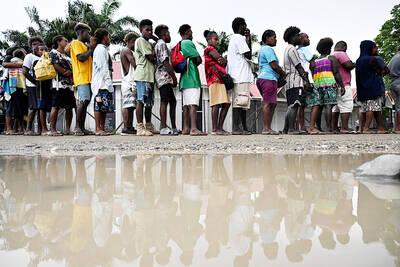
SEEKING CHANGE: A hospital worker said she did not vote in previous elections, but ‘now I can see that maybe my vote can change the system and the country’ Voting closed yesterday across the Solomon Islands in the south Pacific nation’s first general election since the government switched diplomatic allegiance from Taiwan to Beijing and struck a secret security pact that has raised fears of the Chinese navy gaining a foothold in the region. The Solomon Islands’ closer relationship with China and a troubled domestic economy weighed on voters’ minds as they cast their ballots. As many as 420,000 registered voters had their say across 50 national seats. For the first time, the national vote also coincided with elections for eight of the 10 local governments. Esther Maeluma cast her vote in the
Nearly half of China’s major cities are suffering “moderate to severe” levels of subsidence, putting millions of people at risk of flooding, especially as sea levels rise, according to a study of nationwide satellite data released yesterday. The authors of the paper, published by the journal Science, found that 45 percent of China’s urban land was sinking faster than 3mm per year, with 16 percent at more than 10mm per year, driven not only by declining water tables, but also the sheer weight of the built environment. With China’s urban population already in excess of 900 million people, “even a small portion

UNSETTLING IMAGES: The scene took place in front of TV crews covering the Trump trial, with a CNN anchor calling it an ‘emotional and unbelievably disturbing moment’ A man who doused himself in an accelerant and set himself on fire outside the courthouse where former US president Donald Trump is on trial has died, police said yesterday. The New York City Police Department (NYPD) said the man was declared dead by staff at an area hospital. The man was in Collect Pond Park at about 1:30pm on Friday when he took out pamphlets espousing conspiracy theories, tossed them around, then doused himself in an accelerant and set himself on fire, officials and witnesses said. A large number of police officers were nearby when it happened. Some officers and bystanders rushed

HYPOCRISY? The Chinese Ministry of Foreign Affairs yesterday asked whether Biden was talking about China or the US when he used the word ‘xenophobic’ US President Joe Biden on Wednesday called for a hike in steel tariffs on China, accusing Beijing of cheating as he spoke at a campaign event in Pennsylvania. Biden accused China of xenophobia, too, in a speech to union members in Pittsburgh. “They’re not competing, they’re cheating. They’re cheating and we’ve seen the damage here in America,” Biden said. Chinese steel companies “don’t need to worry about making a profit because the Chinese government is subsidizing them so heavily,” he said. Biden said he had called for the US Trade Representative to triple the tariff rates for Chinese steel and aluminum if Beijing was


 RSS
RSS