


Iran, at loggerheads with the US and EU over its nuclear activities, has completed a heavy water production plant built to supply a nuclear research reactor which could be used to make plutonium for atom bombs, a think tank said on Friday.
Providing satellite photos to back up its assertion, the Institute for Science and International Security (ISIS), also quoted Iranian security official Hassan Rowhani saying on Feb. 7: "We may be able to produce heavy water soon, within the next few weeks."
EU negotiators Britain, France and Germany are trying to convince Iran to dismantle nuclear fuel work which the US says is part of a covert atomic weapons development, in return for economic and political rewards.

PHOTO: AFP
But Iran insists its nuclear program is purely for civilian energy needs.
According to the ISIS the heavy water would supply a 40-megawatt reactor being built despite objections from the Vienna-based International Atomic Energy Agency (IAEA), which is investigating Iran on the US charges that Tehran is secretly developing nuclear weapons.
"Adjacent to the reactor construction site is the heavy water production plant, which is anticipated to supply the necessary heavy water for the heavy water reactor," ISIS said, explaining three crystal-clear satellite photos taken by the US commercial firms Space Imaging and DigitalGlobe.
It said the photographs had been taken on Feb. 17 and Feb. 27 this year and on Feb. 29, 2004.
ISIS president David Albright, a former UN weapons inspector, said he also had ground photos, some sent to his institute anonymously, which showed the Iranians already testing the production plant as there was steam coming off pipes.
"It looks like the plant is completed," Albright said. He said the "huge" facility, its towers for distilling heavy water clearly visible in the satellite photos, has been under construction for several years.
Reporters revealed Thursday that Iran was already pouring the foundation for the reactor, citing diplomats working from satellite photos, and this is also clearly visible in the ISIS-supplied images.
Albright said there was even progress being made in the images 10 days apart, although the foundation was not yet completed. Work on the reactor could be completed in 2009.
The construction work for the reactor began in September, just after the IAEA had asked Iran to refrain from building it as a "confidence-building measure" to show it does not seek to make nuclear weapons, a diplomat who asked not to be named told reporters.
IAEA deputy director Pierre Goldschmidt had Tuesday told an IAEA governing board meeting in Vienna that Iran was pressing ahead with work on the Arak reactor but he gave no details.
Goldschmidt said IAEA inspectors had not visited the site since the agency's board adopted a resolution on September 18 calling on Iran "voluntarily to reconsider its decision to start construction of a research reactor moderated by heavy water."
The IAEA began its investigation into Iran after revelations in August 2002 from the Iranian resistance group the National Council of Resistance of Iran (NCRI) that Tehran was working on the heavy-water production plant as well as a uranium enrichment plant in Natanz, two facilities which had not been declared to the IAEA and which the NCRI said were signs of covert weapons development.

Republican US lawmakers on Friday criticized US President Joe Biden’s administration after sanctioned Chinese telecoms equipment giant Huawei unveiled a laptop this week powered by an Intel artificial intelligence (AI) chip. The US placed Huawei on a trade restriction list in 2019 for contravening Iran sanctions, part of a broader effort to hobble Beijing’s technological advances. Placement on the list means the company’s suppliers have to seek a special, difficult-to-obtain license before shipping to it. One such license, issued by then-US president Donald Trump’s administration, has allowed Intel to ship central processors to Huawei for use in laptops since 2020. China hardliners
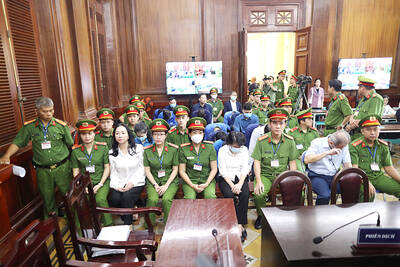
A top Vietnamese property tycoon was on Thursday sentenced to death in one of the biggest corruption cases in history, with an estimated US$27 billion in damages. A panel of three hand-picked jurors and two judges rejected all defense arguments by Truong My Lan, chair of major developer Van Thinh Phat, who was found guilty of swindling cash from Saigon Commercial Bank (SCB) over a decade. “The defendant’s actions ... eroded people’s trust in the leadership of the [Communist] Party and state,” read the verdict at the trial in Ho Chi Minh City. After the five-week trial, 85 others were also sentenced on

‘DELUSIONAL’: Targeting the families of Hamas’ leaders would not push the group to change its position or to give up its demands for Palestinians, Ismail Haniyeh said Israeli aircraft on Wednesday killed three sons of Hamas’ top political leader in the Gaza Strip, striking high-stakes targets at a time when Israel is holding delicate ceasefire negotiations with the militant group. Hamas said four of the leader’s grandchildren were also killed. Ismail Haniyeh’s sons are among the highest-profile figures to be killed in the war so far. Israel said they were Hamas operatives, and Haniyeh accused Israel of acting in “the spirit of revenge and murder.” The deaths threatened to strain the internationally mediated ceasefire talks, which appeared to gain steam in recent days even as the sides remain far
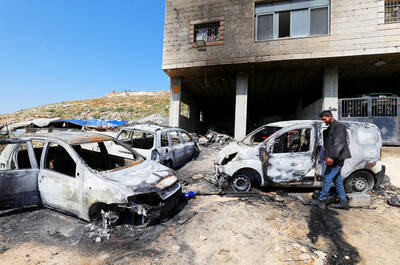
RAMPAGE: A Palestinian man was left dead after dozens of Israeli settlers searching for a missing 14-year-old boy stormed a village in the Israeli-occupied West Bank US President Joe Biden on Friday said he expected Iran to attack Israel “sooner, rather than later” and warned Tehran not to proceed. Asked by reporters about his message to Iran, Biden simply said: “Don’t,” underscoring Washington’s commitment to defend Israel. “We are devoted to the defense of Israel. We will support Israel. We will help defend Israel and Iran will not succeed,” he said. Biden said he would not divulge secure information, but said his expectation was that an attack could come “sooner, rather than later.” Israel braced on Friday for an attack by Iran or its proxies as warnings grew of


 RSS
RSS