


Premier Wen Jiabao (
In his annual "state of the nation" address to parliament at the Great Hall of the People, Wen said a priority of the government would be to ensure the country's rapid social and economic development was not reckless.
In the report Wen acknowledged that "we clearly see that problems and difficulties remain" in guiding the world's fastest growing major economy while keeping 1.3 billion people happy.
He cautioned that while opening up and reforming China would remain "the driving force behind all aspects of our work" development must not happen "recklessly."
"If we do not keep this in mind, we could end up just spinning our wheels and going nowhere or even suffering serious losses," he told the near-3,000 delegates at the National People's Congress.
As China has raced into the modern age, a stark lack of economic opportunities among its 800 million rural dwellers has become increasingly evident, raising fears of social unrest and turmoil.
Security around the congress remained intense with Tiananmen Square, adjacent to the hall, closed off to the public during the morning session as police and sniffer dogs patrolled the environs.
Government corruption and power abuse at the local level have been cited as major reasons hampering the development of the countryside and Wen vowed the issues would be tackled.
"Some low-income people lead difficult lives and there are more than a few factors threatening social stability," Wen said.
"Solving the problems facing agriculture, rural areas and farmers remains a top priority of all our work," said Wen.
One of the main concerns of the downtrodden rural Chinese is graft within government and Wen admitted that "formalism, bureaucracy, dishonesty, extravagance and waste are relatively severe."
"We must face the above mentioned problems squarely and continue to adopt measures to solve them," he said.
Education would be "a strategic priority" in the year ahead, particularly in the countryside where various fees for the poor would be exempted and free textbooks offered, he said to a smattering of applause.
Some 10.9 billion yuan (US$1.3 billion) will also be allocated to help retrenched workers locate employment.
To further help farmers, agricultural taxes will be abolished this year, while subsidies will be increased for grain producers.
To create enough employment for the nation's millions, Wen announced an economic growth target of 8 percent this year, up from previous years when 7 percent was deemed the minimum necessary to keep enough people out of unemployment.
"Maintaining steady and rapid economic development is an important issue that the government must successfully handle," Wen said in his speech.
"This is a period of important strategic opportunities for China, and the economy should grow rapidly, but not be allowed to overheat," he said.
But he warned of a possible return to overheating of fixed asset investment while supplies of coal, electricity, petrol and transportation "are still very tight."
There was also still "considerable" inflationary pressure on prices.

Republican US lawmakers on Friday criticized US President Joe Biden’s administration after sanctioned Chinese telecoms equipment giant Huawei unveiled a laptop this week powered by an Intel artificial intelligence (AI) chip. The US placed Huawei on a trade restriction list in 2019 for contravening Iran sanctions, part of a broader effort to hobble Beijing’s technological advances. Placement on the list means the company’s suppliers have to seek a special, difficult-to-obtain license before shipping to it. One such license, issued by then-US president Donald Trump’s administration, has allowed Intel to ship central processors to Huawei for use in laptops since 2020. China hardliners
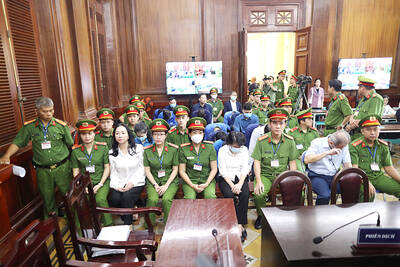
A top Vietnamese property tycoon was on Thursday sentenced to death in one of the biggest corruption cases in history, with an estimated US$27 billion in damages. A panel of three hand-picked jurors and two judges rejected all defense arguments by Truong My Lan, chair of major developer Van Thinh Phat, who was found guilty of swindling cash from Saigon Commercial Bank (SCB) over a decade. “The defendant’s actions ... eroded people’s trust in the leadership of the [Communist] Party and state,” read the verdict at the trial in Ho Chi Minh City. After the five-week trial, 85 others were also sentenced on

‘DELUSIONAL’: Targeting the families of Hamas’ leaders would not push the group to change its position or to give up its demands for Palestinians, Ismail Haniyeh said Israeli aircraft on Wednesday killed three sons of Hamas’ top political leader in the Gaza Strip, striking high-stakes targets at a time when Israel is holding delicate ceasefire negotiations with the militant group. Hamas said four of the leader’s grandchildren were also killed. Ismail Haniyeh’s sons are among the highest-profile figures to be killed in the war so far. Israel said they were Hamas operatives, and Haniyeh accused Israel of acting in “the spirit of revenge and murder.” The deaths threatened to strain the internationally mediated ceasefire talks, which appeared to gain steam in recent days even as the sides remain far
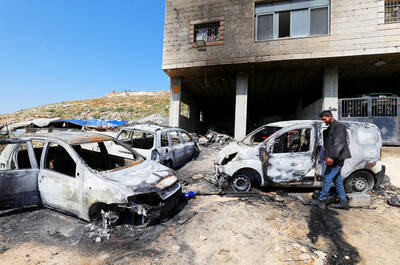
RAMPAGE: A Palestinian man was left dead after dozens of Israeli settlers searching for a missing 14-year-old boy stormed a village in the Israeli-occupied West Bank US President Joe Biden on Friday said he expected Iran to attack Israel “sooner, rather than later” and warned Tehran not to proceed. Asked by reporters about his message to Iran, Biden simply said: “Don’t,” underscoring Washington’s commitment to defend Israel. “We are devoted to the defense of Israel. We will support Israel. We will help defend Israel and Iran will not succeed,” he said. Biden said he would not divulge secure information, but said his expectation was that an attack could come “sooner, rather than later.” Israel braced on Friday for an attack by Iran or its proxies as warnings grew of


 RSS
RSS