


Cellphones aren't ringing these days in this Himalayan nation: Small businessmen can't take orders, children can't phone their parents and political activists can't call around to organize a decent-sized protest.
For the past month, since King Gyanendra seized power and ordered communications links switched off, Nepalese have been learning to live without their cellphones. About a third of Nepal's telephone lines are cellular, and while landline phones and Internet links were restored a week after the king's surprise announcement, there's no sign that cellphones -- the communications method of choice for government opponents -- will be working anytime soon.
"I have not had any business since the mobile phones were shut down," said Krishna Maharjan, who had to sell the tanker truck he once used to deliver water to homes in Kathmandu. "I don't know how long this will last and I just cannot go on like this."
Maharjan needed his cellphone to take orders, since he was always driving around Kathmandu, where many homes have serious water shortages. New customers would also call him -- using the number he had painted on his blue tanker.
At a time when he should have been preparing for the dry summer months ahead, his busiest time of year, he had to sell his tanker, close his business and begin looking for another job.
Others are suffering, too. Nepal has about 246,000 cellphone subscribers, a number that has grown dramatically in the five years they've been available here. For most Nepalese, there's no alternative: Getting a landline phone can mean a five-year wait.
Last year, Nepal Telcom, a government-owned company with a cellphone monopoly, announced 50,000 new lines. But more than 150,000 people lined up outside company officers nationwide. In some cities, police beat back applicants with batons.
Gyanendra, a constitutional monarch, seized power Feb. 1, imposed emergency rule and suspended civil liberties. He said he had to act because of the Maoist insurgency that has taken over much of the mountainous countryside. He has ignored repeated calls from the international community to restore democracy.
Government officials say the phones were shut down to prevent opposition supporters from organizing protest rallies -- now illegal under the state of emergency. With cellphones, it was easier for activists to coordinate with each other and communicate their moves far from the police, who sweep down to disrupt protests.
But the shutdown had hurt plenty of regular Nepalese. Many stores selling cellphones and accessories have been forced to close, and the remaining stores are unsure how long they can remain open. Half the 150 cellphone stores in Kathmandu are believed to have shut down.

Republican US lawmakers on Friday criticized US President Joe Biden’s administration after sanctioned Chinese telecoms equipment giant Huawei unveiled a laptop this week powered by an Intel artificial intelligence (AI) chip. The US placed Huawei on a trade restriction list in 2019 for contravening Iran sanctions, part of a broader effort to hobble Beijing’s technological advances. Placement on the list means the company’s suppliers have to seek a special, difficult-to-obtain license before shipping to it. One such license, issued by then-US president Donald Trump’s administration, has allowed Intel to ship central processors to Huawei for use in laptops since 2020. China hardliners
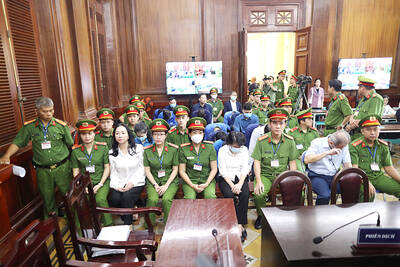
A top Vietnamese property tycoon was on Thursday sentenced to death in one of the biggest corruption cases in history, with an estimated US$27 billion in damages. A panel of three hand-picked jurors and two judges rejected all defense arguments by Truong My Lan, chair of major developer Van Thinh Phat, who was found guilty of swindling cash from Saigon Commercial Bank (SCB) over a decade. “The defendant’s actions ... eroded people’s trust in the leadership of the [Communist] Party and state,” read the verdict at the trial in Ho Chi Minh City. After the five-week trial, 85 others were also sentenced on

‘DELUSIONAL’: Targeting the families of Hamas’ leaders would not push the group to change its position or to give up its demands for Palestinians, Ismail Haniyeh said Israeli aircraft on Wednesday killed three sons of Hamas’ top political leader in the Gaza Strip, striking high-stakes targets at a time when Israel is holding delicate ceasefire negotiations with the militant group. Hamas said four of the leader’s grandchildren were also killed. Ismail Haniyeh’s sons are among the highest-profile figures to be killed in the war so far. Israel said they were Hamas operatives, and Haniyeh accused Israel of acting in “the spirit of revenge and murder.” The deaths threatened to strain the internationally mediated ceasefire talks, which appeared to gain steam in recent days even as the sides remain far
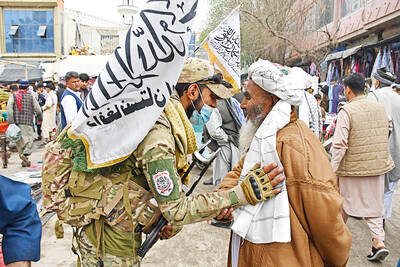
The Taliban’s reclusive supreme leader made a rare public appearance yesterday, an Afghan government spokesman said, leading thousands of worshipers in prayers marking Eid al-Fitr. Hibatullah Akhundzada has made only a handful of public appearances since inheriting the leadership of the Taliban in 2016 and leading the movement back to power with the withdrawal of US forces in 2021. Taliban government spokesman Zabihullah Mujahid said prayer in the largest mosque in Kandahar was “performed under the leadership of the supreme leader.” In a statement on X, he said the early-morning service “was attended by thousands of compatriots” in the southern province considered the


 RSS
RSS