


■ China
Internet cafe crackdown
The government closed 47,000 Internet cafes over a 10-month period last year in a campaign aimed at creating a more wholesome environment for children, a news report said yesterday. China's leaders encourage Internet use for business and education, but have expressed growing concern that it gives children access to violent or sexually explicit material, and have tried to block online criticism of their Communist rule. About 21,000 of the closed cafes might be allowed to re-open after making unspecified changes. The business licenses of 2,131 were revoked. The government said last October that it had detained 445 people for operating Web sites deemed pornographic, and fined Internet cafe operators a total of 100 million yuan (US$12 million) for letting children play violent games.
■ Japan
Kidnappings probed
A special UN investigator on human rights in North Korea urged Pyongyang yesterday to address Japanese claims that there still are Japanese kidnap victims alive in that country. North Korea has admitted to abducting about a dozen Japanese in the 1970s and 1980s, but says only five are still alive and all of them have returned to Japan. Japan says there are several more suspicious cases, and has questioned the North's explanation of how some of the eight others died. North Korean agents reportedly kidnapped the Japanese to be used as language teachers for the North's spies.
■ Thailand
Return of crown sought
A 78-year-old man, Li Kasemsang, has confessed to being involved in the robbery of an ancient crown. Li said that he and 20 others raided a temple in the former capital of Ayutthaya in 1956, stealing the crown and other precious items from inside a hollow Buddha image. Eight of the group were arrested and some of the items returned, but Li evaded arrest, and the crown, believed to be made in 1424, "was passed on until it reached a foreign buyer." Li blamed his unhappy life on his theft. The foreign affairs ministry said it would unearth more information about the crown before contacting US authorities to seek its return. Thai Prime Minister Thaksin Shinawatra has spearheaded the investigation. It is on display at San Francisco's Asian Art Museum as part of an exhibition.
■ United Kingdom
Prince stops short at grubs
Prince Charles, known to be a keen environmentalist and nature lover, drew the line at swallowing a live witchetty grub during a visit to Australia. The 56-year-old heir to the British throne held the wriggling bug up to his mouth during a visit to Alice Springs Desert Park, pretending to eat it, before choosing not to devour the delicacy. Turning to photographers, he said: "There are limits." Park worker Doug Taylor told him that the witchetty grubs, found in the roots of the Acacia bush, had to be eaten head first to stop their tails moving. "The last time I was here I had raw seal -- I'm older and wiser now" Charles said.
■ Philippines
Councilor killed
A city official was killed yesterday in a daylight attack by a lone assassin outside the municipal hall. Abel Ladera, a councilor of Tarlac City, 105km north of Manila, was pronounced dead on arrival at hospital due to a single gunshot wound. Ladera had just left his city council office when he was shot.
■ United Kingdom
Convict freed by armed men
A dangerous criminal was on the run in Britain yesterday after he escaped his guards while travelling from prison to hospital in a taxi, police said. Two armed men ambushed the taxi to free Neil Brennan, 21, who was serving a six-year sentence at a prison in Salford, northern England, for conspiracy to commit robbery. They made off in a silver get-away vehicle without firing a shot, but the guards who had been in the taxi were left in a state of shock, police said. As a man hunt was launched, detective chief inspector Sam Haworth said it appeared to be normal practice at the privately-run prison to ferry convicts around in a taxi cab.
■ United Kingdom
`Cursing Stone' a curse?
After a string of local misfortunes, elders of the town of Carlisle are considering whether the £10,000 (US$19,000) artwork, the "Cursing Stone" should be removed and destroyed, a report said on Wednesday. The stone, a 14-tonne granite slab intricately engraved with a 16th-century diatribe against violent raiders, was commissioned by city councilors for the Millennium celebrations. Created by Carlisle-born artist Gordon Young, is now stands at the center of the city, near its castle. The 1,069-word curse was originally levelled at "reiver families," who raided Carlisle and other parts of the far north of England from just over the border in Scotland in the 16th century.
■ South Africa
Coup plotters to be freed
Most of the suspected mercenaries detained in Zimbabwe over an alleged coup plot in oil-rich Equatorial Guinea were set to return to South Africa yesterday after their sentences were suddenly reduced without explanation, a foreign ministry official said. On Wednesday, a Zimbabwean court cut the sentences of most men by four months, but judge Yunus Omerjee gave no reasons when he handed down his ruling in an application made by the suspected mercenaries' lawyers late last year.
■ The Hague
Bosnian pleads not guilty
The wartime commander of Bosnia's Muslim army pleaded not guilty at a war crimes tribunal yesterday, to charges of responsibility for the murder and rape of Croats and Serbs by foreign Islamic fighters. Delic, charged with four counts of violations of the laws or customs of war, pleaded not guilty to responsibility for the murder, cruel treatment and rape of Croats and Serbs by forces under his command during the 1992-95 Bosnian war. "Your Honor, not guilty," Delic said in a webcast of his initial appearance at the UN's tribunal for the former Yugoslavia in The Hague.
■ United States
Writer leaves mystery
It might not have the majesty of Fear and Loathing in Las Vegas, or the viciousness of his attacks on the American dream. But the last written word of Hunter S. Thompson, who died last week, has left the literary world intrigued and enthralled. According to a sheriff's report, the author's body was found in a chair by his kitchen table, on which a typewriter had been placed and a page of writing paper had been lined up with the word "counselor" typed at its center. Thompson, 67, killed himself with a shot from a pistol at his home in Colorado. The police report describes how his son, Juan Thompson, walked outside the house after discovering the body and fired three shotgun blasts into the air, later telling a deputy sheriff he had done it to "mark the passing of his father."
Nearly half of China’s major cities are suffering “moderate to severe” levels of subsidence, putting millions of people at risk of flooding, especially as sea levels rise, according to a study of nationwide satellite data released yesterday. The authors of the paper, published by the journal Science, found that 45 percent of China’s urban land was sinking faster than 3mm per year, with 16 percent at more than 10mm per year, driven not only by declining water tables, but also the sheer weight of the built environment. With China’s urban population already in excess of 900 million people, “even a small portion

‘IN A DIFFERENT PLACE’: The envoy first visited Shanghai, where he attended a Chinese basketball playoff match, and is to meet top officials in Beijing tomorrow US Secretary of State Antony Blinken yesterday arrived in China on his second visit in a year as the US ramps up pressure on its rival over its support for Russia while also seeking to manage tensions with Beijing. The US diplomat tomorrow is to meet China’s top brass in Beijing, where he is also expected to plead for restraint as Taiwan inaugurates president-elect William Lai (賴清德), and to raise US concerns on Chinese trade practices. However, Blinken is also seeking to stabilize ties, with tensions between the world’s two largest economies easing since his previous visit in June last year. At the

UNSETTLING IMAGES: The scene took place in front of TV crews covering the Trump trial, with a CNN anchor calling it an ‘emotional and unbelievably disturbing moment’ A man who doused himself in an accelerant and set himself on fire outside the courthouse where former US president Donald Trump is on trial has died, police said yesterday. The New York City Police Department (NYPD) said the man was declared dead by staff at an area hospital. The man was in Collect Pond Park at about 1:30pm on Friday when he took out pamphlets espousing conspiracy theories, tossed them around, then doused himself in an accelerant and set himself on fire, officials and witnesses said. A large number of police officers were nearby when it happened. Some officers and bystanders rushed
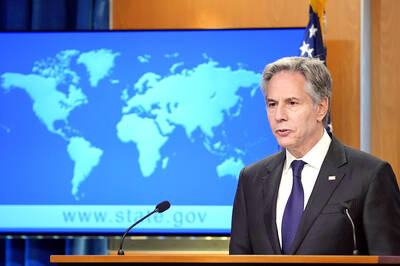
Beijing is continuing to commit genocide and crimes against humanity against Uyghurs and other Muslim minorities in its western Xinjiang province, U.S. Secretary of State Antony Blinken said in a report published on Monday, ahead of his planned visit to China this week. The State Department’s annual human rights report, which documents abuses recorded all over the world during the previous calendar year, repeated language from previous years on the treatment of Muslims in Xinjiang, but the publication raises the issue ahead of delicate talks, including on the war in Ukraine and global trade, between the top U.S. diplomat and Chinese


 RSS
RSS