


The number of US military deaths in Iraq rose to 1,500, a media report count showed yesterday as the military announced one of its troops was killed in action just south of the capital.
The latest fatality occurred Wednesday in Babil province, part of an area known as the "Triangle of Death" because of the frequency of insurgent attacks on US and Iraqi-led forces there.
In eastern Baghdad, two suicide car bombs exploded outside the Interior Ministry, killing at least two policemen and wounding five others, police Major Jabar Hassan said. Officials at nearby al-Kindi hospital said 15 people were injured the blasts.
Hassan said the car bombers were trailing a police convoy that was trying to enter the ministry. Iraqi security forces opened fire on the vehicles and disabled them before they could arrive at a main checkpoint outside the building, said Colonel Adnan Abdul-Rahman, an Interior Ministry spokesman.
"Casualties were very small because they didn't get to the checkpoint," Abdul-Rahman said.
Meanwhile, talks aimed at forging a new coalition government faltered Wednesday over Kurdish demands for more land and concerns that the dominant Shiite alliance seeks to establish an Islamic state, delaying the planned first meeting of Iraq's new parliament.
The snag in negotiations between Shiite and Kurdish leaders in northern Iraq came as clashes and two other car bombings in Baghdad on Wednesday killed at least 14 Iraqi soldiers and police officers -- the latest in a relentless wave of violence since elections Jan. 30.
The group led by Iraq's most wanted insurgent, Abu-Musab al-Zarqawi, purportedly claimed responsibility in an Internet posting for Wednesday's clashes and at least one of the bombings -- as it had for a suicide car bombing Monday that killed 125 people in Hillah, a town south of the capital.
National Security Adviser Mouwafak al-Rubaie vowed the attacks would not derail the political process. "The Iraqi government will go after and hunt down each and every one of these terrorists whether in Iraq or elsewhere," he said.
The US soldier, assigned to the 1st Marine Expeditionary Force, was killed in action "while conducting security and stability operations," the military said without elaborating.
"Force protection measures preclude the release of any information that could aid enemy personnel in assessing the effectiveness, or lack thereof, with regard to their tactics, techniques and procedures," the military said. "The release of more details about the incident could place our personnel at greater risk."
As is customary in the military, the name of the soldier was withheld pending notification of next of kin.
US troops are killed nearly every day in Iraq.
The latest death brought to at least 1,500 the number of members of the US military who have died since the US-led war in Iraq began in March 2003, according to a wire service count. At least 1,140 died as a result of hostile action, according to the Defense Department. The figures include four military civilians.
Since May 1, 2003, when US President George W. Bush declared that major combat operations in Iraq had ended, 1,362 US military members have died, according to the count. That includes at least 1,030 deaths resulting from hostile action, according to the military's numbers.
The tally was compiled based on Pentagon records and reporting from Iraq.
The US exit strategy is dependent on handing over responsibility for security to Iraq's fledgling army and police forces. Forming Iraq's first democratically elected coalition government is turning out to be a laborious process.
Shiite and Kurdish leaders, Iraq's new political powers, failed to reach agreement after two days of negotiations in the northern city of Irbil, with the clergy-backed candidate for prime minister, Ibrahim al-Jaafari, leaving with only half the deal he needed.
The Shiite-led United Iraqi Alliance, which has 140 seats in the 275-member National Assembly, hopes to win backing from the 75 seats held by Kurdish political parties so it can muster the required two-thirds majority to insure control of top posts in the new government.
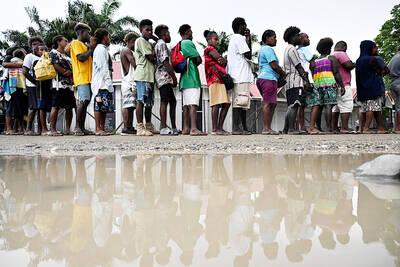
SEEKING CHANGE: A hospital worker said she did not vote in previous elections, but ‘now I can see that maybe my vote can change the system and the country’ Voting closed yesterday across the Solomon Islands in the south Pacific nation’s first general election since the government switched diplomatic allegiance from Taiwan to Beijing and struck a secret security pact that has raised fears of the Chinese navy gaining a foothold in the region. The Solomon Islands’ closer relationship with China and a troubled domestic economy weighed on voters’ minds as they cast their ballots. As many as 420,000 registered voters had their say across 50 national seats. For the first time, the national vote also coincided with elections for eight of the 10 local governments. Esther Maeluma cast her vote in the
Nearly half of China’s major cities are suffering “moderate to severe” levels of subsidence, putting millions of people at risk of flooding, especially as sea levels rise, according to a study of nationwide satellite data released yesterday. The authors of the paper, published by the journal Science, found that 45 percent of China’s urban land was sinking faster than 3mm per year, with 16 percent at more than 10mm per year, driven not only by declining water tables, but also the sheer weight of the built environment. With China’s urban population already in excess of 900 million people, “even a small portion

UNSETTLING IMAGES: The scene took place in front of TV crews covering the Trump trial, with a CNN anchor calling it an ‘emotional and unbelievably disturbing moment’ A man who doused himself in an accelerant and set himself on fire outside the courthouse where former US president Donald Trump is on trial has died, police said yesterday. The New York City Police Department (NYPD) said the man was declared dead by staff at an area hospital. The man was in Collect Pond Park at about 1:30pm on Friday when he took out pamphlets espousing conspiracy theories, tossed them around, then doused himself in an accelerant and set himself on fire, officials and witnesses said. A large number of police officers were nearby when it happened. Some officers and bystanders rushed

HYPOCRISY? The Chinese Ministry of Foreign Affairs yesterday asked whether Biden was talking about China or the US when he used the word ‘xenophobic’ US President Joe Biden on Wednesday called for a hike in steel tariffs on China, accusing Beijing of cheating as he spoke at a campaign event in Pennsylvania. Biden accused China of xenophobia, too, in a speech to union members in Pittsburgh. “They’re not competing, they’re cheating. They’re cheating and we’ve seen the damage here in America,” Biden said. Chinese steel companies “don’t need to worry about making a profit because the Chinese government is subsidizing them so heavily,” he said. Biden said he had called for the US Trade Representative to triple the tariff rates for Chinese steel and aluminum if Beijing was


 RSS
RSS