


A late winter storm clogged the streets of Washington and Ottawa just in time to do double duty as a metaphor for a sudden chill in US-Canada relations.
Canada's decision last week to opt out of a US missile defense shield dented efforts by both sides to talk up ties across the world's longest undefended frontier, after a grouchy period following Canada's refusal to join the Iraq war.
Canadian Prime Minister Paul Martin came to power just over a year ago promising to mend relations with the superpower to the south, roiled by his predecessor Jean Chretien.
However, Martin's decision on missile defense took Washington by surprise -- though Canadian support for missile defense would have been more of a political symbol than a prerequisite for the scheme to go ahead.
Despite Martin's protestations last week that the rebooting of relations would survive the missile defense rebuff, the Bush administration showed new signs of anger toward Ottawa.
A spokesman in Washington insisted on the record that the decision would not harm wider relations, but Canadian officials implicitly admitted Bush had yet to return Martin's telephone call to explain his decision.
"The president has been traveling," Martin spokeswoman Melanie Gruer said, searching for a silver lining.
In London, a US official said on condition of anonymity that Secretary of State Condoleezza Rice had delayed a planned visit to Canada next month -- partly due to the missile defense decision.
Martin's decision surprised some observers here, as he had given every sign of acknowledging the view that failure to sign up to the shield would be tantamount to Canada ceding its role in defending the North American continent.
His about-turn seemed rooted in simple political arithmetic: Bush and his missile shield are fiercely unpopular in Canada, and Martin sits in a perilous position atop a minority government.
The decision "was obviously made for domestic, intra-party reasons and for political reasons," said Denis Stairs, professor of political science at Dalhousie University in Halifax, Nova Scotia.
Martin's prospects of leading his centrist Liberal Party back to majority rule hinge on bolstering softened support in Ontario and Quebec -- the very provinces where Bush rouses most ire.
The prime minister's diplomatic and political nous has been called into question, however, after he agonized for a year over the question -- as analysts said privately that Ottawa signalled often it would eventually join -- albeit with caveats.
"It spells for America, and particularly for this administration, yet another sign of the unpredictability of Canada as an ally," said Wesley Wark, professor of political science at the University of Toronto.
Martin's aides have been forced to parry claims their man, a once-lauded finance minister, is indecisive -- fanned when the Economist magazine mocked him as "Mr Dithers" and wondered if Canada's top job was "too big for him."
Such a view may have consequences for the personal chemistry which Bush, prizes in dealing with world leaders.

Republican US lawmakers on Friday criticized US President Joe Biden’s administration after sanctioned Chinese telecoms equipment giant Huawei unveiled a laptop this week powered by an Intel artificial intelligence (AI) chip. The US placed Huawei on a trade restriction list in 2019 for contravening Iran sanctions, part of a broader effort to hobble Beijing’s technological advances. Placement on the list means the company’s suppliers have to seek a special, difficult-to-obtain license before shipping to it. One such license, issued by then-US president Donald Trump’s administration, has allowed Intel to ship central processors to Huawei for use in laptops since 2020. China hardliners
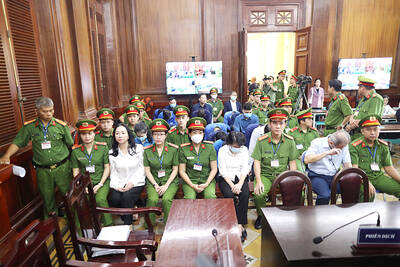
A top Vietnamese property tycoon was on Thursday sentenced to death in one of the biggest corruption cases in history, with an estimated US$27 billion in damages. A panel of three hand-picked jurors and two judges rejected all defense arguments by Truong My Lan, chair of major developer Van Thinh Phat, who was found guilty of swindling cash from Saigon Commercial Bank (SCB) over a decade. “The defendant’s actions ... eroded people’s trust in the leadership of the [Communist] Party and state,” read the verdict at the trial in Ho Chi Minh City. After the five-week trial, 85 others were also sentenced on

Conjoined twins Lori and George Schappell, who pursued separate careers, interests and relationships during lives that defied medical expectations, died this month in Pennsylvania, funeral home officials said. They were 62. The twins, listed by Guinness World Records as the oldest living conjoined twins, died on April 7 at the Hospital of the University of Pennsylvania, obituaries posted by Leibensperger Funeral Homes of Hamburg said. The cause of death was not detailed. “When we were born, the doctors didn’t think we’d make 30, but we proved them wrong,” Lori said in an interview when they turned 50, the Philadelphia Inquirer reported. The
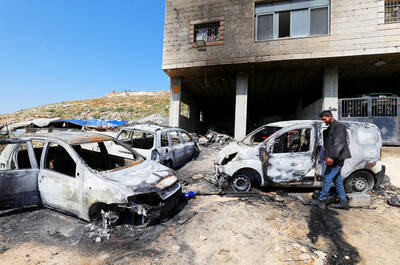
RAMPAGE: A Palestinian man was left dead after dozens of Israeli settlers searching for a missing 14-year-old boy stormed a village in the Israeli-occupied West Bank US President Joe Biden on Friday said he expected Iran to attack Israel “sooner, rather than later” and warned Tehran not to proceed. Asked by reporters about his message to Iran, Biden simply said: “Don’t,” underscoring Washington’s commitment to defend Israel. “We are devoted to the defense of Israel. We will support Israel. We will help defend Israel and Iran will not succeed,” he said. Biden said he would not divulge secure information, but said his expectation was that an attack could come “sooner, rather than later.” Israel braced on Friday for an attack by Iran or its proxies as warnings grew of


 RSS
RSS