


Weeping and beating their chests, hundreds of people inspected corpses at a hospital morgue in Hilla yesterday, trying to identify friends and family who died in a suicide bombing that killed at least 120 people, the single deadliest attack of its kind since the fall of Saddam Hussein.
Hospital official Ali Hassoun said at least five people had succumbed to wounds overnight, raising the toll to 120 dead. More than 130 others were wounded in the blast, which targeted mostly Shiite police and National Guard recruits lined up for physical exams at a medical clinic.
Distraught relatives at the morgue placed the dead into coffins and loaded them onto pickup trucks, taking them to city mosques and homes where the bodies will be washed before burial, a Muslim tradition in Iraq.
Many of the corpses, charred or dismembered, were unrecognizable.
Funeral processions are expected to be held in Hilla and many of the dead will be taken to the holy Shiite city of Najaf for burial later Tuesday.
Monday's bombing presented the boldest challenge yet to Iraq's efforts to build a security force that can take over from the US.
The explosion in Hilla, a largely Shiite Muslim town about 100km south of Baghdad, was so powerful that the only thing remaining of the bomber's car was the twisted wreckage of the engine block.
Dozens of people stepped through small lakes of blood that pooled on the street to retrieve shattered limbs, severed feet and hands.
Empty shoes and sandals of those killed or wounded were thrown into a corner. Scorch marks infused with blood covered the clinic's walls. Morgue workers unloaded plastic body bags from pickup trucks as weeping relatives looked on.
Some of the victims were shoppers or vendors from a nearby outdoor street market selling produce, sandwiches and other food. But most were recruits waiting outside the clinic.
"I was lucky because I was the last person in line when the explosion took place. Suddenly there was panic and many frightened people stepped on me. I lost consciousness and the next thing I was aware of was being in the hospital," said Muhsin Hadi, 29, a recruit. One of his legs was broken in the blast.
Angry crowds gathered outside the main hospital, chanting "Allahu Akbar," Arabic for "God is great," demanding to know their relatives' fate. People at the site of the attack reportedly chanted slogans against the "Wahhabis," referring to adherents of the strict form of Islam preached by Osama bin Laden.
The bombing comes at a time when the Sunni Arab insurgency is trying to disrupt the formation of a new government set to be led by majority Shiites for the first time in modern history. Iraqi forces are eventually supposed to take over responsibility for security -- the key to Washington's exit strategy -- but they remain under-equipped, ill-prepared to fight insurgents and often make easy targets.
The Shiites have refrained from striking back -- mostly at the behest of their most revered leader, Grand Ayatollah Ali al-Sistani, who is widely credited with bringing them this far. Al-Sistani wants nothing to impede the Shiites from gaining the political power they have craved in Iraq, and will not allow them to engage in a civil war.
It's not that they lack the firepower -- nominally disbanded Shiite militias could easily field thousands of tough and effective fighters that could deal a crushing blow to the insurgency.
"We sacrificed a lot of blood, we have to be patient and not drift into a civil war as Ayatollah al-Sistani has said," said Jalal Eddin al-Sagheer, a senior Shiite cleric.
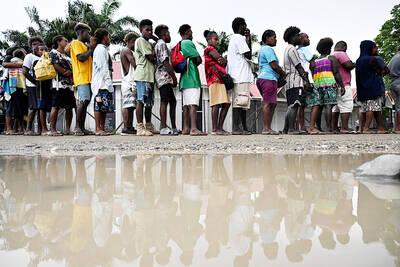
SEEKING CHANGE: A hospital worker said she did not vote in previous elections, but ‘now I can see that maybe my vote can change the system and the country’ Voting closed yesterday across the Solomon Islands in the south Pacific nation’s first general election since the government switched diplomatic allegiance from Taiwan to Beijing and struck a secret security pact that has raised fears of the Chinese navy gaining a foothold in the region. The Solomon Islands’ closer relationship with China and a troubled domestic economy weighed on voters’ minds as they cast their ballots. As many as 420,000 registered voters had their say across 50 national seats. For the first time, the national vote also coincided with elections for eight of the 10 local governments. Esther Maeluma cast her vote in the
Nearly half of China’s major cities are suffering “moderate to severe” levels of subsidence, putting millions of people at risk of flooding, especially as sea levels rise, according to a study of nationwide satellite data released yesterday. The authors of the paper, published by the journal Science, found that 45 percent of China’s urban land was sinking faster than 3mm per year, with 16 percent at more than 10mm per year, driven not only by declining water tables, but also the sheer weight of the built environment. With China’s urban population already in excess of 900 million people, “even a small portion

UNSETTLING IMAGES: The scene took place in front of TV crews covering the Trump trial, with a CNN anchor calling it an ‘emotional and unbelievably disturbing moment’ A man who doused himself in an accelerant and set himself on fire outside the courthouse where former US president Donald Trump is on trial has died, police said yesterday. The New York City Police Department (NYPD) said the man was declared dead by staff at an area hospital. The man was in Collect Pond Park at about 1:30pm on Friday when he took out pamphlets espousing conspiracy theories, tossed them around, then doused himself in an accelerant and set himself on fire, officials and witnesses said. A large number of police officers were nearby when it happened. Some officers and bystanders rushed

HYPOCRISY? The Chinese Ministry of Foreign Affairs yesterday asked whether Biden was talking about China or the US when he used the word ‘xenophobic’ US President Joe Biden on Wednesday called for a hike in steel tariffs on China, accusing Beijing of cheating as he spoke at a campaign event in Pennsylvania. Biden accused China of xenophobia, too, in a speech to union members in Pittsburgh. “They’re not competing, they’re cheating. They’re cheating and we’ve seen the damage here in America,” Biden said. Chinese steel companies “don’t need to worry about making a profit because the Chinese government is subsidizing them so heavily,” he said. Biden said he had called for the US Trade Representative to triple the tariff rates for Chinese steel and aluminum if Beijing was


 RSS
RSS