


China yesterday introduced new regulations intended to protect freedom of faith, although critics argue that the broad guidelines could be used to persecute religious groups that authorities deem troublesome.
The guidelines are meant to provide a legal framework for China's constitutional promise of freedom of religion, state media reported.
Under existing laws, communist authorities allow worship only in state-monitored churches, temples or mosques. Millions of believers attend unauthorized services, often in private homes, but are subject to arrest and harassment.
China, which will convene its annual legislative session on Saturday in Beijing, has banned many religious or spiritual groups, including the Falun Gong movement and churches loyal to the pope. It also tightly controls Tibetan Buddhism.
The Regulations on Religious Affairs cover everything from how licensed organizations can accept religious donations and claim tax exemptions, to how religious institutions may accept foreign students, among other topics, according to the state-run China Daily.
The new law says that "anyone who compels citizens to believe in or not believe in any religions ... shall be ordered to make corrections by the religious affairs department" and could face criminal charges, the newspaper said.
Such language could be used to persecute the faithful that it allegedly protects, contends Nicolas Becquelin, research director of the New York-based group Human Rights in China.
"The law purports to protect `normal' religious activities which in effect means religious activities expressly authorized by the state through a system of compulsory licensing and mandatory inspections," he said.
Becquelin said overly broad regulations have in the past been used as a pretext to "suspend, ban and suppress religious congregations as well as fine, detain or arrest religious practitioners."
Other foreign observers say the outcome of the new law remains uncertain.
Egil Lothe of the Oslo Coalition on Freedom of Religion or Belief, a nonprofit Norwegian group, said the new regulations offer "an improvement on present practices," because they give clearer procedures for registering religious groups and institutions.
But, "to what extent the regulations will change other aspects of Chinese policies on religion remains to be seen," Lothe added.
The US State Department said in a 2003 report that China "tries to control and regulate religious groups to prevent the rise of groups that could constitute sources of authority outside of the control of the government and the Chinese Communist Party."
The report called the Chinese government's respect for religious freedom "poor."

Republican US lawmakers on Friday criticized US President Joe Biden’s administration after sanctioned Chinese telecoms equipment giant Huawei unveiled a laptop this week powered by an Intel artificial intelligence (AI) chip. The US placed Huawei on a trade restriction list in 2019 for contravening Iran sanctions, part of a broader effort to hobble Beijing’s technological advances. Placement on the list means the company’s suppliers have to seek a special, difficult-to-obtain license before shipping to it. One such license, issued by then-US president Donald Trump’s administration, has allowed Intel to ship central processors to Huawei for use in laptops since 2020. China hardliners
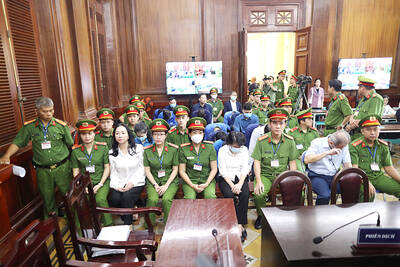
A top Vietnamese property tycoon was on Thursday sentenced to death in one of the biggest corruption cases in history, with an estimated US$27 billion in damages. A panel of three hand-picked jurors and two judges rejected all defense arguments by Truong My Lan, chair of major developer Van Thinh Phat, who was found guilty of swindling cash from Saigon Commercial Bank (SCB) over a decade. “The defendant’s actions ... eroded people’s trust in the leadership of the [Communist] Party and state,” read the verdict at the trial in Ho Chi Minh City. After the five-week trial, 85 others were also sentenced on

Conjoined twins Lori and George Schappell, who pursued separate careers, interests and relationships during lives that defied medical expectations, died this month in Pennsylvania, funeral home officials said. They were 62. The twins, listed by Guinness World Records as the oldest living conjoined twins, died on April 7 at the Hospital of the University of Pennsylvania, obituaries posted by Leibensperger Funeral Homes of Hamburg said. The cause of death was not detailed. “When we were born, the doctors didn’t think we’d make 30, but we proved them wrong,” Lori said in an interview when they turned 50, the Philadelphia Inquirer reported. The

RAMPAGE: A Palestinian man was left dead after dozens of Israeli settlers searching for a missing 14-year-old boy stormed a village in the Israeli-occupied West Bank US President Joe Biden on Friday said he expected Iran to attack Israel “sooner, rather than later” and warned Tehran not to proceed. Asked by reporters about his message to Iran, Biden simply said: “Don’t,” underscoring Washington’s commitment to defend Israel. “We are devoted to the defense of Israel. We will support Israel. We will help defend Israel and Iran will not succeed,” he said. Biden said he would not divulge secure information, but said his expectation was that an attack could come “sooner, rather than later.” Israel braced on Friday for an attack by Iran or its proxies as warnings grew of


 RSS
RSS