


Japan is set to launch a rocket for the first time since an embarrassing failure in 2003 with pressure mounting as China presses ahead in space and established space countries take the lead in the lucrative satellite market.
"The next launch of the rocket may decide the fate of the space development program of Japan," said Hideo Nagasu, former chief of the National Aerospace Laboratory of Japan.
"Because Japan still needs more experience, we have a long way ahead of ourselves before Japan's dream of entering a commercial satellite launch market is to be realized," he said.
The Japan Aerospace Exploration Agency, which was established in 2003 by integrating three Japanese space agencies including the National Aerospace Laboratory, will launch the H-2A rocket today to send into orbit a multi-function satellite that can monitor weather and navigate aircraft.
The launch was originally scheduled for Thursday from the Tanegashima Space Center in southern Kagoshima prefecture but was postponed because of bad weather.
"We have studied the cause of the previous failure. We redesigned the rocket and we are confident that this will be successful," said Masato Nakamura, spokesman for the Japan Aerospace Exploration Agency.
So far, Japan has sent up five H-2A rockets successfully, but suffered a setback in November 2003 when it had to destroy the sixth H-2A rocket just 10 minutes after lift-off when one of two rocket boosters failed to separate from the main body.
"Many countries, such as Europe, Russia and the United States, have also failed many times as they gained experience. We believe we are more advanced than many other countries," Nakamura said.
The failure was all the more embarrassing as it came one month after China, Japan's neighbor and growing rival, became the third country after the US and the former Soviet Union to launch a successful manned space flight.
While few would feel Japan needs to prove itself in technology, the world's second largest economy is looking for a slice of the market in launching satellites.
"We think we can eventually enter the commercial satellite launch market, in which we would be launching satellites for Japanese and foreign entities," Nakamura said.
The Japan Meteorological Agency, which will manage the new satellite on the H-2A, said it once considered using Europe's Ariane rocket because of the less than stable performance of the Japanese rockets.
In November 1999, Japanese space authorities exploded a ?24 billion (US$228 million) H-2 rocket and a multi-functional weather satellite of the meteorological agency by remote control when it veered off-course after liftoff.

Republican US lawmakers on Friday criticized US President Joe Biden’s administration after sanctioned Chinese telecoms equipment giant Huawei unveiled a laptop this week powered by an Intel artificial intelligence (AI) chip. The US placed Huawei on a trade restriction list in 2019 for contravening Iran sanctions, part of a broader effort to hobble Beijing’s technological advances. Placement on the list means the company’s suppliers have to seek a special, difficult-to-obtain license before shipping to it. One such license, issued by then-US president Donald Trump’s administration, has allowed Intel to ship central processors to Huawei for use in laptops since 2020. China hardliners
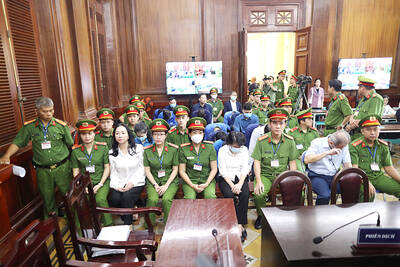
A top Vietnamese property tycoon was on Thursday sentenced to death in one of the biggest corruption cases in history, with an estimated US$27 billion in damages. A panel of three hand-picked jurors and two judges rejected all defense arguments by Truong My Lan, chair of major developer Van Thinh Phat, who was found guilty of swindling cash from Saigon Commercial Bank (SCB) over a decade. “The defendant’s actions ... eroded people’s trust in the leadership of the [Communist] Party and state,” read the verdict at the trial in Ho Chi Minh City. After the five-week trial, 85 others were also sentenced on

‘DELUSIONAL’: Targeting the families of Hamas’ leaders would not push the group to change its position or to give up its demands for Palestinians, Ismail Haniyeh said Israeli aircraft on Wednesday killed three sons of Hamas’ top political leader in the Gaza Strip, striking high-stakes targets at a time when Israel is holding delicate ceasefire negotiations with the militant group. Hamas said four of the leader’s grandchildren were also killed. Ismail Haniyeh’s sons are among the highest-profile figures to be killed in the war so far. Israel said they were Hamas operatives, and Haniyeh accused Israel of acting in “the spirit of revenge and murder.” The deaths threatened to strain the internationally mediated ceasefire talks, which appeared to gain steam in recent days even as the sides remain far

The Taliban’s reclusive supreme leader made a rare public appearance yesterday, an Afghan government spokesman said, leading thousands of worshipers in prayers marking Eid al-Fitr. Hibatullah Akhundzada has made only a handful of public appearances since inheriting the leadership of the Taliban in 2016 and leading the movement back to power with the withdrawal of US forces in 2021. Taliban government spokesman Zabihullah Mujahid said prayer in the largest mosque in Kandahar was “performed under the leadership of the supreme leader.” In a statement on X, he said the early-morning service “was attended by thousands of compatriots” in the southern province considered the


 RSS
RSS