


Japan's Nagoya District Court yesterday turned down a lawsuit by former World War II forced laborers from South Korea demanding compensation and an apology.
The seven South Korean plaintiffs -- six former laborers and the relative of a deceased laborer -- demanded the state and Mitsubishi Heavy Industries, for whom they were forced to work, pay out ?240 million yen (US$2.3 million) in compensation and offer an apology.

PHOTO: AP
The plaintiffs said the seven Korean women were lured from Korea to Japan around May-June in 1944 at age 13 to 15, and were told to work in Japan while receiving higher education.
They said they were not allowed to attend school as promised and were forced to work at Mitsubishi's Nagoya factory in central Aichi prefecture, a reconnaissance aircraft plant, and were not paid until they returned to Korea after Japan surrendered in August 1945.
The plaintiffs also said they suffered mental anguish after returning home as they were mistaken to have been forced to provide sex to Japanese soldiers.
Presiding Judge Kunio Sakuma said the state does not have a responsibility to pay compensation for events committed under the pre-war Constitution even if an individual suffers damage as a result of the actions of the state.
Japan ruled the Korean Peninsula as a colony before and during World War II.
To make up for a wartime labor shortage, Japan took women as laborers from the Korean Peninsula.
Around 4,000 Korean women were believed to have been sent to Japan to work as laborers, and about 300 of them worked at the Mitsubishi factory in Nagoya.
"After hearing the ruling, I feel like dying. My tears are like blood," Kim Song Ju, 75, one of the plaintiffs, said at a press conference.
The state said it cannot be held responsible for such a case under the law at that time, while Mitsubishi said it is not the same company as it was at that time.
Of the lawsuits concerning forced Korean women laborers, Nachi-Fujikoshi Corp. agreed to pay "settlement money" in a settlement in July 2000 at Japan's Supreme Court.
Two other lawsuits demanding the state compensate wartime forced laborers have been dismissed by the Supreme Court.

Republican US lawmakers on Friday criticized US President Joe Biden’s administration after sanctioned Chinese telecoms equipment giant Huawei unveiled a laptop this week powered by an Intel artificial intelligence (AI) chip. The US placed Huawei on a trade restriction list in 2019 for contravening Iran sanctions, part of a broader effort to hobble Beijing’s technological advances. Placement on the list means the company’s suppliers have to seek a special, difficult-to-obtain license before shipping to it. One such license, issued by then-US president Donald Trump’s administration, has allowed Intel to ship central processors to Huawei for use in laptops since 2020. China hardliners

DISADVANTAGE: Erin O’Toole, who led the Conservatives during the election campaign in 2021, estimated that the interference cost his party as many as nine legislative seats Canada’s domestic spy agency on Monday concluded that China interfered in the past two elections, an official probe heard, the firmest evidence so far of suspected Chinese meddling in Canadian politics. Canadian Prime Minister Justin Trudeau’s Liberal Party won both the elections, held in 2019 and 2021. Under pressure from opposition lawmakers unhappy about media reports on China’s possible role, Trudeau set up a commission into foreign interference. The commission was shown a slide on Monday containing an extract of a briefing in February last year from the Canadian Security Intelligence Service (CSIS). “We know that the PRC [People’s Republic of China] clandestinely
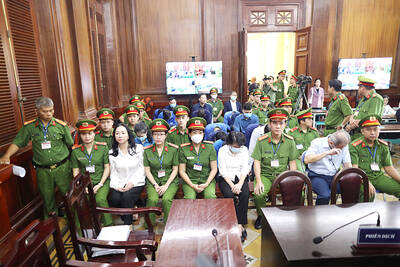
A top Vietnamese property tycoon was on Thursday sentenced to death in one of the biggest corruption cases in history, with an estimated US$27 billion in damages. A panel of three hand-picked jurors and two judges rejected all defense arguments by Truong My Lan, chair of major developer Van Thinh Phat, who was found guilty of swindling cash from Saigon Commercial Bank (SCB) over a decade. “The defendant’s actions ... eroded people’s trust in the leadership of the [Communist] Party and state,” read the verdict at the trial in Ho Chi Minh City. After the five-week trial, 85 others were also sentenced on

‘DELUSIONAL’: Targeting the families of Hamas’ leaders would not push the group to change its position or to give up its demands for Palestinians, Ismail Haniyeh said Israeli aircraft on Wednesday killed three sons of Hamas’ top political leader in the Gaza Strip, striking high-stakes targets at a time when Israel is holding delicate ceasefire negotiations with the militant group. Hamas said four of the leader’s grandchildren were also killed. Ismail Haniyeh’s sons are among the highest-profile figures to be killed in the war so far. Israel said they were Hamas operatives, and Haniyeh accused Israel of acting in “the spirit of revenge and murder.” The deaths threatened to strain the internationally mediated ceasefire talks, which appeared to gain steam in recent days even as the sides remain far


 RSS
RSS