


Militant groups have agreed to temporarily halt attacks on Israel -- a precursor to a formal truce agreement -- to give Palestinian President Mahmoud Abbas a chance to persuade Israel to stop targeting militants in return, Palestinian officials said on Monday.
The movement toward a cease-fire, coupled with efforts by Palestinian police to stop militants from firing rockets from Gaza into Israel, has raised hopes that a deal can be reached to end four years of bloody conflict between the sides.
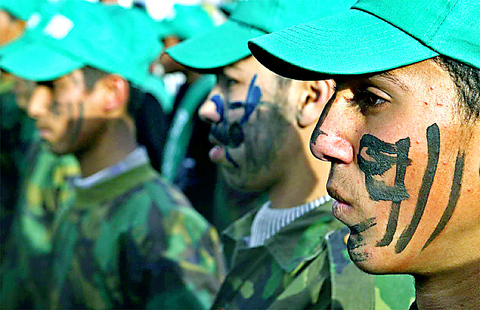
PHOTO: EPA
In the only serious incident on Monday, soldiers shot and killed a Palestinian in a no-go zone near the Karni crossing between Gaza and Israel, apparently planning to plant a bomb, Army Radio and the military said. On Jan. 13, Palestinian attackers killed five Israelis at the crossing.
Abbas said he was close to sealing a ceasefire agreement with the militants.
"Differences have diminished and I hope that there will be a final agreement very soon," he told reporters when he arrived back in the West Bank city of Ramallah after nearly a week of talks with militant leaders in Gaza.
Palestinian officials say Abbas will not formally declare a truce until he receives Israeli guarantees that it will halt military operations, including arrest raids and targeted killings of militants.
Palestinian negotiator Ziad Abu Amr said on Monday the armed groups have promised to temporarily suspend attacks on Israel.
"They will continue doing that for some time to see if Israel is ready to accept demands and hold the truce," Abu Amr told the Voice of Palestine radio.
Israeli officials have long resisted making a formal commitment to stop targeting militants, but said they would "respond to quiet with quiet," halting military raids. Israeli Prime Minister Ariel Sharon has reacted positively to the recent calm but warned of a tough response if attacks resume.
Abbas won a Jan. 9 Palestinian election to replace Yasser Arafat, who died in November. Israel shunned Arafat after the current round of violence began in September 2000, accusing him of encouraging terror attacks. But Israeli officials have been optimistic that Abbas, a pragmatist who has criticized the armed Palestinian uprising, will help bring calm to the region in advance of Israel's planned pullout from the Gaza Strip later this year.
In the new spirit of hope, Israeli President Moshe Katsav, who holds a largely ceremonial post, called Abbas on Monday to talk about the importance of working together for peace, Katsav's office said.
Israeli Vice Premier Shimon Peres said Israel should help Abbas win popular support for his policies.
"There are things we have to do, in everyone's opinion, such as removing the obstacle of the checkpoints," Peres told Israel Army Radio on Monday.
Peres is the leader of the dovish Labor Party, Sharon's newest coalition partner.
Peres also warned that Iran is trying to disrupt the emerging truce. Iranian-backed Hezbollah guerrillas have been funding some Palestinian militant groups.
"Iran ... is the center of terrorism in the Middle East," Peres said.
In a sign of internal change under Abbas, Palestinian workers early yesterday began tearing down illegal buildings along Gaza City's Mediterranean beachfront. Two bulldozers leveled kiosks in an operation the local police commander said would continue until hundreds of such structures are destroyed.
The commander, Moussa Alaian, said Abbas ordered the operation after he saw the illegal construction.
"We are a new era now. We must respect the law," Alaian said, indicating the long-ignored laws would now be enforced under the Abbas regime.
Hundreds of heavily armed Palestinian police protected the workers, and large crowds of people came to watch, but there was no resistance.
Egyptian Foreign Minister Ahmed Aboul Gheit told reporters in Cairo that Abbas may visit there next week as part of his efforts to broker a truce. Egypt has worked as a mediator between the Palestinians and Israel in recent years.
US envoy William Burns, a senior State Department official, is to arrive in the region later this week for talks with Israeli and Palestinian leaders on the truce efforts.
In another development, Israel has resumed construction of one of the most sensitive parts of its separation barrier in the West Bank, Israeli media reported Monday.
The 4km section is part of a fence that would surround the settlement of Ariel, deep in the West Bank. Residents of the nearby Palestinian town of Salfit stopped construction for four months by appealing to Israel's Supreme Court.
At first, Israel planned to include Ariel on the "Israeli" side of the barrier, fencing in a significant slice of West Bank land to reach the settlement. Palestinian and international criticism and court cases forced Israel to revise the route, planning instead to build a security fence around the settlement, but it would still enclose Palestinian land.
Israel says it needs the barrier to prevent Palestinian suicide bombers and other attackers from infiltrating. Palestinians charge that the route of the barrier, dipping into the West Bank, amounts to an Israeli land grab.
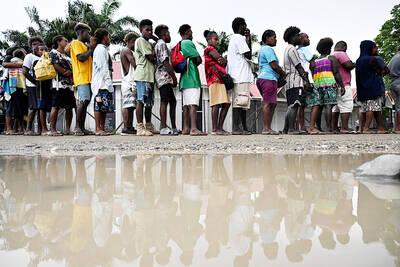
SEEKING CHANGE: A hospital worker said she did not vote in previous elections, but ‘now I can see that maybe my vote can change the system and the country’ Voting closed yesterday across the Solomon Islands in the south Pacific nation’s first general election since the government switched diplomatic allegiance from Taiwan to Beijing and struck a secret security pact that has raised fears of the Chinese navy gaining a foothold in the region. The Solomon Islands’ closer relationship with China and a troubled domestic economy weighed on voters’ minds as they cast their ballots. As many as 420,000 registered voters had their say across 50 national seats. For the first time, the national vote also coincided with elections for eight of the 10 local governments. Esther Maeluma cast her vote in the
Nearly half of China’s major cities are suffering “moderate to severe” levels of subsidence, putting millions of people at risk of flooding, especially as sea levels rise, according to a study of nationwide satellite data released yesterday. The authors of the paper, published by the journal Science, found that 45 percent of China’s urban land was sinking faster than 3mm per year, with 16 percent at more than 10mm per year, driven not only by declining water tables, but also the sheer weight of the built environment. With China’s urban population already in excess of 900 million people, “even a small portion

UNSETTLING IMAGES: The scene took place in front of TV crews covering the Trump trial, with a CNN anchor calling it an ‘emotional and unbelievably disturbing moment’ A man who doused himself in an accelerant and set himself on fire outside the courthouse where former US president Donald Trump is on trial has died, police said yesterday. The New York City Police Department (NYPD) said the man was declared dead by staff at an area hospital. The man was in Collect Pond Park at about 1:30pm on Friday when he took out pamphlets espousing conspiracy theories, tossed them around, then doused himself in an accelerant and set himself on fire, officials and witnesses said. A large number of police officers were nearby when it happened. Some officers and bystanders rushed

HYPOCRISY? The Chinese Ministry of Foreign Affairs yesterday asked whether Biden was talking about China or the US when he used the word ‘xenophobic’ US President Joe Biden on Wednesday called for a hike in steel tariffs on China, accusing Beijing of cheating as he spoke at a campaign event in Pennsylvania. Biden accused China of xenophobia, too, in a speech to union members in Pittsburgh. “They’re not competing, they’re cheating. They’re cheating and we’ve seen the damage here in America,” Biden said. Chinese steel companies “don’t need to worry about making a profit because the Chinese government is subsidizing them so heavily,” he said. Biden said he had called for the US Trade Representative to triple the tariff rates for Chinese steel and aluminum if Beijing was


 RSS
RSS