


Villagers untouched by last week's killer waves lie in wait on roads leading to the devastated southern Indian district of Nagapattinam, hoping to snatch aid intended for others.
For unsuspecting relief workers, the women and children squatting in groups along the roadside with hands outstretched may give the impression of people shattered and in dire need of help and supplies.
But the villagers, mainly laborers and farm workers, are cashing in on the disaster, treating it as a lucrative source of food, water, rice and clothes.
Most of the women pretend to cry and tell the story of how the tsunamis devastated their homes and destroyed their livelihood. But a trip to their village 3km away reveals a different story.
Not a single house has been touched by the giant wall of water which smashed into the southern Indian coastline Dec. 26, killing at least 9,986 people on the mainland and in the far-flung Andaman and Nicobar islands, and left 5,679, missing and presumed dead, according to official figures.
Some 6,023 people died in Nagapattinam district in Tamil Nadu, which has recorded 7,932 dead so far.
On the outskirts, a group of children are posted to flag down relief trucks on the way to the worst-hit Nagapattinam town laden with medicine, mats, stoves, food and other supplies.
Muthuswami Ilangovan, a 15-year-old boy, heads a team of more than 20 girls and younger boys to grab supplies. They shout and mime signs of hunger by pointing fingers to their mouths in front of any passing vehicle.
"I've lost everything. The waters entered our village. All homes were destroyed," Ilangovan told a reporter.
"During the last couple of days we've managed to get bags of rice and clothes," he said. "Some trucks and cars stop when they see us while others just speed past."
But the team of reporters took Ilangovan home to his Mathankadi village and found his family safe and house standing tall. He laughed and swiftly vanished into the narrow bylanes.
The Indian Citizens' Initiative, a private non-governmental organisation, said it was seeking to tackle the problem of aid freeloaders.
"We've set up a coordination committee among the NGOs to try to ensure relief reaches the right people," said Clifton Rozario, a senior official with the group.
At the same time, he said, Nagapattinam district was hard-hit by a lack of rain.
"They might not be affected by the tsunamis but they've been affected by drought. They tell us, `At least give us the leftovers.'"
More than 500 villagers, mainly women wearing colorful saris, are engaged in the same trade as Ilangovan. In the late evenings, they cart home bagfulls of supplies along with bamboo sleeping mats intended those made homeless.
Fifty-two year-old Nayakam, who goes by one name, is among one group of around half a dozen women who squat for hours on the road.
"On some days, we sit from morning to evening. My whole family has been affected and I've nowhere to go. The government is not giving as any relief and they are only giving it to people near the sea," she lamented.
"I have lost my family. If you've the money, I'll accept it," said Nayakam.
Another woman in the group, Indrani, chided her in the local Tamil language not to tell "so many lies."
"You're exaggerating too much. Don't say people died in your village, just say you have lost everything," she said.
N. Prabhu, a farmer who earns 75 rupees (US$1.60) a day, said he was forced to beg for relief as he was poor. About a third of India's one billion-plus population live below the poverty line.
"These are hard times for people in this district," Prabhu said. "They started giving away clothes and I took plenty. Rice and other supplies followed."
Policemen on rounds of the city chase away the villagers and at times cane them.
Nearly half of China’s major cities are suffering “moderate to severe” levels of subsidence, putting millions of people at risk of flooding, especially as sea levels rise, according to a study of nationwide satellite data released yesterday. The authors of the paper, published by the journal Science, found that 45 percent of China’s urban land was sinking faster than 3mm per year, with 16 percent at more than 10mm per year, driven not only by declining water tables, but also the sheer weight of the built environment. With China’s urban population already in excess of 900 million people, “even a small portion

UNSETTLING IMAGES: The scene took place in front of TV crews covering the Trump trial, with a CNN anchor calling it an ‘emotional and unbelievably disturbing moment’ A man who doused himself in an accelerant and set himself on fire outside the courthouse where former US president Donald Trump is on trial has died, police said yesterday. The New York City Police Department (NYPD) said the man was declared dead by staff at an area hospital. The man was in Collect Pond Park at about 1:30pm on Friday when he took out pamphlets espousing conspiracy theories, tossed them around, then doused himself in an accelerant and set himself on fire, officials and witnesses said. A large number of police officers were nearby when it happened. Some officers and bystanders rushed

HYPOCRISY? The Chinese Ministry of Foreign Affairs yesterday asked whether Biden was talking about China or the US when he used the word ‘xenophobic’ US President Joe Biden on Wednesday called for a hike in steel tariffs on China, accusing Beijing of cheating as he spoke at a campaign event in Pennsylvania. Biden accused China of xenophobia, too, in a speech to union members in Pittsburgh. “They’re not competing, they’re cheating. They’re cheating and we’ve seen the damage here in America,” Biden said. Chinese steel companies “don’t need to worry about making a profit because the Chinese government is subsidizing them so heavily,” he said. Biden said he had called for the US Trade Representative to triple the tariff rates for Chinese steel and aluminum if Beijing was
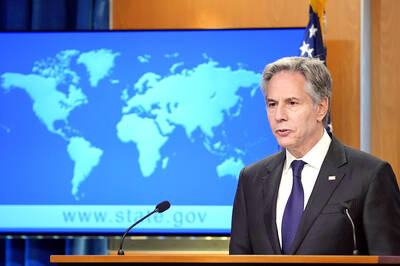
Beijing is continuing to commit genocide and crimes against humanity against Uyghurs and other Muslim minorities in its western Xinjiang province, U.S. Secretary of State Antony Blinken said in a report published on Monday, ahead of his planned visit to China this week. The State Department’s annual human rights report, which documents abuses recorded all over the world during the previous calendar year, repeated language from previous years on the treatment of Muslims in Xinjiang, but the publication raises the issue ahead of delicate talks, including on the war in Ukraine and global trade, between the top U.S. diplomat and Chinese


 RSS
RSS