


A suicide bomber detonated his car Monday at the gate to the home of the leader of Iraq's biggest political party, killing and wounding several of the guards but leaving the cleric unharmed, his spokesman said.
Abdul Aziz al-Hakim, head of the Supreme Council for the Islamic Revolution in Iraq -- the country's most powerful Shiite political group -- was in his residence in Baghdad's Jadiriyah district when the attack occurred, said Haitham al-Husseini. He was unharmed.
The blast shook the district and sent a cloud of smoke high above the area.
"It was a suicide attack near the gate leading to the office," al-Husseini said. "Several of the guards were killed and wounded."
Political and religious leaders of the Shiite community, who strongly back the holding of next month's vote, have been repeatedly targeted by the mainly Sunni Muslim insurgents since Saddam's ouster.
Iraq's election body rejected a suggestion in Washington it adjust the results of next month's vote to benefit the Sunni minority if low turnout in Sunni areas means Shiites win an exaggerated majority in the new assembly.
Speaking of "unacceptable" interference, Electoral Commission spokesman Farid Ayar said: "Who wins, wins. That is the way it is. That is the way it will be in the election."
US diplomats in Baghdad, at pains to keep their role in the election discreet, declined comment on a New York Times report from Washington which said Sunnis might be granted extra seats if the community's vote was judged to have been too low.
US officials have expressed concern that if the ballot on Jan. 30 fails to reflect Iraq's sectarian and ethnic mix due to violence and boycotts in Sunni areas, then the assembly will lack legitimacy.
But any attempt to fix the proportion of seats going to the main groups in advance could have the same effect.
"The Americans are expressing their views and those aren't always the same as the Commission's," Ayar told reporters.
"But the Commission is absolutely independent. It is not acceptable for anyone to interfere in our business."
call for postponement
Some leaders among Sunni Arabs, a 20-percent minority who dominated the country under Saddam Hussein and before, have called for the election to be put off because violence in the north and west will make it hard for Sunnis to vote.
But Shiites, who account for 60 percent of the 26 million population, are keen to exercise their electoral weight.
The New York Times said Shiite leaders had been approached about the idea. Shiites would be reluctant to see the minority shut out of power if that means more violence, like the twin suicide car bombs that rocked their holy cities a week ago.
Next month's vote will elect 275 legislators who will appoint a president and government and oversee the drafting of a new constitution over the next year.
White House spokesman Trent Duffy insisted it was up to the Iraqis, not Washington, to decide the rules of the election.
"The US supports the Iraqi election commission in defining those rules. But it's up to the Iraqi election commission to determine the rules," Duffy said.
POLICE CHIEF TARGETED
In scattered violence in the north and west, a police colonel was assassinated in Baghdad, the latest of many.
Local witnesses said a civilian was killed in two hours of fighting near Samarra between US forces and insurgents.
Also, two civilians were killed in clashes in the desert town of Qaim.
Police in the Shiite holy city of Najaf said they were making progress in catching those responsible for the bombing last week that killed 52 people.
Along with a bomb that killed 14 in nearby Kerbala, it was seen as an attempt to spark sectarian conflict in the run-up to the election.
Police chief Ghalib al-Jazairi said one man in detention had confessed to attending a guerrilla training camp in Syria.
Iraq accuses Syrian intelligence of aiding former Saddam loyalists and Islamist groups in Iraq.
Another man had been arrested who had filmed the scene before and after the bombing.

Republican US lawmakers on Friday criticized US President Joe Biden’s administration after sanctioned Chinese telecoms equipment giant Huawei unveiled a laptop this week powered by an Intel artificial intelligence (AI) chip. The US placed Huawei on a trade restriction list in 2019 for contravening Iran sanctions, part of a broader effort to hobble Beijing’s technological advances. Placement on the list means the company’s suppliers have to seek a special, difficult-to-obtain license before shipping to it. One such license, issued by then-US president Donald Trump’s administration, has allowed Intel to ship central processors to Huawei for use in laptops since 2020. China hardliners
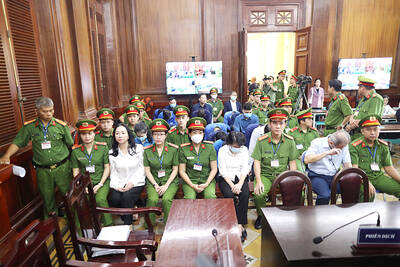
A top Vietnamese property tycoon was on Thursday sentenced to death in one of the biggest corruption cases in history, with an estimated US$27 billion in damages. A panel of three hand-picked jurors and two judges rejected all defense arguments by Truong My Lan, chair of major developer Van Thinh Phat, who was found guilty of swindling cash from Saigon Commercial Bank (SCB) over a decade. “The defendant’s actions ... eroded people’s trust in the leadership of the [Communist] Party and state,” read the verdict at the trial in Ho Chi Minh City. After the five-week trial, 85 others were also sentenced on

Conjoined twins Lori and George Schappell, who pursued separate careers, interests and relationships during lives that defied medical expectations, died this month in Pennsylvania, funeral home officials said. They were 62. The twins, listed by Guinness World Records as the oldest living conjoined twins, died on April 7 at the Hospital of the University of Pennsylvania, obituaries posted by Leibensperger Funeral Homes of Hamburg said. The cause of death was not detailed. “When we were born, the doctors didn’t think we’d make 30, but we proved them wrong,” Lori said in an interview when they turned 50, the Philadelphia Inquirer reported. The
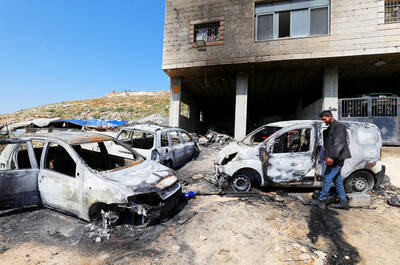
RAMPAGE: A Palestinian man was left dead after dozens of Israeli settlers searching for a missing 14-year-old boy stormed a village in the Israeli-occupied West Bank US President Joe Biden on Friday said he expected Iran to attack Israel “sooner, rather than later” and warned Tehran not to proceed. Asked by reporters about his message to Iran, Biden simply said: “Don’t,” underscoring Washington’s commitment to defend Israel. “We are devoted to the defense of Israel. We will support Israel. We will help defend Israel and Iran will not succeed,” he said. Biden said he would not divulge secure information, but said his expectation was that an attack could come “sooner, rather than later.” Israel braced on Friday for an attack by Iran or its proxies as warnings grew of


 RSS
RSS