


In the few days since a drama company in the Midlands canceled the run of a contentious play in the face of violent religious protests, British theater has been grappling with a range of uncomfortable and unusual questions about censorship, freedom and faith.
The cancellation, by the Birmingham Repertory Theater, challenged Britain's 400,000 Sikhs to contemplate the distinctions within their ranks as values change, separating a conservative old guard of immigrants from a newer generation born and reared in Britain. And the episode posed a near-unanswerable question for liberal-minded British theatergoers: What counts more, their commitment to free speech or their commitment to minority rights? Indeed, what kind of a society permits a mob to silence artistic expression in the first place?
"I think it's one of the blackest days for the arts in this country that I have ever experienced," said Neal Foster, the manager of another theater, the Birmingham Stage Company. "Violence is not part of the process we are used to. In the short term the thugs have won, and this has never happened before in the artistic community."
The furor centers on a play by Gurpreet Kaur Bhatti, the British-born daughter of Sikh immigrants. Her latest work, "Behzti" ("Dishonor"), used a Sikh temple as the setting for a harrowing scene in which a young woman is beaten by other women, including her own mother, after being raped by a man who claims to have had a homosexual relationship with her father.
As the play was being performed on Dec. 18, hundreds of Sikh protesters attacked the building, throwing bricks, smashing windows and fighting with police. Citing the threat of further disruptions, the theater canceled the run, which started Dec. 9, but that was only the beginning of a much broader drama.
In the midst of this impassioned debate, Bhatti went into hiding, fearing for her life after death threats. The situation has evoked comparisons with the fatwa by Ayatollah Ruhollah Khomeini of Iran in 1989 that sent the writer Salman Rushdie into hiding following the publication of his Satanic Verses, a novel the Iranian authorities regarded as insulting to Islam.
"This is the Sikhs' Rushdie affair," said Gurharpal Singh, a professor of inter-religious studies at the University of Birmingham. "There are overtones of religious censorship and the clash between community norms and liberal society."
The soul-searching has become even more tangled because the staging of "Behzti" intersects with another discussion in Britain over a new law that would make incitement to religious hatred a crime, in effect extending earlier legislation that outlawed incitement to racial hatred.
In some ways it is all the more perplexing that the incident should have taken place in Birmingham, England's second largest city, which has managed to achieve an ethnic balance with a large minority of people from an Asian background, most of them Muslims. Not only Bhatti, the playwright, is a Sikh, but so are several members of the cast.
The play's setting infuriated Sikh protesters, who argued that acts like rape and brutality could never happen in the sanctity of a temple. Sikh leaders labeled the drama an insult to their faith, which has some 16 million adherents. The religion, founded in the 15th century, is rooted in the Punjab region of India and has spread in a million-strong diaspora to Britain, Canada, the United States and other countries.
The play itself, with themes like arranged marriage and the clash of tradition with modernity, drew mixed reviews. It was advertised as a black comedy, but The Birmingham Evening Mail said that "what begins as a sharp and black look at a modern family dilemma sinks beneath its own weight." By contrast, The Birmingham Post called the play -- Bhatti's second after a 2001 work, "Behsharam" ("Shameless") -- "gripping and essential."
Whatever the faults and merits, though, they were lost in a debate that made headlines in British newspapers and on radio and television shows, and raised profound concerns about the consequences of, as some saw it, caving in to violence.
In the future, "theaters will not want to take the risk" of staging provocative works, Foster of the Birmingham Stage Company said. "It doesn't just affect theater. What about controversial books, art galleries, paintings?"
(Braham Murray, an artistic director of the Royal Exchange Theater in Manchester, which has commissioned a new play from Bhatti, said there would be "no prescription" about the theme of the play and "no doubts about staging it provided the play is a good play").
But many Sikh representatives argue that the issues have been misunderstood. Harmander Singh, a spokesman for the advocacy group Sikhs in England, said concerns about the setting of the play had gone unheeded for days before the violent protests. Sikh representatives had suggested that the play would be far less offensive if the setting were changed from a temple to a community center, a proposal the theater rejected.
"Rape and other things happen everywhere," Singh said in a telephone interview. "We know that is a reality."
The fact that Bhatti's play took place in a temple was at the center of Sikh objections. "It's nothing to do with the contents; it's the context," he said. "We are not against freedom of speech, but there's no right to offend."
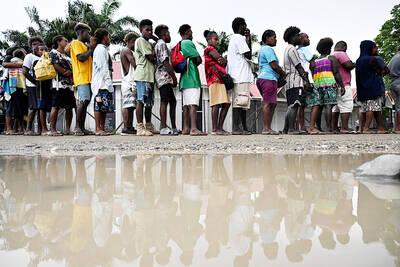
SEEKING CHANGE: A hospital worker said she did not vote in previous elections, but ‘now I can see that maybe my vote can change the system and the country’ Voting closed yesterday across the Solomon Islands in the south Pacific nation’s first general election since the government switched diplomatic allegiance from Taiwan to Beijing and struck a secret security pact that has raised fears of the Chinese navy gaining a foothold in the region. The Solomon Islands’ closer relationship with China and a troubled domestic economy weighed on voters’ minds as they cast their ballots. As many as 420,000 registered voters had their say across 50 national seats. For the first time, the national vote also coincided with elections for eight of the 10 local governments. Esther Maeluma cast her vote in the
Nearly half of China’s major cities are suffering “moderate to severe” levels of subsidence, putting millions of people at risk of flooding, especially as sea levels rise, according to a study of nationwide satellite data released yesterday. The authors of the paper, published by the journal Science, found that 45 percent of China’s urban land was sinking faster than 3mm per year, with 16 percent at more than 10mm per year, driven not only by declining water tables, but also the sheer weight of the built environment. With China’s urban population already in excess of 900 million people, “even a small portion

UNSETTLING IMAGES: The scene took place in front of TV crews covering the Trump trial, with a CNN anchor calling it an ‘emotional and unbelievably disturbing moment’ A man who doused himself in an accelerant and set himself on fire outside the courthouse where former US president Donald Trump is on trial has died, police said yesterday. The New York City Police Department (NYPD) said the man was declared dead by staff at an area hospital. The man was in Collect Pond Park at about 1:30pm on Friday when he took out pamphlets espousing conspiracy theories, tossed them around, then doused himself in an accelerant and set himself on fire, officials and witnesses said. A large number of police officers were nearby when it happened. Some officers and bystanders rushed

HYPOCRISY? The Chinese Ministry of Foreign Affairs yesterday asked whether Biden was talking about China or the US when he used the word ‘xenophobic’ US President Joe Biden on Wednesday called for a hike in steel tariffs on China, accusing Beijing of cheating as he spoke at a campaign event in Pennsylvania. Biden accused China of xenophobia, too, in a speech to union members in Pittsburgh. “They’re not competing, they’re cheating. They’re cheating and we’ve seen the damage here in America,” Biden said. Chinese steel companies “don’t need to worry about making a profit because the Chinese government is subsidizing them so heavily,” he said. Biden said he had called for the US Trade Representative to triple the tariff rates for Chinese steel and aluminum if Beijing was


 RSS
RSS