


Weeks before President George W. Bush announced a plan to protect African babies from AIDS, top US health officials were warned that research on the key drug was flawed and may have underreported severe reactions including deaths, government documents show.
The 2002 warnings about the drug, nevirapine, were serious enough to suspend testing for more than a year, let Uganda's government know of the dangers and prompt the drug's maker to pull its request for permission to use the medicine to protect newborns in the US.
But the National Institutes of Health, the government's premier health research agency, chose not to inform the White House as it scrambled to keep its experts' concerns from scuttling the use of nevirapine in Africa as a cheap solution, according to documents obtained by The Associated Press.
"Everyone recognized the enormity that this decision could have on the worldwide use of nevirapine to interrupt mother-baby transmission," NIH's AIDS research chief, Dr. Edmund Tramont, reported on March 14, 2002, to his boss, Anthony Fauci, director of the National Institute of Allergy and Infectious Diseases.
The documents show Tramont and other NIH officials dismissed the problems with the nevirapine research in Uganda as overblown and were slow to report safety concerns to the Food and Drug Administration.
Records for NIH's nevirapine research in Uganda were so sloppy that NIH investigators couldn't be sure which mothers got the drug. They had to use blood samples to confirm doses, the documents show.
Less than a month after Bush announced a US$500 million plan to push nevirapine across Africa to slow the AIDS epidemic, the Health and Human Services Department sent a nine-page letter to Ugandan officials identifying violations of federal patient protection rules by NIH's research. Africa accounts for more than two-thirds of the world's AIDS cases, with 27 million infected.
The NIH research "may have represented a failure to minimize risk to the subjects," the Office of Human Research Protections told Ugandan authorities in summer 2002.
Because of the problems, NIH shut down the Uganda research for 15 months, from the spring of 2002 to the summer of last year, to review the science and take corrective actions.
NIH officials said they remain confident after re-reviewing the Uganda study and other research that nevirapine can be used safely in single doses by African mothers and children to prevent HIV transmissions during birth.
But they acknowledged their Uganda research failed to meet required US standards. The NIH has spent millions in the last two years improving its safety monitoring and record-keeping.
Senate Finance Committee Chairman Charles Grassley has asked the Justice Department to investigate NIH's conduct.
One lesson already learned from a closer review of the Uganda research is that even single doses of nevirapine can create instant resistance, meaning patients may not be able to use the drug or others in its class again when their AIDS worsens, Lane said.
"It was unexpected, and what it means is nevirapine probably shouldn't be a drug of first choice if other options are available," Lane said.
Lane said NIH officials were aware in spring 2002 about the impending White House announcement on nevirapine but did not tell presidential aides of the problems because they were confident, even before reviewing the Uganda research, that the underlying science was solid.
The White House -- though unaware of the NIH concerns -- remains confident in Bush's US$500 million plan in 2002 to send nevirapine to Africa. Bush approved US$2.9 billion for global AIDS fighting next year.
Nevirapine is an antiretroviral drug that has been used since the 1990s to treat adult AIDS patients and is known to have potentially lethal effects like liver damage and severe rashes when taken over time.
In 1997, NIH began studying in Uganda whether it could be given safely in single doses to stop mother-to-baby transmissions. That research showed it could reduce transmission in as many as half the births.
But by early 2002, an NIH auditor, the agency's medical safety experts and the drug's maker all disclosed widespread problems about the US-funded research in Uganda.
Westat Corp., a professional medical auditing firm hired by NIH, reported there were 14 deaths not reported in the study database as of early 2002 and that the top two researchers in Uganda acknowledged "thousands" of bad reactions that weren't disclosed.
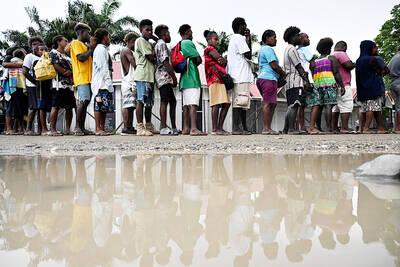
SEEKING CHANGE: A hospital worker said she did not vote in previous elections, but ‘now I can see that maybe my vote can change the system and the country’ Voting closed yesterday across the Solomon Islands in the south Pacific nation’s first general election since the government switched diplomatic allegiance from Taiwan to Beijing and struck a secret security pact that has raised fears of the Chinese navy gaining a foothold in the region. The Solomon Islands’ closer relationship with China and a troubled domestic economy weighed on voters’ minds as they cast their ballots. As many as 420,000 registered voters had their say across 50 national seats. For the first time, the national vote also coincided with elections for eight of the 10 local governments. Esther Maeluma cast her vote in the
Nearly half of China’s major cities are suffering “moderate to severe” levels of subsidence, putting millions of people at risk of flooding, especially as sea levels rise, according to a study of nationwide satellite data released yesterday. The authors of the paper, published by the journal Science, found that 45 percent of China’s urban land was sinking faster than 3mm per year, with 16 percent at more than 10mm per year, driven not only by declining water tables, but also the sheer weight of the built environment. With China’s urban population already in excess of 900 million people, “even a small portion

UNSETTLING IMAGES: The scene took place in front of TV crews covering the Trump trial, with a CNN anchor calling it an ‘emotional and unbelievably disturbing moment’ A man who doused himself in an accelerant and set himself on fire outside the courthouse where former US president Donald Trump is on trial has died, police said yesterday. The New York City Police Department (NYPD) said the man was declared dead by staff at an area hospital. The man was in Collect Pond Park at about 1:30pm on Friday when he took out pamphlets espousing conspiracy theories, tossed them around, then doused himself in an accelerant and set himself on fire, officials and witnesses said. A large number of police officers were nearby when it happened. Some officers and bystanders rushed

HYPOCRISY? The Chinese Ministry of Foreign Affairs yesterday asked whether Biden was talking about China or the US when he used the word ‘xenophobic’ US President Joe Biden on Wednesday called for a hike in steel tariffs on China, accusing Beijing of cheating as he spoke at a campaign event in Pennsylvania. Biden accused China of xenophobia, too, in a speech to union members in Pittsburgh. “They’re not competing, they’re cheating. They’re cheating and we’ve seen the damage here in America,” Biden said. Chinese steel companies “don’t need to worry about making a profit because the Chinese government is subsidizing them so heavily,” he said. Biden said he had called for the US Trade Representative to triple the tariff rates for Chinese steel and aluminum if Beijing was


 RSS
RSS