


■ China
Mine blast kills 33
Thirty-three workers were killed after a gas explosion at a coal mine in north China, once again highlighting the appalling safety standards blighting the industry, officials said yesterday. Seventy-one miners were in the shaft when the blast occurred on Thursday afternoon at Nanlou township near the city of Yangquan in Shanxi province, a county official told reporters. Twenty-eight miners were killed in the initial explosion and five others died during a rescue attempt, he said. Everyone else escaped. The accident comes less than two weeks after 166 people were killed in a coal mine in neighboring Shaanxi province in the country's worst mining disaster in 44 years.
■ China
Worm removed from brain
Surgeons in central China have removed a 12cm-long parasitic worm from a 24-year-old man's brain, a news report said Friday. The case is one of less than 100 worldwide where a human has been infected by the sparganum worm, according to the Hong Kong edition of the China Daily. The man is believed to have been infected with the parasite -- which works its way towards the brain after being infested -- after eating wild snake and frog, species that can carry the worm.
■ Vietnam
Soldiers' bodies found
Vietnamese authorities have uncovered remains believed to be of French soldiers who died in the battle that won Vietnam's independence 50 years ago, senior local officials said on Friday. The 15 sets of remains were uncovered during construction at the former Dien Bien Phu battlefield, the official said. Eleven sets of remains were discovered last week during construction of a dam on the Nam Rom river, just 200m southwest of the bunker of the French commander, Colonel Christian de Castries.
■ China
Bilingual toilets planned
China's capital Beijing plans to require attendants at its public toilets to speak basic English in a bid to improve the services provided to foreign visitors, state media said yesterday. It is part of an ambitious campaign to raise the standards of public loos in the city of 13 million as it gets ready to welcome thousands of tourists for the 2008 Olympics, the Beijing Morning Post reported. The paper did not specify the level of English toilet staff need to possess, but said they must in future also be proficient in sign language. It made no mention on whether they planned to train the workers, or leave them to their own devices. Beijing is emerging as an actor to be reckoned with in toilet science, recently hosting the World Toilet Summit, a gathering of urban planners and environmental experts.
■ Zimbabwe
Some NGOs banned
Zimbabwe's parliament approved legislation on Thursday that would effectively outlaw foreign or foreign-supported NGOs, groups that have pressed for broader human-rights guarantees in President Robert Mugabe's authoritarian government. This legislation and a sheaf of other proposals restricting domestic freedoms have been denounced by human-rights activists, who say the measures are part of a broader plan to suppress opposition political activity before elections in March. But Mugabe, who has railed against what he calls a Western plot to restore colonial rule, has accused foreign-backed civic groups of being "conduits of interference in our national efforts."
■ Argentina
Thousands left homeless
At least 10,000 people have been left homeless by rain-induced floods in northern Argentina, officials said late Thursday. In Chaco province, more than 600,000 hectares of residential land were under water, the provincial government said. The floods coincide with a world climate conference taking place in the country's capital, Buenos Aires, where experts have warned that such flooding will become more frequent through global warming. Governor Roy Nikisch said that the floods were the result of uncontrolled clearing of land over the past decades. Rescue workers were bringing victims of the flooding into emergency shelters supplied with food, warm blankets and clothing.
■ France
Terrorists on to ATMs
Radical Islamic cells in Europe are using an ingenious way to finance terror networks that's virtually impossible to trace: withdrawing hundreds of thousands of dollars a month from cash machines with fake credit cards, according to France's top anti-terrorism judge. Jean-Louis Bruguiere, who's been at the forefront of the war on terror for 20 years, also told reporters the Caucasus has replaced Afghanistan as a key militant training ground for Osama bin Laden's al-Qaeda network and other groups around the world. Bruguiere said militant financing networks "represent millions of euros" in fund-raising for terrorists.
■ France
Eiffel Tower ice rink opens
A skating rink with a bird's-eye view of Paris was opened 57m up the Eiffel Tower on Thursday, offering a free but chilly thrill for visitors to France's most famous monument. The rink, constructed on the first platform of the 324m tall Paris landmark, was inaugurated by French world skating silver medalists Sarah Abitbol and Stephane Bernadis. It is hoped that the high-rise skating rink will attract more locals to the tower which is overwhelmingly visited by overseas tourists.
■ Ghana
Incumbent wins presidency
Incumbent John Kufuor has been re-elected president of Ghana, according to official results announced by the electoral commission on Thursday. Results in the west African country put Kufuor ahead with 52.75 percent of the ballots and his main opponent John Atta Mills on 44.32 percent, the commission said. The turnout rate was a massive 83.2 percent in the polling stations where the votes have already been counted, according to the election commission.
■ United States
Plane crash-lands on truck
A small plane that had lost power briefly landed atop an 18-wheeler before crashing onto the highway, authorities said. The two people aboard the plane came out unscathed, and the truck driver never heard a thing. "Nothing happened to the truck, except for a couple of skid marks up top," said Trooper Lucila Torres, a spokeswoman for the Texas Department of Public Safety. The single-engine plane carrying an El Paso couple fell off the trailer and landed upside down on Interstate 10 during the emergency landing Thursday about 30km east of El Paso, Torres said. Pilot Mark Taylor Davis, 45, and wife Mercedes Davis, 42, were returning home from Austin when the 1967 Mooney M20F developed engine trouble.
■United States
Weather thwarts rescue
Frustrated by furious winds, mountainous seas and a mere five-hour window of December daylight, rescuers searched for six people lost in the Bering Sea after the Coast Guard helicopter that had plucked them from a crippled freighter crashed in the darkness. The ship they left behind ran aground and split apart, spilling thousands of gallons of fuel that threatened sensitive wildlife habitats on the western side of Unalaska Island in the Aleutian chain. Environmental officials said it could take months to clean up. Searchers hoped the missing crew had somehow lived through the night, but 6 degrees Celsius temperatures reduced survival estimates to about three hours. Rescuers were hampered by seas that swelled to 6m and wind that howled at 56kph.
■ United States
Mother violates privacy
In a victory for rebellious teenagers, the state Supreme Court ruled that a mother violated Washington's privacy law by eavesdropping on her daughter's phone conversa-tion. Privacy advocates hailed the Thursday ruling, but the mother was unrepentant. "My daughter was out of control, and that was the only way I could get information and keep track of her. I did it all the time." The Supreme Court ruled that Dixon's testimony against a friend of her daughter should not have been admitted in court because it was based on the intercepted conversation.
■ United Nations
Children face new threat: UN
Advances in children's survival, health and education are being reversed by a "triple whammy" of AIDS, conflict and poverty, according to the UN children's agency, UNICEF. The disease is driving the destruction of basic services for one billion children and violating their right to grow and develop, said Carol Bellamy, the organization's executive director. "We believe AIDS is the worst catastrophe ever to hit the world," she told the London-based Guardian newspaper. "It is just ripping up systems, be it health or education. Childhood is being robbed from them."
■ United States
Depression gene discovered
Scientists in North Carolina have discovered a genetic variation that could predis-pose people to depression and may help explain why some people who develop the condition get no relief from drug treatments. The findings, which were posted Thursday in the online edition of the journal Neuron, may allow researchers to develop a test for genetic vulnerability to depression and to create more effective treatments. "The results need to be replicated, but they suggest that we may be able to personalize the treatment of depression," said Dr Thomas Insel, director of the National Institute of Mental Health, which helped finance the study.

Republican US lawmakers on Friday criticized US President Joe Biden’s administration after sanctioned Chinese telecoms equipment giant Huawei unveiled a laptop this week powered by an Intel artificial intelligence (AI) chip. The US placed Huawei on a trade restriction list in 2019 for contravening Iran sanctions, part of a broader effort to hobble Beijing’s technological advances. Placement on the list means the company’s suppliers have to seek a special, difficult-to-obtain license before shipping to it. One such license, issued by then-US president Donald Trump’s administration, has allowed Intel to ship central processors to Huawei for use in laptops since 2020. China hardliners
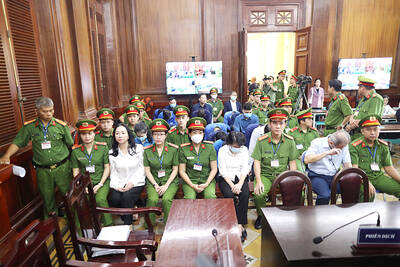
A top Vietnamese property tycoon was on Thursday sentenced to death in one of the biggest corruption cases in history, with an estimated US$27 billion in damages. A panel of three hand-picked jurors and two judges rejected all defense arguments by Truong My Lan, chair of major developer Van Thinh Phat, who was found guilty of swindling cash from Saigon Commercial Bank (SCB) over a decade. “The defendant’s actions ... eroded people’s trust in the leadership of the [Communist] Party and state,” read the verdict at the trial in Ho Chi Minh City. After the five-week trial, 85 others were also sentenced on

‘DELUSIONAL’: Targeting the families of Hamas’ leaders would not push the group to change its position or to give up its demands for Palestinians, Ismail Haniyeh said Israeli aircraft on Wednesday killed three sons of Hamas’ top political leader in the Gaza Strip, striking high-stakes targets at a time when Israel is holding delicate ceasefire negotiations with the militant group. Hamas said four of the leader’s grandchildren were also killed. Ismail Haniyeh’s sons are among the highest-profile figures to be killed in the war so far. Israel said they were Hamas operatives, and Haniyeh accused Israel of acting in “the spirit of revenge and murder.” The deaths threatened to strain the internationally mediated ceasefire talks, which appeared to gain steam in recent days even as the sides remain far

The Taliban’s reclusive supreme leader made a rare public appearance yesterday, an Afghan government spokesman said, leading thousands of worshipers in prayers marking Eid al-Fitr. Hibatullah Akhundzada has made only a handful of public appearances since inheriting the leadership of the Taliban in 2016 and leading the movement back to power with the withdrawal of US forces in 2021. Taliban government spokesman Zabihullah Mujahid said prayer in the largest mosque in Kandahar was “performed under the leadership of the supreme leader.” In a statement on X, he said the early-morning service “was attended by thousands of compatriots” in the southern province considered the


 RSS
RSS