


■ The Philippines
Journalist toll rises to 13
A journalist was bludgeoned to death in the north, making him the 13th member of
the press to be killed this year, police said yesterday. Stephen Omaois, 24, a reporter for the provincial news weekly Guru Press
and for government-run radio DZRK, was found dead by police on the outskirts
of Tabuk town on Saturday, police investigators said.
He had head injuries, appa-rently from rocks that were found beside the body, said
a provincial police official. No arrests have been made and the motive is unknown. Arthur Alad-iw, vice chair-man of the National Union
of Journalists in the Philip-pines, claimed Omaois had been abducted last Friday. Family members only identified his body yesterday after it had been lying at a local mortuary for five days.
■ China
Rich-poor gap widening
The gap between rich and poor, triggered by 20 years of economic reforms, is getting wider, the official Economic Information Daily said yesterday. The annual dis-posable per capita income of a high-income family grew
13 percent last year to 17,472 yuan (US$2,111), while that of a low-income family rose 8.7 percent to just 329.5 yuan, the paper said, quoting the National Bureau of Statistics. It did not detail how many Chinese families fall into the high-income bracket. Government leaders, wary of the potential for social unrest, have declared war on poverty and pledged to narrow the yawning gap between the rich and the poor.
■ Japan
Jizo helps town stay clean
The town of Nagato in the mountains of central Nagano prefecture has found divine help in ridding its car parks and roadsides of litter dis-carded by tourists passing through on their way to nearby ski resorts. Nagato authorities placed statues
of Jizo, whose role in Bud-dhism is to help others find enlightenment, at parking spots on a main road through the town. In the four months since the appearance of the statues, carved by local residents, litter has almost disappeared, public broad-caster NHK said yesterday.
"I can't drop litter now, not with the statue looking at me," NHK quoted one driver as saying.
■ Japan
Crime-fighters wear kimonos
Bar hostesses clad in ki-monos have joined forces with police in a symbolic move to crack down on rising crime in Tokyo's fashionable Ginza enter-tainment and shopping district. Complaining of
what they say are rising rates of pick-pocketing and mug-ging, several kimono-clad hostesses have started to patrol the district once a month. "Men patrol the streets too, but we feel it's our duty to help out to take care of our town and return it to a place of safe streets like it used to be," said Kie Kittaka, a bar owner, wear-ing a kimono with a green sash reading: "Protect our town." The women visit bars in the evening to hand out flyers aimed at raising awareness of crime in the district.
■ Hong Kong
Tougher air-rage law sought
The government is seeking a legal amendment enabling it to prosecute unruly pas-sengers on all planes bound for the territory. The law allows authorities to pro-secute crimes committed on Hong Kong-controlled air-craft regardless of where they are located. But the government wants to expand its jurisdiction over crimes that involve unruly behavior to all planes that are destined for Hong Kong.
■ United States
Lava lamp kills man
A Washington state man who placed a lava lamp on a hot stove died when the lamp exploded and a glass shard pierced his heart, police said on Tuesday. Phillip Quinn, 24, was found dead in his trailer home on Sunday night in Kent. "There appeared to have been an explosion that was centered on the stove top. There were glass fragments all over, embedded in the walls," said Paul Petersen, a Kent police spokesman. A lava lamp features blobs of wax in liquid that rise and fall in a container when heated by a bulb at the base of the lamp. Quinn was probably standing in front of the lamp when it exploded, then stumbled into his bedroom and died.
■ Mexico
Cancun officials nabbed
The federal Attorney General's office fired its representative in Cancun on Wednesday and took a top city police official and a number of other suspects into custody in connection with the killings of nine people, including three federal agents. The firing of Miguel Angel Hernandez came a day after soldiers surrounded the headquarters of federal investigators in this resort city and Mexico's top drug and organized crime prosecutor, Jose Luis Santiago Vasconcelos, said everyone who worked there was under suspicion for protecting or working for drug smugglers.
■ Bosnia
Steel mine plan hits snag
Survivors of a concentration camp in Omarska, and relatives of the hundreds killed there, are pleading with Britain's richest resident, Lakshmi Mittal, not to convert the site back to a mine without preserving some installations in commemoration of what happened there. The mine was the site of the infamous concentration camp of Omarska, operated by the Bosnian Serbs for the internment, torture and mass murder of Muslim and Croat prisoners during the summer of 1992. Mittal, who last month became the biggest steel producer in the world, aims to restart the Omarska iron ore mine.
■ France
Juppe gets light sentence
Former French Prime Minister Alain Juppe got a new lease on his political life on Wednesday when appeals judges reduced his sentence in a party financing scandal, opening the door for his possible return to office in elections in 2007. The court sentenced Juppe to a 14-month suspended prison sentence, down from the original 18 months, and barred him from elected office for just one year, instead of the potentially career-ending 10-year ban handed down in January in his first trial. The shorter ban could allow Juppe to run for office in 2007, when presidential and legislative elections are scheduled.
■ Germany
Einstein had booze fridge
He is best known as the last century's most famous genius. But as well as coming up with his theory of relativity, German scientist Albert Einstein was also responsible, it emerged Wednesday, for a less celebrated discovery -- a fridge. Nearly 80 years after he invented it, a group of German physicists are now building Einstein's unique alcohol-powered fridge for the first time. According to historians, the fridge reveals the great scientist was not merely a romantic theoretician but also a down-to-earth practical inventor. Jurgen Renn, director of the Max-Plank-Institute in Berlin said: "He came from a merchant family, he had to worry about money, and he was supposed to take over the family business."

Republican US lawmakers on Friday criticized US President Joe Biden’s administration after sanctioned Chinese telecoms equipment giant Huawei unveiled a laptop this week powered by an Intel artificial intelligence (AI) chip. The US placed Huawei on a trade restriction list in 2019 for contravening Iran sanctions, part of a broader effort to hobble Beijing’s technological advances. Placement on the list means the company’s suppliers have to seek a special, difficult-to-obtain license before shipping to it. One such license, issued by then-US president Donald Trump’s administration, has allowed Intel to ship central processors to Huawei for use in laptops since 2020. China hardliners
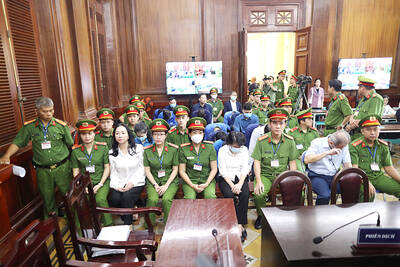
A top Vietnamese property tycoon was on Thursday sentenced to death in one of the biggest corruption cases in history, with an estimated US$27 billion in damages. A panel of three hand-picked jurors and two judges rejected all defense arguments by Truong My Lan, chair of major developer Van Thinh Phat, who was found guilty of swindling cash from Saigon Commercial Bank (SCB) over a decade. “The defendant’s actions ... eroded people’s trust in the leadership of the [Communist] Party and state,” read the verdict at the trial in Ho Chi Minh City. After the five-week trial, 85 others were also sentenced on

Conjoined twins Lori and George Schappell, who pursued separate careers, interests and relationships during lives that defied medical expectations, died this month in Pennsylvania, funeral home officials said. They were 62. The twins, listed by Guinness World Records as the oldest living conjoined twins, died on April 7 at the Hospital of the University of Pennsylvania, obituaries posted by Leibensperger Funeral Homes of Hamburg said. The cause of death was not detailed. “When we were born, the doctors didn’t think we’d make 30, but we proved them wrong,” Lori said in an interview when they turned 50, the Philadelphia Inquirer reported. The
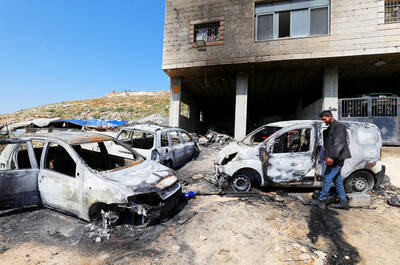
RAMPAGE: A Palestinian man was left dead after dozens of Israeli settlers searching for a missing 14-year-old boy stormed a village in the Israeli-occupied West Bank US President Joe Biden on Friday said he expected Iran to attack Israel “sooner, rather than later” and warned Tehran not to proceed. Asked by reporters about his message to Iran, Biden simply said: “Don’t,” underscoring Washington’s commitment to defend Israel. “We are devoted to the defense of Israel. We will support Israel. We will help defend Israel and Iran will not succeed,” he said. Biden said he would not divulge secure information, but said his expectation was that an attack could come “sooner, rather than later.” Israel braced on Friday for an attack by Iran or its proxies as warnings grew of


 RSS
RSS