


■ Pikastan
Wedding guests die in crash
A speeding bus carrying wedding guests fell from a bridge in eastern Pakistan early yesterday, killing 21 people and injuring 41, police said. The accident occurred near Cheecha Watni, a small town about 130km east of Multan, a main city in Pakistan's eastern Punjab province, said Malik Khuda Bakhsh, the police chief for the area. He said the bride and groom were not in the bus when the accident occurred. The dead included three women, two children and 16 men, Bahksh said. The bus was taking the guests to the groom's home after the ceremony late on Friday at the bride's village, Zafar said.
■ Afghanistan
Journalists' killer sentenced
An Afghan man accused of killing four journalists, including two from Reuters, three years ago was found guilty yesterday and sentenced to death. Reza Khan, 29, was also guilty of raping an Italian woman among the four journalists, and was sentenced to 15 years in prison on that charge, said National Security Court judge Abdul Baset Bakhtari. Khan was also convicted on a separate charge of killing his wife. The four journalists, including Australian television cameraman Harry Burton and Afghan photographer Azizullah Haidari of Reuters, were killed on Nov. 19, 2001, by gunmen at Tangi Abrishum, about 90km east of Kabul. Spanish journalist Julio Fuentes of El Mundo and Italian journalist Maria Grazia Il Cutuli of Corriere della Sera were the other two victims.
■ Australia
Church needs priests
The Catholic Church is advertising abroad for priests to fill vacancies in Outback Australia, news reports said yesterday. The drift away from country town and dwindling numbers in seminaries have combined to leave parishes without priests. Bishop Christopher Tilley from the Forbes-Wilcannia diocese in northern New South Wales told national broadcaster ABC that the tables had been turned on the church in Australia. "Australia is not really producing its own, so we're going to have to get priests to come to Australia from overseas," Bishop Tilley said.
■ Australia
Boy stabbed at posh school
A 14-year-old student stabbed a classmate in the back on Friday at the campus of an exclusive Sydney private school, police said. The victim, also 14, was not seriously wounded, said Christopher Daunt Watney, principal of the SCEGGS Redlands school in an upscale Sydney harborside neighbor-hood. Police arrested the suspected attacker and were questioning him on Friday evening. "The victim is fine, he's got some stitches," Daunt Watney said. He added he did not know of a motive for the attack. "I'm not aware of any pre-existing animosity [between the two boys]," he said.
■ Japan
Jenkins may be released
Former US sergeant Charles Robert Jenkins, who is serving a 30-day confinement term in Japan for deserting to North Korea four decades ago, may be released early for good behavior, Kyodo news agency said yesterday. Kyodo said the 64-year-old Jenkins may be let go as early as the end of this month. Jenkins was given the confinement and a dishonorable discharge from the military at a court martial on Nov. 3 after confessing to deserting to North Korea in 1965 while on patrol near the demilitarized zone between the two Koreas.
■ Germany
Ex-Nazi gets legal boost
A former Nazi commander on trial in Germany for overseeing a massacre in Czechoslovakia at the end of World War II received a legal boost Friday from a 70-year-old woman who witnessed the events. Ladislav Niznansky was the leader of a German-Czech military unit dubbed "Edelweiss," which he said he joined to avoid being sent to a concentration camp after he was caught in an uprising against the occupying Nazi forces. He is accused of responsibility in the murder of 164 people, many of them women and children, in two villages and of ordering the execution of 18 Jews in another village in a region of what is now Slovakia. The woman said the men who had fired on the civilians "wore German uniforms" and spoke only in German. Niznansky and his unit wore Slovakian military attire.
■ Netherlands
Closing dope cafes mulled
The mayor of the Dutch city of Maastricht wants to ban all 16 cannabis cafes in the city center and set up a "weed boulevard" to keep drug tourists and criminals out of town, his spokesman told ANP news agency Friday. Maastricht is close to the border with both Belgium and Germany and attracts almost 1.5 million drug tourists yearly, who flock to the so-called coffee shops where cannabis is sold legally. Most come from Germany and France. Maastricht mayor Gerd Leers wants all coffee shops in the center to move to one location outside of town to limit the nuisance caused by drug tourism.
■ United Kingdom
Drug maker gets jail term
A Briton who manufactured bogus Viagra and the tranquilizer diazepam and sold it internationally was sentenced Friday to 5 1/2 years in prison. Allen Valentine, 44, of Harrow, had pleaded guilty to conspiracy to supply drugs and to two charges of contravening the Trade Marks Act and Medicines Act. Valentine was formerly a salesman for Pfizer Inc, which makes Viagra. Prosecutor Steven Perian said there was evidence of significant "connections" with India, where much of his equipment and base chemicals were bought.
■ France
Music to be played on Titan
When the Cassini-Huygens spacecraft completes its journey to Saturn's moon Titan in January, its probe will carry out many missions -- among them, to boldly blast rock n' roll music where none has been heard before. The US-European vessel, run by NASA, the European Space Agency and the Italian space agency, is carrying a 14-minute CD loaded with music from two little-known French artists who will have the honor of having their tracks broadcast to any alien ears that may be listening.
■ Germany
Elvis exhibition on display
The two years that Elvis Presley spent in Germany as the most famous GI in history are the subject of a new exhibition opening here tomorrow. The organizers are putting on show 300 items from Presley's stay in Friedberg, which left the sleepy town "All Shook Up," to quote one of the King's best-known songs. Fans can see the military-issue bag Elvis was carrying when he arrived in the northern port of Bremerhaven in 1958 to begin his military service, the partially reconstructed barracks hut where he had his regulation army haircut, or the pink Cadillac he drove on days off.
■ United Kingdom
Coffee-beer on the market
Watch out Starbucks. British beermakers are wooing the caffeine-crazed with a new beer made from fair-trade coffee beans, launched yesterday. Coffee beans from the central African country of Rwanda are mixed with barley grown in Britain, creating a beer with the same amount of caffeine in one bottle as in a cup of coffee. Drinkers can get an added buzz from the political correctness of their coffee, labelled fair trade -- meaning it has been grown in conditions which ensure the fair treatment of and living wages for workers in developing countries. British supermarket chain Sainsbury's is exclusively selling "Coffee Beer," which comes on the heels of strawberry and chocolate-flavored brews turned out by the same Meantime Brewery in Greenwich, southeast London.
■ Germany
Shroeder's dog supermodel
German Chancellor Gerhard Schroeder's dog Winston Holly is the face of a new line of pet care products to be launched next month, the Rossman store chain announced Friday. The chain said it will be selling the new range -- including dog shampoo, brushes and fake bones -- in 150 of its estimated 800 stores across Germany. A spokesman said the idea came from the chancellor's wife, Doris Schroeder-Koepf, who was said to be fed up with her border terrier's ability to "chew up certain objects in just a few minutes." The spokesman said the product line of "quality accessories for dogs" was drawn up after about a year of careful research.
■ United States
Charles' last album a hit
The late soul legend Ray Charles is still stirring up the music charts more than five months after his death, with his last album going multi-platinum across the globe. The man dubbed the "genius of soul's" final studio album has now been certified silver, gold and platinum worldwide following his death from liver disease in June, his publicists said. Genius Loves Company, which has featured on the top 10 of the Billboard music charts since its August 31 debut, has shipped more than two million copies in the United States and more than three million worldwide. Charles's 250th album has now gone gold, silver and platinum in North America, Europe and beyond, becoming the best selling recording of his remarkable six-decade career.
■ Peru
New `Kon-Tiki' trip planned
A grandson of Thor Heyerdahl, the Norwegian who 60 years ago sailed from Polynesia to Peru aboard Kon-Tiki, will launch a reenactment of the trip in April 2005 across the Pacific.
Olav Heyerdahl, 27, will set sail with a crew of five from Lima's port of El Callao for Polynesia. Starting on April 28, the crew, which as last time will consist of five Norwegians, one Swede and a parrot, expects to cover a distance of 8,000km from Peru to Polynesia in 101 days, just like Heyerdahl did on his legendary voyage in 1947. Heyerdahl set off on his Pacific crossing on the Kon-Tiki, a raft made of balsa wood and named after the ancient Incan sun god Tiki, to prove that the indigenous population of the Polynesian islands could have originated in Latin America and was not exclusively the result of migration from southeast Asia as prevailing theories held. The extraordinary crossing, in which the crew experienced close-up encounters with whales, giant octopuses and sharks, later became the subject of a book, which has been translated into nearly 70 languages.

Republican US lawmakers on Friday criticized US President Joe Biden’s administration after sanctioned Chinese telecoms equipment giant Huawei unveiled a laptop this week powered by an Intel artificial intelligence (AI) chip. The US placed Huawei on a trade restriction list in 2019 for contravening Iran sanctions, part of a broader effort to hobble Beijing’s technological advances. Placement on the list means the company’s suppliers have to seek a special, difficult-to-obtain license before shipping to it. One such license, issued by then-US president Donald Trump’s administration, has allowed Intel to ship central processors to Huawei for use in laptops since 2020. China hardliners

Conjoined twins Lori and George Schappell, who pursued separate careers, interests and relationships during lives that defied medical expectations, died this month in Pennsylvania, funeral home officials said. They were 62. The twins, listed by Guinness World Records as the oldest living conjoined twins, died on April 7 at the Hospital of the University of Pennsylvania, obituaries posted by Leibensperger Funeral Homes of Hamburg said. The cause of death was not detailed. “When we were born, the doctors didn’t think we’d make 30, but we proved them wrong,” Lori said in an interview when they turned 50, the Philadelphia Inquirer reported. The
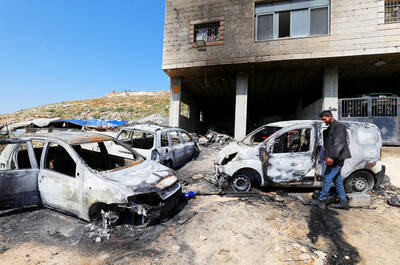
RAMPAGE: A Palestinian man was left dead after dozens of Israeli settlers searching for a missing 14-year-old boy stormed a village in the Israeli-occupied West Bank US President Joe Biden on Friday said he expected Iran to attack Israel “sooner, rather than later” and warned Tehran not to proceed. Asked by reporters about his message to Iran, Biden simply said: “Don’t,” underscoring Washington’s commitment to defend Israel. “We are devoted to the defense of Israel. We will support Israel. We will help defend Israel and Iran will not succeed,” he said. Biden said he would not divulge secure information, but said his expectation was that an attack could come “sooner, rather than later.” Israel braced on Friday for an attack by Iran or its proxies as warnings grew of

A prominent Christian leader has allegedly been stabbed at the altar during a Mass yesterday in southwest Sydney. Bishop Mar Mari Emmanuel was saying Mass at Christ The Good Shepherd Church in Wakeley just after 7pm when a man approached him at the altar and allegedly stabbed toward his head multiple times. A live stream of the Mass shows the congregation swarm forward toward Emmanuel before it was cut off. The church leader gained prominence during the COVID-19 pandemic, amassing a large online following, Officers attached to Fairfield City police area command attended a location on Welcome Street, Wakeley following reports a number


 RSS
RSS