


Rich, intelligent and reasonably photogenic, it is not surprising that France's most media-friendly philosopher is the target of the occasional attack.
But the scale of the assault that is being mounted on Bernard-Henri Levy this autumn has shocked and delighted Paris's literary elite.
Seven books attacking the writer's methods, questioning his intellectual achievements and peering into the origins of his personal fortune are due to be published over the next few months.
Several of the works promise to unmask him as an "intellectual imposter," and a series of libel suits is already under way as he struggles to save his academic reputation from ruin.
For three decades Levy has reigned supreme as the demigod of the television debate show, famous less for his intellectual standpoints than for his beautifully coiffed hair and fondness for displaying more chest than is polite in scholarly circles.
Now his critics are questioning whether BHL, as he is semi-affectionately known, really deserves to occupy the space vacated by Derrida, Sartre, Foucault and other greats of French postwar philosophy.
The authors of a book which dissects his research methods, Le BA BA de BHL (The ABC of BHL), say they were motivated by impatience with his "massive ego," his relentless promotion of himself as "France's greatest intellectual" and with the unquestioning adulation usually accorded him in the French media.
The books reflect an outburst of irritation with the powerful cult of personality Levy has created for himself over the decades, based as much on his glamorous lifestyle as on his publications.
More likely to be feted by Paris Match than by contemporary philosophy journals, Levy appears regularly on the diary pages of French glossy magazines, his arm wrapped around the famously narrow waist of his third wife, the actor Arielle Dombasle.
"It's not possible for the media to hold him up as a great intellectual when he isn't recognized by any philosopher or university," Erwan Poiraud, a professor of political science in Paris, whose doctorate is entitled: "BHL -- a media intellectual," told Le Parisien.
"His strength is in rapid thought. Where a philosopher might take five years to complete a nuanced work, he takes four months to write a book, which comes ready-made for television and radio," Poiraud said.
Richard Labeviere, a journalist with French radio, and Bruno Jeanmart, philosopher at Grenoble University have already finished work on their book, uncompromisingly entitled The Absence of Thought in Bernard-Henri Levy, which concludes that Levy's work is "hollow."
Meanwhile Nicolas Beau, a journalist with the satirical and investigative weekly paper Le Canard Enchainee, has collaborated with another writer Olivier Toscer to produce a study of the origins of the writer's fortune, which is estimated at around euros 150 million (US$191 million).
Much of this wave of interest has been triggered by Levy's controversial book on the murder of the Wall Street Journal reporter in Pakistan, Who Killed Daniel Pearl? Classed a romanquete -- half novel, half investigation -- the book, published last year, upset Pearl's family with its fictionalized recreation of his death and was criticized for its errors and extravagant conclusion -- that Pearl was killed because knew too much about al-Qaeda's attempts to develop nuclear weapons.
Most alarming for Levy is the imminent publication of a book by Philippe Cohen, the co-author of The Hidden Face of Le Monde, a best-selling and aggressive investigation into the newspaper, which caused a sensation last year. The latest work is thought to stretch to more than 500 pages and to analyse the writer's private life in detail.
Levy refused to make any comment on the biographies when contacted on Thursday, but he has told friends that he is not wounded by the onslaught and that he sees this explosion of interest in him as an enormous compliment, pointing out that never before has a single writer attracted so many biographies in such a short period of time. He says that at 56 he has learnt how to deal with criticism.
"When one attacks BHL one does not attack Bernard-Henri Levy ... BHL is a caricature," Levy said recently.

Republican US lawmakers on Friday criticized US President Joe Biden’s administration after sanctioned Chinese telecoms equipment giant Huawei unveiled a laptop this week powered by an Intel artificial intelligence (AI) chip. The US placed Huawei on a trade restriction list in 2019 for contravening Iran sanctions, part of a broader effort to hobble Beijing’s technological advances. Placement on the list means the company’s suppliers have to seek a special, difficult-to-obtain license before shipping to it. One such license, issued by then-US president Donald Trump’s administration, has allowed Intel to ship central processors to Huawei for use in laptops since 2020. China hardliners
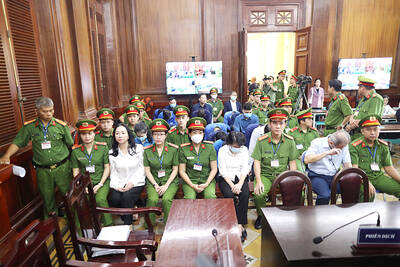
A top Vietnamese property tycoon was on Thursday sentenced to death in one of the biggest corruption cases in history, with an estimated US$27 billion in damages. A panel of three hand-picked jurors and two judges rejected all defense arguments by Truong My Lan, chair of major developer Van Thinh Phat, who was found guilty of swindling cash from Saigon Commercial Bank (SCB) over a decade. “The defendant’s actions ... eroded people’s trust in the leadership of the [Communist] Party and state,” read the verdict at the trial in Ho Chi Minh City. After the five-week trial, 85 others were also sentenced on

‘DELUSIONAL’: Targeting the families of Hamas’ leaders would not push the group to change its position or to give up its demands for Palestinians, Ismail Haniyeh said Israeli aircraft on Wednesday killed three sons of Hamas’ top political leader in the Gaza Strip, striking high-stakes targets at a time when Israel is holding delicate ceasefire negotiations with the militant group. Hamas said four of the leader’s grandchildren were also killed. Ismail Haniyeh’s sons are among the highest-profile figures to be killed in the war so far. Israel said they were Hamas operatives, and Haniyeh accused Israel of acting in “the spirit of revenge and murder.” The deaths threatened to strain the internationally mediated ceasefire talks, which appeared to gain steam in recent days even as the sides remain far
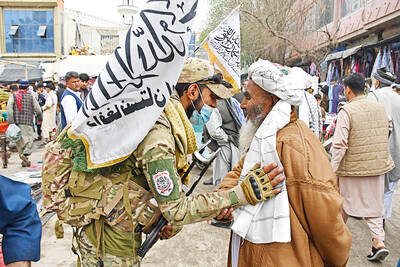
The Taliban’s reclusive supreme leader made a rare public appearance yesterday, an Afghan government spokesman said, leading thousands of worshipers in prayers marking Eid al-Fitr. Hibatullah Akhundzada has made only a handful of public appearances since inheriting the leadership of the Taliban in 2016 and leading the movement back to power with the withdrawal of US forces in 2021. Taliban government spokesman Zabihullah Mujahid said prayer in the largest mosque in Kandahar was “performed under the leadership of the supreme leader.” In a statement on X, he said the early-morning service “was attended by thousands of compatriots” in the southern province considered the


 RSS
RSS