


Smuggling of goods ranging from oil to frozen food is costing China's treasury billions of dollars each year, threatening the national economy and possibly even communist rule despite a marathon crackdown, officials said yesterday.
Customs officials have prosecuted more than 90,000 smuggling cases over the past five years, involving goods worth 200 billion yuan (US$24 billion), said Sheng Guangzu, China's deputy customs minister.
But still, smuggling is "directly affecting national tax revenue, hurting national economic safety, debasing social morality and even endangering our party's ruling basis," said a report issued at a news conference by Sheng.
Customs officials vowed to apply more sophisticated technology and methods against smugglers who they said are getting shrewder and taking advantage of freer trade across the Chinese mainland's frontier with Hong Kong to evade tariffs.
"We will maintain pressure against smuggling activities," said Lu Bing, director-general of the State Administration of Customs.
The communist government launched a sweeping anti-smuggling crackdown in the late 1990s after realizing that the massive loss of import duties could threaten the solvency of China's treasury.
Communist leaders worry that bribery of party officials by smuggling gangs could undermine party control.
Sheng didn't answer a question about how much money the treasury still was losing annually. But he said anti-smuggling efforts have led in recent years to annual increases of 100 billion yuan (US$12 billion) in import duties.
Drugs, guns, sexually explicit films and other contraband make up just a small portion of the goods smuggled into China. The rest includes a wide range of otherwise legal products such as oil, cigarettes, liquor, cars, industrial machinery and frozen food.
Many smuggled goods are brought openly through Chinese ports, with importers either lying about the value of the shipment or bribing Customs inspectors.

Republican US lawmakers on Friday criticized US President Joe Biden’s administration after sanctioned Chinese telecoms equipment giant Huawei unveiled a laptop this week powered by an Intel artificial intelligence (AI) chip. The US placed Huawei on a trade restriction list in 2019 for contravening Iran sanctions, part of a broader effort to hobble Beijing’s technological advances. Placement on the list means the company’s suppliers have to seek a special, difficult-to-obtain license before shipping to it. One such license, issued by then-US president Donald Trump’s administration, has allowed Intel to ship central processors to Huawei for use in laptops since 2020. China hardliners
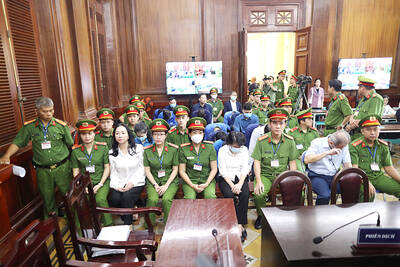
A top Vietnamese property tycoon was on Thursday sentenced to death in one of the biggest corruption cases in history, with an estimated US$27 billion in damages. A panel of three hand-picked jurors and two judges rejected all defense arguments by Truong My Lan, chair of major developer Van Thinh Phat, who was found guilty of swindling cash from Saigon Commercial Bank (SCB) over a decade. “The defendant’s actions ... eroded people’s trust in the leadership of the [Communist] Party and state,” read the verdict at the trial in Ho Chi Minh City. After the five-week trial, 85 others were also sentenced on

‘DELUSIONAL’: Targeting the families of Hamas’ leaders would not push the group to change its position or to give up its demands for Palestinians, Ismail Haniyeh said Israeli aircraft on Wednesday killed three sons of Hamas’ top political leader in the Gaza Strip, striking high-stakes targets at a time when Israel is holding delicate ceasefire negotiations with the militant group. Hamas said four of the leader’s grandchildren were also killed. Ismail Haniyeh’s sons are among the highest-profile figures to be killed in the war so far. Israel said they were Hamas operatives, and Haniyeh accused Israel of acting in “the spirit of revenge and murder.” The deaths threatened to strain the internationally mediated ceasefire talks, which appeared to gain steam in recent days even as the sides remain far
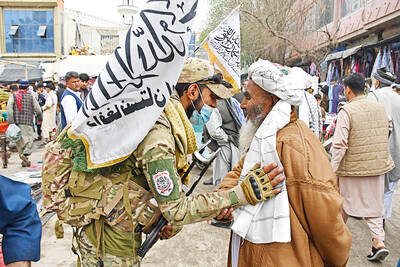
The Taliban’s reclusive supreme leader made a rare public appearance yesterday, an Afghan government spokesman said, leading thousands of worshipers in prayers marking Eid al-Fitr. Hibatullah Akhundzada has made only a handful of public appearances since inheriting the leadership of the Taliban in 2016 and leading the movement back to power with the withdrawal of US forces in 2021. Taliban government spokesman Zabihullah Mujahid said prayer in the largest mosque in Kandahar was “performed under the leadership of the supreme leader.” In a statement on X, he said the early-morning service “was attended by thousands of compatriots” in the southern province considered the


 RSS
RSS