


A Soyuz capsule made a soft landing in the pitch-dark in Kazakhstan's steppes on Sunday, and its US-Russian crew said they were happy to breathe in the smell of Earth after a long stint in orbit.
US astronaut Michael Fincke and Russian Gennady Padalka had manned the 16-nation International Space Station for almost 188 days, while Russian Yuri Shargin spent just 10 days there.
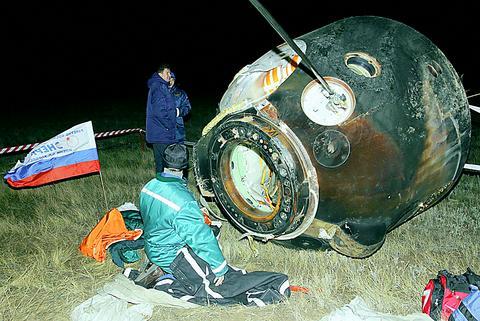
PHOTO: AFP
The returning crew precisely on time and on target, 88km north of the Kazakh town of Arkalyk.
"We were very happy to be home," a smiling and relaxed Fincke told a news briefing later. "When they opened the hatch, there was such a beautiful smell that we knew we'd come home."
Once he was recovered from the capsule, Fincke called his family via satellite phone.
"Hi, baby," he exclaimed with joy.
Seated in a chair next to the charred black Soyuz TMA-4 capsule, Fincke said he had been exhilarated by its re-entry into the atmosphere.
"It was like fireworks," he quipped.
Despite their landing in the dark, which complicated the search and rescue operation, and a chilly and rainy morning with squalls of wind, an upbeat Padalka said the crew had been touched by "the warmth of reception" on Earth.
The crew were treated to hot tea and then underwent medical checks in an inflatable field hospital.
Fincke looked amazingly fit for a person who had just spent six months in orbit where muscles atrophy in weightlessness. He adroitly alighted from a helicopter and tried to walk on his own when the crew were flown to the regional capital Kustanai later.
Helicopters with medical staff and recovery teams hovered above the capsule while they waited for daylight to be able to land, a spokesman for mission control said.
Scores of Russian space and military specialists and a fleet of planes and helicopters had taken up position for the pre-dawn landing, ready to take fast action if the capsule veered off its course and fell off target as happened in May last year.
"It's great to see the Expedition Nine team come home," Bill Gerstenmayer, ISS program manager, told reporters. "It's an amazing testimony to Russia's space program and to the design of this capsule, which has been around so long."
Russian spacecraft have become the sole means of sending crews and cargo to the ISS since February 2003, when the US space shuttle fleet was grounded after the Columbia craft disintegrated over Texas, killing all seven people on board.
Shuttle flights may resume in May or June next year, US space officials say.
Padalka and Fincke each made four spacewalks -- instead of the originally planned two -- and each time in Russian-made suits. Fincke's first spacewalk in a US suit ended abruptly after it showed a pressure drop in his oxygen tank.
During their accident-prone mission, the US-Russian crew had twice lost the station's orientation in space, and on one occasion mission control briefly lost all contact with them.

Republican US lawmakers on Friday criticized US President Joe Biden’s administration after sanctioned Chinese telecoms equipment giant Huawei unveiled a laptop this week powered by an Intel artificial intelligence (AI) chip. The US placed Huawei on a trade restriction list in 2019 for contravening Iran sanctions, part of a broader effort to hobble Beijing’s technological advances. Placement on the list means the company’s suppliers have to seek a special, difficult-to-obtain license before shipping to it. One such license, issued by then-US president Donald Trump’s administration, has allowed Intel to ship central processors to Huawei for use in laptops since 2020. China hardliners

DISADVANTAGE: Erin O’Toole, who led the Conservatives during the election campaign in 2021, estimated that the interference cost his party as many as nine legislative seats Canada’s domestic spy agency on Monday concluded that China interfered in the past two elections, an official probe heard, the firmest evidence so far of suspected Chinese meddling in Canadian politics. Canadian Prime Minister Justin Trudeau’s Liberal Party won both the elections, held in 2019 and 2021. Under pressure from opposition lawmakers unhappy about media reports on China’s possible role, Trudeau set up a commission into foreign interference. The commission was shown a slide on Monday containing an extract of a briefing in February last year from the Canadian Security Intelligence Service (CSIS). “We know that the PRC [People’s Republic of China] clandestinely
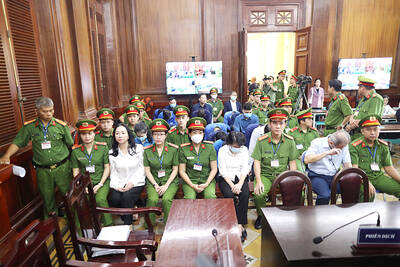
A top Vietnamese property tycoon was on Thursday sentenced to death in one of the biggest corruption cases in history, with an estimated US$27 billion in damages. A panel of three hand-picked jurors and two judges rejected all defense arguments by Truong My Lan, chair of major developer Van Thinh Phat, who was found guilty of swindling cash from Saigon Commercial Bank (SCB) over a decade. “The defendant’s actions ... eroded people’s trust in the leadership of the [Communist] Party and state,” read the verdict at the trial in Ho Chi Minh City. After the five-week trial, 85 others were also sentenced on

‘DELUSIONAL’: Targeting the families of Hamas’ leaders would not push the group to change its position or to give up its demands for Palestinians, Ismail Haniyeh said Israeli aircraft on Wednesday killed three sons of Hamas’ top political leader in the Gaza Strip, striking high-stakes targets at a time when Israel is holding delicate ceasefire negotiations with the militant group. Hamas said four of the leader’s grandchildren were also killed. Ismail Haniyeh’s sons are among the highest-profile figures to be killed in the war so far. Israel said they were Hamas operatives, and Haniyeh accused Israel of acting in “the spirit of revenge and murder.” The deaths threatened to strain the internationally mediated ceasefire talks, which appeared to gain steam in recent days even as the sides remain far


 RSS
RSS