


In a blow to international efforts to forge multiethnic harmony in Kosovo, the vast majority of Serbs boycotted the province's general elections.
Election officials estimated turnout in Saturday's election at 53 percent, but the absence of Kosovo Serb voters underscored the deep divisions between the province's ethnic Albanian majority and Serb minority. Local Serb leaders had called for a boycott, citing a lack of security.
Turnout in the general elections three years ago was about 64 percent. Saturday's vote represented the second general election in beleaguered Kosovo, where an unemployment rate estimated at 60 percent has exacerbated political and economic woes in the province.
Kosovo's ethnic Albanians viewed Saturday's elections as means to further their goal of securing independence. Kosovo Serbs and Belgrade want the province to remain part of Serbia-Montenegro, the successor to Yugoslavia.
Lawmakers elected Saturday are likely to lead the province into UN-led talks on its future. The talks are expected to begin the middle of next year if the province makes progress in fields such as the rule of law and protection of minorities.
Preliminary results were expected today; final results a week later.
An independent group that monitored ballot counting in 17 percent of the polling stations said the results appeared to be similar to those from the election held three years ago.
The Pristina-based Council for the Defense of Human Rights and Freedoms projected that Kosovo's biggest party, the Democratic League of Kosovo led by moderate President Ibrahim Rugova captured 47 percent of the vote -- too little to govern alone.
The projection indicated that the Democratic Party of Kosovo placed second with 27 percent, followed by the Alliance for the Future of Kosovo with 8 percent. Both parties are led by former rebel leaders.
Ibrahim Makolli, a CDHRF official, said the projection had a margin of error of 0.5 percentage point.
Kosovo was placed under UN and NATO rule in 1999, after an alliance air war ended former Yugoslav President Slobodan Milosevic's crackdown on independence-minded ethnic Albanians.
The 1998-99 war killed an estimated 10,000 people, mainly ethnic Albanians.
Though the UN mission here holds ultimate power, the 120-seat assembly elected Saturday -- and the president and government it chooses -- holds some authority. Ten assembly seats are reserved for the Serb minority -- about 100,000 of Kosovo's 2 million people.
The election came seven months after mobs of ethnic Albanians attacked Serbs and their property in riots that killed 19 people and injured more than 900 others. The violence was the worst since the 1998-99 Kosovo war.
After the voting ended, Kosovo's top UN administrator, Soeren Jessen-Petersen, said he thought many Kosovo Serbs were pressured to avoid the polls.
But despite "the low turnout, we have legitimate elected representatives of the Kosovo Serbs," he added.
Serb leader and boycott organizer Milan Ivanovic estimated the Serb turnout at three-tenths of a percent, and described the boycott as successful.
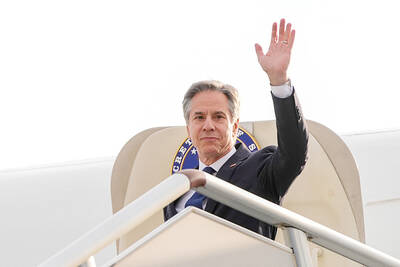
‘IN A DIFFERENT PLACE’: The envoy first visited Shanghai, where he attended a Chinese basketball playoff match, and is to meet top officials in Beijing tomorrow US Secretary of State Antony Blinken yesterday arrived in China on his second visit in a year as the US ramps up pressure on its rival over its support for Russia while also seeking to manage tensions with Beijing. The US diplomat tomorrow is to meet China’s top brass in Beijing, where he is also expected to plead for restraint as Taiwan inaugurates president-elect William Lai (賴清德), and to raise US concerns on Chinese trade practices. However, Blinken is also seeking to stabilize ties, with tensions between the world’s two largest economies easing since his previous visit in June last year. At the
Nearly half of China’s major cities are suffering “moderate to severe” levels of subsidence, putting millions of people at risk of flooding, especially as sea levels rise, according to a study of nationwide satellite data released yesterday. The authors of the paper, published by the journal Science, found that 45 percent of China’s urban land was sinking faster than 3mm per year, with 16 percent at more than 10mm per year, driven not only by declining water tables, but also the sheer weight of the built environment. With China’s urban population already in excess of 900 million people, “even a small portion

UNSETTLING IMAGES: The scene took place in front of TV crews covering the Trump trial, with a CNN anchor calling it an ‘emotional and unbelievably disturbing moment’ A man who doused himself in an accelerant and set himself on fire outside the courthouse where former US president Donald Trump is on trial has died, police said yesterday. The New York City Police Department (NYPD) said the man was declared dead by staff at an area hospital. The man was in Collect Pond Park at about 1:30pm on Friday when he took out pamphlets espousing conspiracy theories, tossed them around, then doused himself in an accelerant and set himself on fire, officials and witnesses said. A large number of police officers were nearby when it happened. Some officers and bystanders rushed

Beijing is continuing to commit genocide and crimes against humanity against Uyghurs and other Muslim minorities in its western Xinjiang province, U.S. Secretary of State Antony Blinken said in a report published on Monday, ahead of his planned visit to China this week. The State Department’s annual human rights report, which documents abuses recorded all over the world during the previous calendar year, repeated language from previous years on the treatment of Muslims in Xinjiang, but the publication raises the issue ahead of delicate talks, including on the war in Ukraine and global trade, between the top U.S. diplomat and Chinese


 RSS
RSS