


Humanity's reliance on fossil fuels, the spread of cities, the destruction of natural habitats for farmland and over-exploitation of the oceans are destroying Earth's ability to sustain life, the environmental group World Wildlife Fund (WWF) has warned in a new report.
The biggest consumers of non-renewable natural resources are the United Arab Emirates, the US, Kuwait, Australia and Sweden, who leave the biggest "ecological footprint," WWF said in its regular Living Planet Report released on Thursday.
Humans currently consume 20 percent more natural resources than the Earth can produce, the report said.
"We are spending nature's capital faster than it can regenerate," WWF chief Claude Martin said. "We are running up an ecological debt which we won't be able to pay off unless governments restore the balance between our consumption of natural resources and the Earth's ability to renew them."
But Fred Smith, president of the Washington-based Competitive Enterprise Institute and a former official of the US Environmental Protection Agency during the Nixon and Ford administrations, said he was skeptical. In a telephone interview, Smith said the WWF view is "static" and fails to take into account the benefits many people get from resource use.
Use of fossil fuels such as coal, gas and oil increased by almost 700 percent between 1961 and 2001, the study said.
Burning fossil fuels -- in power plants and automobiles, for example -- releases carbon dioxide, which experts say contributes to global warming. The planet is unable to keep pace and absorb the emissions, WWF said.
Populations of land, freshwater and marine species fell on average by 40 percent between 1970 and 2000. The report cited urbanization, forest clearance, pollution, over-fishing and the introduction by humans of non-native animals, such as cats and rats, which often drive out indigenous species.
"The question is how the world's entire population can live with the resources of one planet," said Jonathan Loh, one of the report's authors.
The study, WWF's fifth since 1998, examined the "ecological footprint" of the planet's entire population.
Most of a person's footprint is caused by the space needed to absorb the waste from energy consumption, including carbon dioxide. WWF also measured the total area of cities, roads and other infrastructure and the space required to produce food and fiber -- for clothing, for example.
"We don't just live on local resources," so the footprint is not confined to the country where consumers live, said Mathis Wacknagel, head of the Global Footprint Network, which includes WWF.
For example, Western demand for Asian palm oil and South American soybeans has wrecked natural habitats in those regions, so the des-truction is considered part of the footprint of importing nations. The same applies to Arab oil consumed in the US.
The findings are similar to those in WWF's 2002 report, which covered the period up to 1999. But the latest study contains more detailed data stretching to 2001. It shows the situation has changed little in most countries and is now more worrying in fast-growing China and India.
The world's 6.1 billion people leave a collective footprint of 13.5 billion hectares, or just over two hectares per person. To allow the Earth to regenerate, the average per person should be no more than 1.8 hectares, WWF said.
The impact of an average North American is double that of a European, but seven times that of the average Asian or African.
Residents of the United Arab Emirates, who use air conditioning extensively, leave a 9.9-hectare footprint, two-thirds caused by fossil fuel use.
The average US resident leaves a 9.5-hectare footprint, also largely from fuel.

Republican US lawmakers on Friday criticized US President Joe Biden’s administration after sanctioned Chinese telecoms equipment giant Huawei unveiled a laptop this week powered by an Intel artificial intelligence (AI) chip. The US placed Huawei on a trade restriction list in 2019 for contravening Iran sanctions, part of a broader effort to hobble Beijing’s technological advances. Placement on the list means the company’s suppliers have to seek a special, difficult-to-obtain license before shipping to it. One such license, issued by then-US president Donald Trump’s administration, has allowed Intel to ship central processors to Huawei for use in laptops since 2020. China hardliners

Conjoined twins Lori and George Schappell, who pursued separate careers, interests and relationships during lives that defied medical expectations, died this month in Pennsylvania, funeral home officials said. They were 62. The twins, listed by Guinness World Records as the oldest living conjoined twins, died on April 7 at the Hospital of the University of Pennsylvania, obituaries posted by Leibensperger Funeral Homes of Hamburg said. The cause of death was not detailed. “When we were born, the doctors didn’t think we’d make 30, but we proved them wrong,” Lori said in an interview when they turned 50, the Philadelphia Inquirer reported. The
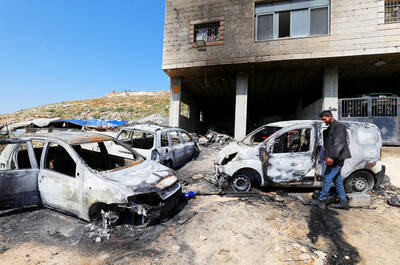
RAMPAGE: A Palestinian man was left dead after dozens of Israeli settlers searching for a missing 14-year-old boy stormed a village in the Israeli-occupied West Bank US President Joe Biden on Friday said he expected Iran to attack Israel “sooner, rather than later” and warned Tehran not to proceed. Asked by reporters about his message to Iran, Biden simply said: “Don’t,” underscoring Washington’s commitment to defend Israel. “We are devoted to the defense of Israel. We will support Israel. We will help defend Israel and Iran will not succeed,” he said. Biden said he would not divulge secure information, but said his expectation was that an attack could come “sooner, rather than later.” Israel braced on Friday for an attack by Iran or its proxies as warnings grew of

A prominent Christian leader has allegedly been stabbed at the altar during a Mass yesterday in southwest Sydney. Bishop Mar Mari Emmanuel was saying Mass at Christ The Good Shepherd Church in Wakeley just after 7pm when a man approached him at the altar and allegedly stabbed toward his head multiple times. A live stream of the Mass shows the congregation swarm forward toward Emmanuel before it was cut off. The church leader gained prominence during the COVID-19 pandemic, amassing a large online following, Officers attached to Fairfield City police area command attended a location on Welcome Street, Wakeley following reports a number


 RSS
RSS