


Interior ministers from the five largest western European states agreed to adopt the use of digital fingerprinting on passports, officials said, but a second day of talks yesterday found them still deadlocked on a controversial plan to create migrant holding centers in Africa.
Italian interior ministry officials said there was broad agreement on the introduction of digital fingerprinting and face recognition biometrics for all EU pass-ports to make them more difficult to forge.
Most of the groundwork for the digital passports was discussed at the last interior ministers meeting in Sheffield, England, in July. According to Italian officials, the measure would be in force "before the end of 2006."
Italian Interior Minister Giuseppe Pisanu is hosting his counterparts David Blunkett of Britain, Otto Schily of Germany, Dominique de Villepin of France and Jose Antonio Alonso of Spain at the talks. The ministers were to hold a press conference at the end of their talks yesterday.
But they remained deeply split over a controversial plan to create holding centers for Europe-bound migrants in Africa.
France and Spain are fiercely opposed to the plan, first mooted in August, and two working sessions on Sunday failed to placate their officials.
French sources said the participants were as far apart as ever on a joint German-Italian plan to create the centers in a bid to stem a seemingly unstoppable tide of immigration from North Africa.
France and Spain have meanwhile proposed "contact points" with the transit countries, mainly in North Africa, where requests for asylum in a third country could be examined.
But Paris rejected the idea of transit camps, fearing the proposed desert information centers "could become a sort of time-bomb for our countries," a French diplomatic source said.
Such camps would have "a perverse effect" and residents "would come to hate Europe," the source added.
Several ministers held bilateral talks on Sunday night and scheduled more for early yesterday in a bid to find a compromise.
Alonso said that Madrid "fears that these camps could become places where human rights would not be respected."
Human-rights organizations liken the idea to creating "concentration camps" in the desert.
"We doubt that the centers will be an obstacle to illegal immigration," Alonso said. "We have not found a solution to the fundamental points and those are: who ends up in these centers, who is looking for political asylum, who is fleeing poverty, who will run them? And what do the countries who must host [the centers] think?"

Republican US lawmakers on Friday criticized US President Joe Biden’s administration after sanctioned Chinese telecoms equipment giant Huawei unveiled a laptop this week powered by an Intel artificial intelligence (AI) chip. The US placed Huawei on a trade restriction list in 2019 for contravening Iran sanctions, part of a broader effort to hobble Beijing’s technological advances. Placement on the list means the company’s suppliers have to seek a special, difficult-to-obtain license before shipping to it. One such license, issued by then-US president Donald Trump’s administration, has allowed Intel to ship central processors to Huawei for use in laptops since 2020. China hardliners

Conjoined twins Lori and George Schappell, who pursued separate careers, interests and relationships during lives that defied medical expectations, died this month in Pennsylvania, funeral home officials said. They were 62. The twins, listed by Guinness World Records as the oldest living conjoined twins, died on April 7 at the Hospital of the University of Pennsylvania, obituaries posted by Leibensperger Funeral Homes of Hamburg said. The cause of death was not detailed. “When we were born, the doctors didn’t think we’d make 30, but we proved them wrong,” Lori said in an interview when they turned 50, the Philadelphia Inquirer reported. The
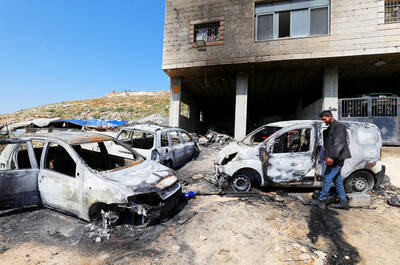
RAMPAGE: A Palestinian man was left dead after dozens of Israeli settlers searching for a missing 14-year-old boy stormed a village in the Israeli-occupied West Bank US President Joe Biden on Friday said he expected Iran to attack Israel “sooner, rather than later” and warned Tehran not to proceed. Asked by reporters about his message to Iran, Biden simply said: “Don’t,” underscoring Washington’s commitment to defend Israel. “We are devoted to the defense of Israel. We will support Israel. We will help defend Israel and Iran will not succeed,” he said. Biden said he would not divulge secure information, but said his expectation was that an attack could come “sooner, rather than later.” Israel braced on Friday for an attack by Iran or its proxies as warnings grew of

IN PURSUIT: Israel’s defense minister said the revenge attacks by Israeli settlers would make it difficult for security forces to find those responsible for the 14-year-old’s death Israeli Prime Minister Benjamin Netanyahu on Saturday condemned the “heinous murder” of an Israeli teenager in the occupied West Bank as attacks on Palestinian villages intensified following news of his death. After Benjamin Achimeir, 14, was reported missing near Ramallah on Friday, hundreds of Jewish settlers backed by Israeli forces raided nearby Palestinian villages, torching vehicles and homes, leaving at least one villager dead and dozens wounded. The attacks escalated in several villages on Saturday after Achimeir’s body was found near the Malachi Hashalom outpost. Agence France-Presse correspondents saw smoke rising from burned houses and fields. Mayor Amin Abu Alyah, of the


 RSS
RSS