


So indecent was his younger brother's death that Idris Yusuf Ghodawala never imagined the indignity that was to follow.
On March 1, 2002, as Hindu-Muslim riots convulsed the state of Gujarat, a Hindu mob armed with shiny new swords set upon Imran Ghodawala, an 18-year-old Muslim, dragged him into the Rabbani mosque and burned him to death. Idris, hiding on a balcony next door, saw the attack and then the smoke billowing from the mosque.
When Idris Ghodawala went to the police to claim Imran's remains, he said the top local police officer, a Hindu named R.J. Patil, told him there were no remains to claim. Patil had burned them, knowing full well that Muslims, unlike Hindus, bury their dead.
The sacrilege still makes Ghodawala, 31, weep.
"We are Muslims, and they burned our body," he said.
Patil's action appears to have been part of a broader effort to conceal evidence and thwart prosecutions after the riots in Gujarat state, which left at least 1,100 Muslims dead and up to 600 missing. Ghodawala could name four members of the mob that killed his brother, two of whom he had played cricket with as a child. But he said Patil refused to let him name names, or even file a complaint. So Ghodawala's case essentially disappeared, as did thousands of others stemming from the riots.
In a state controlled by Hindu nationalists, the police either refused to register the names of the accused or simply summarily closed cases; prosecutors did not oppose bail for suspects, and judges delivered acquittals in cases where dozens of people died.
Only a small number of Hindus have been convicted for any action in the riots, although the Supreme Court has now intervened to force more than 2,000 cases that had been closed to be re-examined and at least two retried.
What happened in this area was typical except in one respect. Late last year, Neeraja Gotru Rao, a policewoman of uncommon courage, arrived here after being sent by the state police to reinvestigate the cases. Her work led to the arrests of about 30 suspects, including the personal assistant to a state government minister.
It also led to the arrest of Patil on suspicion of destroying evidence by burning the remains of Imran Ghodawala and at least 12 other Muslims.
The fate of these two police officers, whose interpretation of duty so diverged, will test more than whether justice will be done in the riots, which were set off by the immolation on Feb. 27, 2002, of 59 Hindus in a train carriage.
It may also determine whether Muslims here can once again believe in the impartiality of the Indian state.
On a recent afternoon, the corpulent Patil was found not in jail, but sipping tea in his pajamas in the local government hospital.
The minister's personal assistant and another well-connected accused person -- all three ostensibly under arrest -- were with him. Pleading illness, they were seeking bail from the comfort of the hospital.
Rao, meanwhile, was back in Ahmedabad, having been ordered by the Gujarat state police to wrap up her unfinished work. She is not granting interviews, but victims and their advocates say the order is another effort to thwart prosecutions.
"She was removed because she was doing good work," Ghodawala said. "And because she said she would try to find out who were the superior officers who gave the orders. Now I don't think anybody will take up this case." The director general of the Gujarat police says that Rao, who is Hindu, was taking too long with her work, and that her investigation was finished.

Republican US lawmakers on Friday criticized US President Joe Biden’s administration after sanctioned Chinese telecoms equipment giant Huawei unveiled a laptop this week powered by an Intel artificial intelligence (AI) chip. The US placed Huawei on a trade restriction list in 2019 for contravening Iran sanctions, part of a broader effort to hobble Beijing’s technological advances. Placement on the list means the company’s suppliers have to seek a special, difficult-to-obtain license before shipping to it. One such license, issued by then-US president Donald Trump’s administration, has allowed Intel to ship central processors to Huawei for use in laptops since 2020. China hardliners

Conjoined twins Lori and George Schappell, who pursued separate careers, interests and relationships during lives that defied medical expectations, died this month in Pennsylvania, funeral home officials said. They were 62. The twins, listed by Guinness World Records as the oldest living conjoined twins, died on April 7 at the Hospital of the University of Pennsylvania, obituaries posted by Leibensperger Funeral Homes of Hamburg said. The cause of death was not detailed. “When we were born, the doctors didn’t think we’d make 30, but we proved them wrong,” Lori said in an interview when they turned 50, the Philadelphia Inquirer reported. The
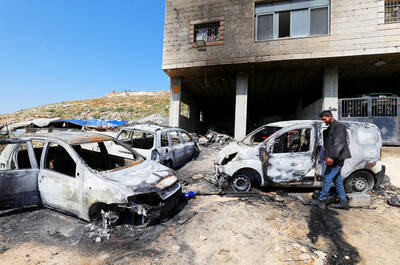
RAMPAGE: A Palestinian man was left dead after dozens of Israeli settlers searching for a missing 14-year-old boy stormed a village in the Israeli-occupied West Bank US President Joe Biden on Friday said he expected Iran to attack Israel “sooner, rather than later” and warned Tehran not to proceed. Asked by reporters about his message to Iran, Biden simply said: “Don’t,” underscoring Washington’s commitment to defend Israel. “We are devoted to the defense of Israel. We will support Israel. We will help defend Israel and Iran will not succeed,” he said. Biden said he would not divulge secure information, but said his expectation was that an attack could come “sooner, rather than later.” Israel braced on Friday for an attack by Iran or its proxies as warnings grew of

A prominent Christian leader has allegedly been stabbed at the altar during a Mass yesterday in southwest Sydney. Bishop Mar Mari Emmanuel was saying Mass at Christ The Good Shepherd Church in Wakeley just after 7pm when a man approached him at the altar and allegedly stabbed toward his head multiple times. A live stream of the Mass shows the congregation swarm forward toward Emmanuel before it was cut off. The church leader gained prominence during the COVID-19 pandemic, amassing a large online following, Officers attached to Fairfield City police area command attended a location on Welcome Street, Wakeley following reports a number


 RSS
RSS