


Despite all the vows of "never again" after the Florida fiasco of 2000, the scary scenarios for Election Day 2004 seem only to have increased: A tie vote in the Electoral College. A terrorist strike on Election Day. A disputed outcome in a critical state.
"When we talk about it around here, we just sigh," says Walter Berns, a scholar at the American Enterprise Institute and an expert on the Electoral College. "I just hope it's a clear victory so we don't have Florida all over again all over the place."
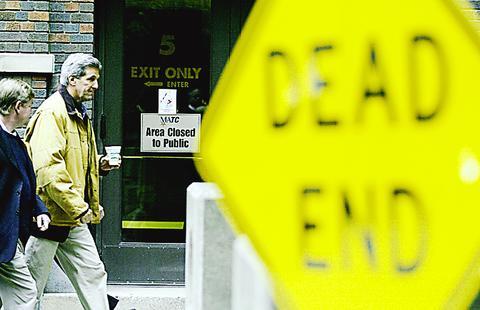
PHOTO: AP
With the electorate sharply divided, the chance of a deadlock in the Electoral College seems all the more real this time after the long-in-limbo outcome of 2000. The National Archives offers an "Electoral College calculator" on its Web site so armchair prognosticators can see just how easy it could be to have the candidates come out even.
For example, if just New Hampshire and Nevada (or West Virginia) shifted from favoring US President George W. Bush to the Democrats this time, there could be a 269-269 tie, leaving it to the House to pick the next president and the Senate to pick the new vice president come January.
That would leave open the jarring possibility of a Bush-Edwards or Kerry-Cheney pairing, depending on the political leanings of the new House and Senate.
More likely is the chance that results from one or more states could be up in the air for a while because of a recount, challenges to provisional or absentee ballots or lawsuits related to other voting problems. Both parties have lawyers primed to pounce at any target of opportunity this time. And the opportunity for challenges has grown under a new federal law requiring all states to allow people to cast provisional votes if their names don't appear on registration rolls.
"With objections raised and legal teams in place, we could have a hell of a fight," said Thomas Mann, a presidential scholar at the Brookings Institution.
Michael White, the federal official responsible for coordinating certain aspects of the Electoral College, says he'll be keeping an especially close eye on Colorado, where voters are considering a referendum to divide the state's electoral votes proportionally among the candidates rather than using the existing winner-takes-all formula. A lawsuit is virtually guaranteed if the referendum is approved, meaning the state's nine electoral votes could be a lingering question long after Election Day.
"That's kind of the nightmare scenario, having the whole thing up in the air on election night," White said.
The US presidential election is decided by electoral votes, with each state guaranteed two electoral votes and apportioned additional votes based on population. Winning a state, even by the smallest of margins, entitles a candidate to all of that state's electoral votes -- except in two states, Nebraska and Maine. Those states split their electoral votes, awarding two to the candidate who wins the popular vote across the state and one to the popular-vote winner in each congressional district.
It takes a majority, or 270 of 538 electoral votes, to win the presidency.
Another quirk involves "faithless electors," who refuse to cast their electoral votes for the person chosen by their state's voters. This rarely happens -- only 10 times in history -- but even one this year could be critical. And one of the five Republican electors from West Virginia is holding out the possibility of withholding his vote for Bush if the president carries the state.
The notion of a split decision between the popular vote and the Electoral College tally, which seemed rather unlikely before 2000, now is almost old hat. Mann, for his part, hopes that if this election splits the opposite way from 2000 -- with Bush winning the popular vote and Kerry the electoral count -- it might ignite a movement to junk the Electoral College altogether.
The idea got some traction after the 2000 vote, but lost momentum when small states raised objections and got sidelined altogether when priorities shifted after the attacks of Sept. 11, 2001.
Those attacks, meanwhile, have given rise to a whole new catalog of nightmare scenarios associated with terrorism. The notion was reinforced when 191 people in Madrid were killed in terrorist bombings last March just three days before Spain's elections.
Most people have forgotten, if they ever knew it, that 9/11 was a local election day in New York City. Governor George Pataki postponed the balloting for two weeks.
It would be a far more complicated matter to postpone presidential voting in all or part of the nation.

Republican US lawmakers on Friday criticized US President Joe Biden’s administration after sanctioned Chinese telecoms equipment giant Huawei unveiled a laptop this week powered by an Intel artificial intelligence (AI) chip. The US placed Huawei on a trade restriction list in 2019 for contravening Iran sanctions, part of a broader effort to hobble Beijing’s technological advances. Placement on the list means the company’s suppliers have to seek a special, difficult-to-obtain license before shipping to it. One such license, issued by then-US president Donald Trump’s administration, has allowed Intel to ship central processors to Huawei for use in laptops since 2020. China hardliners
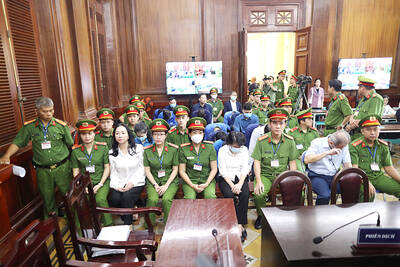
A top Vietnamese property tycoon was on Thursday sentenced to death in one of the biggest corruption cases in history, with an estimated US$27 billion in damages. A panel of three hand-picked jurors and two judges rejected all defense arguments by Truong My Lan, chair of major developer Van Thinh Phat, who was found guilty of swindling cash from Saigon Commercial Bank (SCB) over a decade. “The defendant’s actions ... eroded people’s trust in the leadership of the [Communist] Party and state,” read the verdict at the trial in Ho Chi Minh City. After the five-week trial, 85 others were also sentenced on

‘DELUSIONAL’: Targeting the families of Hamas’ leaders would not push the group to change its position or to give up its demands for Palestinians, Ismail Haniyeh said Israeli aircraft on Wednesday killed three sons of Hamas’ top political leader in the Gaza Strip, striking high-stakes targets at a time when Israel is holding delicate ceasefire negotiations with the militant group. Hamas said four of the leader’s grandchildren were also killed. Ismail Haniyeh’s sons are among the highest-profile figures to be killed in the war so far. Israel said they were Hamas operatives, and Haniyeh accused Israel of acting in “the spirit of revenge and murder.” The deaths threatened to strain the internationally mediated ceasefire talks, which appeared to gain steam in recent days even as the sides remain far
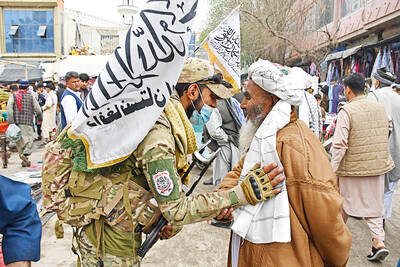
The Taliban’s reclusive supreme leader made a rare public appearance yesterday, an Afghan government spokesman said, leading thousands of worshipers in prayers marking Eid al-Fitr. Hibatullah Akhundzada has made only a handful of public appearances since inheriting the leadership of the Taliban in 2016 and leading the movement back to power with the withdrawal of US forces in 2021. Taliban government spokesman Zabihullah Mujahid said prayer in the largest mosque in Kandahar was “performed under the leadership of the supreme leader.” In a statement on X, he said the early-morning service “was attended by thousands of compatriots” in the southern province considered the


 RSS
RSS