


Tanik Koizev wanders through the burned-out gymnasium of the school where hundreds of hostages died during a terrifying siege in September.
Last week he finally buried his niece, after a delay in identifying her disfigured body. And when a 40-day mourning period ends today, he and others from Beslan have vowed to bury members of the Ingush ethnic group to avenge more than 330 people -- more than half of them children -- who died in the gunfire and explosions.
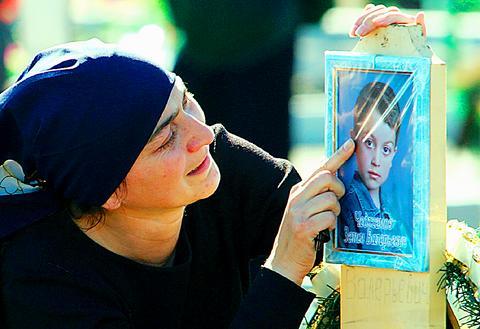
PHOTO: AP
The Sept. 3 attack was carried out by a band of militants with links to Chechen rebels, some of whom came from the province of Ingushetia, which borders this province of North Ossetia.
Russians traditionally observe 40 days of mourning after deaths, and Ossetians say the end of the mourning period could herald an outbreak of interethnic violence among Ossetians and ethnic Ingush who live here.
"There will be violence. It won't be noisy. It will be quiet -- one person at a time," said Koizev as he wandered through the husk of the school, stepping over flowers and stuffed animals left in memory of the victims.
Although Koizev's 12-year-old daughter was among the hostages, she survived. But that hasn't softened his anger.
"They say, `Forgive, forgive.' How do you forgive something like this? How do you explain this? Forgive? No way," Koizev said.
"It's not a secret that we are waiting" for the end of the mourning period, said Sergei Tandaleyev, 67, of Sunja.
"We will demand that [the Ingush] leave. All of them," he said. If they don't, "there will be war."
Venom and fear run deep between the Ingush and the Ossetians, two of the myriad of ethnic groups that mix uneasily here. The Russian Caucasus region also includes Chechnya, where separatist rebels have been fighting Russian forces for more than five years.
Chechen warlord Shamil Ba-sayev reportedly claimed responsibility for the school seizure and said at least nine of the 32 assailants were ethnic Ingush.
The Ingush are predominantly Muslim and are closely related to the Chechens. Ossetians are overwhelmingly Christian and historically have had close ties with Russia.
The Ingush and Chechens share another connection: members of both communities were exiled en masse to Central Asia under Soviet dictator Josef Stalin.
In 1992, after the collapse of the Soviet Union, thousands of Ingush who had returned from exile were evicted from their homes in towns around the North Ossetian capital, their belongings looted and their houses burnt. Hundreds died in 10 days of fighting.
Thousands of Ingush remain in squalid, makeshift towns and refugee camps on the border between North Ossetia and Ingushetia. Those who remain in North Ossetia are subject to harassment, discrimination and -- since Beslan -- death threats. Many Ingush still claim title to land and homes now occupied by Ossetians.
Last month, Ruslan Aushev, a former president of Ingushetia, warned that revenge attacks could destabilize the entire Caucasus region. He appealed to authorities to try to soothe the anger of relatives of the Beslan victims.
But many Ossetians say they are cleaning their guns, many of which were acquired during the last bout of violence in 1992.
Russian authorities have vowed to prevent revenge attacks, dis-patching hundreds of extra police and troops to the region. President Vladimir Putin has said anyone who commits revenge attacks would be siding with the Beslan terrorists.
Meanwhile, frightened Ingush youth have left universities here. Ingush parents are afraid to let their children go to school with Ossetian children.
In the ramshackle border town of Maiski, east of Beslan, some 240 Ingush families live in houses made of tarpaper, plastic tarpaulins, particle board and blankets. Wires hang haphazardly above dirt paths where filthy children run amid cows and chickens. Water comes from a leaky corrugated metal tank.
Resident Mubari Azdoyev, 45, says he sympathizes with those who died at Beslan, but he angrily recalls how Ossetians forced him and his family to flee their home near Vladikavkaz in 1992.
"All the world watched Beslan suffer. They gave money. They sent help. And where was the world 12 years ago, when they shot our sons in front of our eyes?" Azdoyev said. "In 1992, it was worse than in Beslan."
At School No. 1, the gymnasium walls are lined inside and out with rows of flower wreaths, and scrawled with graffiti including: "Answer for the children."
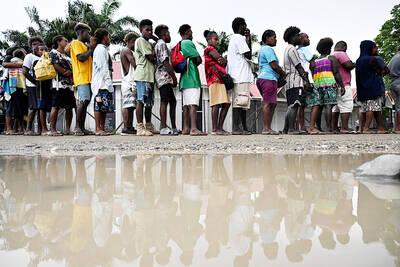
SEEKING CHANGE: A hospital worker said she did not vote in previous elections, but ‘now I can see that maybe my vote can change the system and the country’ Voting closed yesterday across the Solomon Islands in the south Pacific nation’s first general election since the government switched diplomatic allegiance from Taiwan to Beijing and struck a secret security pact that has raised fears of the Chinese navy gaining a foothold in the region. The Solomon Islands’ closer relationship with China and a troubled domestic economy weighed on voters’ minds as they cast their ballots. As many as 420,000 registered voters had their say across 50 national seats. For the first time, the national vote also coincided with elections for eight of the 10 local governments. Esther Maeluma cast her vote in the
Nearly half of China’s major cities are suffering “moderate to severe” levels of subsidence, putting millions of people at risk of flooding, especially as sea levels rise, according to a study of nationwide satellite data released yesterday. The authors of the paper, published by the journal Science, found that 45 percent of China’s urban land was sinking faster than 3mm per year, with 16 percent at more than 10mm per year, driven not only by declining water tables, but also the sheer weight of the built environment. With China’s urban population already in excess of 900 million people, “even a small portion

UNSETTLING IMAGES: The scene took place in front of TV crews covering the Trump trial, with a CNN anchor calling it an ‘emotional and unbelievably disturbing moment’ A man who doused himself in an accelerant and set himself on fire outside the courthouse where former US president Donald Trump is on trial has died, police said yesterday. The New York City Police Department (NYPD) said the man was declared dead by staff at an area hospital. The man was in Collect Pond Park at about 1:30pm on Friday when he took out pamphlets espousing conspiracy theories, tossed them around, then doused himself in an accelerant and set himself on fire, officials and witnesses said. A large number of police officers were nearby when it happened. Some officers and bystanders rushed

HYPOCRISY? The Chinese Ministry of Foreign Affairs yesterday asked whether Biden was talking about China or the US when he used the word ‘xenophobic’ US President Joe Biden on Wednesday called for a hike in steel tariffs on China, accusing Beijing of cheating as he spoke at a campaign event in Pennsylvania. Biden accused China of xenophobia, too, in a speech to union members in Pittsburgh. “They’re not competing, they’re cheating. They’re cheating and we’ve seen the damage here in America,” Biden said. Chinese steel companies “don’t need to worry about making a profit because the Chinese government is subsidizing them so heavily,” he said. Biden said he had called for the US Trade Representative to triple the tariff rates for Chinese steel and aluminum if Beijing was


 RSS
RSS