


Sudan's UN ambassador challenged the US to send troops to the Darfur region if it really believes a genocide is taking place, while British Prime Minister Tony Blair arrived in Khartoum to urge the government to end the conflict.
Sudan's UN envoy Elfatih Mohamed Erwa was asked Tuesday about the effect of the US "genocide" designations when both Bush and his Democratic challenger John Kerry ruled out sending US troops to end the 19-month conflict in their debate Thursday.
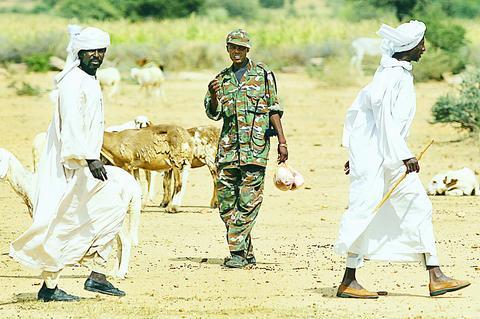
PHOTO: AP
"If it is really a genocide they should be committed to send troops," the Sudanese ambassador said. "This is why I don't think they're genuine about its being genocide."
Would US troops really be welcome?
"I won't say that I welcome them because I don't have the authority to say that, but if they want to do that, let them talk to us," Erwa said.
US Ambassador John Danforth, when told that Erwa raised the possibility of discussing the deployment of US troops, said: "I've never heard of such a thing before. It's certainly an attention grabber."
"It's a curious idea, but I don't think it has a future," he said.
The 1948 genocide convention defines that act as a calculated effort to destroy a national, ethnic, racial or religious group in whole or in part.
Violence broke out when two non-Arab Darfur rebel movements took up arms in February 2003 against government installations, saying they wanted a bigger share of power and Sudan's resources. More than 50,000 people have been killed and 1.4 million driven from their homes in what the UN says is the world's worst humanitarian crisis.
Last month, the US State Department said that in recent interviews with 1,136 Darfur refugees in neighboring Chad it found a "consistent and widespread pattern of atrocities committed against non-Arab villagers." It added that about a third of the refugees who were interviewed heard racial epithets while under attack.
In Khartoum, Blair was to meet with President Omar Ahmed al-Bashir and his deputy Ali Osman Mohammed Taha, on the first leg of a three-day Africa visit.
He is expected to urge al-Bashir to reach a peace deal with rebels wreaking havoc in the Darfur region, to allow aid organizations proper access to refugees, and allow peacekeepers from the African Union.
Due to limited time, Blair will not visit Darfur, with his spokesman saying his presence would be best used hammering home the international community's message to the Sudanese government.
The Prime Minister is making his five-hour flying visit to Sudan, coping with temperatures expected to reach a sweltering 42 Celsius degrees with accompanying high humidity, despite having undergone a heart procedure only last week.
Blair will fly later in the day on to the Ethiopian capital Addis Ababa where he will chair the second meeting of his Commission for Africa designed to pave the way for solutions to the continent's long-term problems.
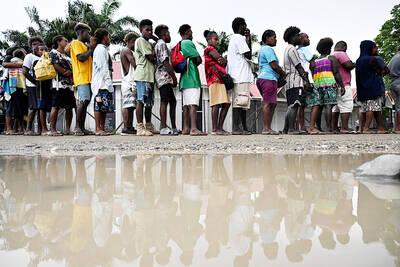
SEEKING CHANGE: A hospital worker said she did not vote in previous elections, but ‘now I can see that maybe my vote can change the system and the country’ Voting closed yesterday across the Solomon Islands in the south Pacific nation’s first general election since the government switched diplomatic allegiance from Taiwan to Beijing and struck a secret security pact that has raised fears of the Chinese navy gaining a foothold in the region. The Solomon Islands’ closer relationship with China and a troubled domestic economy weighed on voters’ minds as they cast their ballots. As many as 420,000 registered voters had their say across 50 national seats. For the first time, the national vote also coincided with elections for eight of the 10 local governments. Esther Maeluma cast her vote in the
Nearly half of China’s major cities are suffering “moderate to severe” levels of subsidence, putting millions of people at risk of flooding, especially as sea levels rise, according to a study of nationwide satellite data released yesterday. The authors of the paper, published by the journal Science, found that 45 percent of China’s urban land was sinking faster than 3mm per year, with 16 percent at more than 10mm per year, driven not only by declining water tables, but also the sheer weight of the built environment. With China’s urban population already in excess of 900 million people, “even a small portion

UNSETTLING IMAGES: The scene took place in front of TV crews covering the Trump trial, with a CNN anchor calling it an ‘emotional and unbelievably disturbing moment’ A man who doused himself in an accelerant and set himself on fire outside the courthouse where former US president Donald Trump is on trial has died, police said yesterday. The New York City Police Department (NYPD) said the man was declared dead by staff at an area hospital. The man was in Collect Pond Park at about 1:30pm on Friday when he took out pamphlets espousing conspiracy theories, tossed them around, then doused himself in an accelerant and set himself on fire, officials and witnesses said. A large number of police officers were nearby when it happened. Some officers and bystanders rushed

HYPOCRISY? The Chinese Ministry of Foreign Affairs yesterday asked whether Biden was talking about China or the US when he used the word ‘xenophobic’ US President Joe Biden on Wednesday called for a hike in steel tariffs on China, accusing Beijing of cheating as he spoke at a campaign event in Pennsylvania. Biden accused China of xenophobia, too, in a speech to union members in Pittsburgh. “They’re not competing, they’re cheating. They’re cheating and we’ve seen the damage here in America,” Biden said. Chinese steel companies “don’t need to worry about making a profit because the Chinese government is subsidizing them so heavily,” he said. Biden said he had called for the US Trade Representative to triple the tariff rates for Chinese steel and aluminum if Beijing was


 RSS
RSS