


For Cuban exiles, the Versailles cafe is a parallel world. If there had been no revolution, no Fidel Castro, they would have been sipping coffee and reading the daily papers in a place just like this in Havana.
But 45 years on, they are still in Little Havana, Miami, in exile limbo.

PHOTO: EPA
The waiters in starched white shirts and forest-green waistcoats make the Versailles look as the Cuban capital once did; so do the tiled floors and coffee counter where Cuban-Americans come to gossip.
The menu and the ambience are essentially unchanged in decades, but the politics of Little Havana are changing in small ways that could have a big effect on this year's presidential election.
The change is clear to anyone who looks out of the Versailles window and across the road,where the John Kerry presidential campaign has set up an office, plastered with Democratic paraphernalia.
As electoral effrontery, this is on a par with Republicans opening up in Harlem. In Florida, the Cuban vote is the rock on which President Bush's 2000 electoral victory was built. Coraled and coddled by Jeb, his Spanish-speaking brother and state governor, 82 percent of Florida's 450,000 Cuban-Americans voted Republican.
That near-monopoly is now showing signs of crumbling. Younger Cubans and more recent immigrants are turning away from the politics of the post-revolutionary exiles, los historicos.
One of the younger men drinking coffee, Ignacio Luzarraga, is a perfect example. He is 26 years old, a second generation Cuban-American, who will not follow family tradition at the polling booth on Nov. 2. He will be voting Democrat, for Senator Kerry.
"The younger generation of Cuban-Americans will not follow suit just for the sake of following suit," he said.
To talk to older Cuban-Americans about politics is to take a detour down four bitter decades of US-Cuban relations, in which the Republicans established themselves in Little Havana as the party of anti-communism, the embargo, and, in exile eyes, of revenge.
Luzarraga's concerns are like those of most other young Americans. He worries about Iraq, and believes George Bush "has not been honest as he should have been" about the reasons for going to war and its consequences for US troops and for the Iraqi people.
Tessie Arau is another Cuban Republican who won't vote for George Bush. She runs a company organizing flights to Cuba for Cuban-Americans to see relatives.
In May, the Bush administration ordered those trips to be cut to one every three years per person. The decision delighted hard-line historicos, who no longer have close ties to the island. For many newer arrivals, the measure was a disaster.
"It's inhumane. There was a gentleman who killed himself because he knew he couldn't see his autistic son for three years," Arau said. "I don't see how that brings democracy."
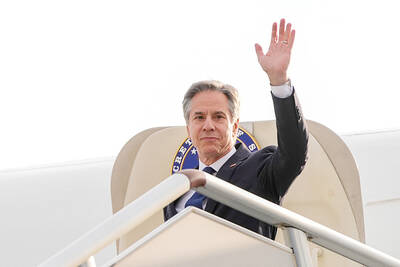
‘IN A DIFFERENT PLACE’: The envoy first visited Shanghai, where he attended a Chinese basketball playoff match, and is to meet top officials in Beijing tomorrow US Secretary of State Antony Blinken yesterday arrived in China on his second visit in a year as the US ramps up pressure on its rival over its support for Russia while also seeking to manage tensions with Beijing. The US diplomat tomorrow is to meet China’s top brass in Beijing, where he is also expected to plead for restraint as Taiwan inaugurates president-elect William Lai (賴清德), and to raise US concerns on Chinese trade practices. However, Blinken is also seeking to stabilize ties, with tensions between the world’s two largest economies easing since his previous visit in June last year. At the
Nearly half of China’s major cities are suffering “moderate to severe” levels of subsidence, putting millions of people at risk of flooding, especially as sea levels rise, according to a study of nationwide satellite data released yesterday. The authors of the paper, published by the journal Science, found that 45 percent of China’s urban land was sinking faster than 3mm per year, with 16 percent at more than 10mm per year, driven not only by declining water tables, but also the sheer weight of the built environment. With China’s urban population already in excess of 900 million people, “even a small portion

UNSETTLING IMAGES: The scene took place in front of TV crews covering the Trump trial, with a CNN anchor calling it an ‘emotional and unbelievably disturbing moment’ A man who doused himself in an accelerant and set himself on fire outside the courthouse where former US president Donald Trump is on trial has died, police said yesterday. The New York City Police Department (NYPD) said the man was declared dead by staff at an area hospital. The man was in Collect Pond Park at about 1:30pm on Friday when he took out pamphlets espousing conspiracy theories, tossed them around, then doused himself in an accelerant and set himself on fire, officials and witnesses said. A large number of police officers were nearby when it happened. Some officers and bystanders rushed

Beijing is continuing to commit genocide and crimes against humanity against Uyghurs and other Muslim minorities in its western Xinjiang province, U.S. Secretary of State Antony Blinken said in a report published on Monday, ahead of his planned visit to China this week. The State Department’s annual human rights report, which documents abuses recorded all over the world during the previous calendar year, repeated language from previous years on the treatment of Muslims in Xinjiang, but the publication raises the issue ahead of delicate talks, including on the war in Ukraine and global trade, between the top U.S. diplomat and Chinese


 RSS
RSS