


The US military is in the final stages of readying its national ballistic missile defense system, with officials predicting it will be activated before year's end. But several questions remain, including how well the experimental missile interceptors work.
The Pentagon maintains that any defense against intercontinental ballistic missiles (ICBMs) is better than none. Critics contend the Bush administration is vastly overselling an expensive, unproven defense system.
There has been an expectation that the administration will shortly declare that the missile defense system is operational and on alert. Military officials said they know of no specific plans for such an announcement.
Such an announcement would have political and strategic value for the administration.
To those who believe it will work, activating the system would fulfill a pledge by President George W. Bush to have an operational missile defense system by the end of this year. Such an announcement would also have greater value if it came before the Nov. 2 elections.
Bush has promoted the system while campaigning for re-election.
"We want to continue to perfect this system, so we say to those tyrants who believe they can blackmail America and the free world: you fire; we're going to shoot it down," he said at Ridley Park, Pennsylvania, on Aug. 17.
Military officials stressed that the initial system will be modest and limited in capability, but will improve over time.
Critics of the system, such as Philip Coyle, the Pentagon's former chief of testing, say Bush is wrong.
"Of course we don't have any capability to do that," he said. "For the president to sort of dare them [to fire missiles] is really misleading and even reckless."
Democratic presidential nominee Senator John Kerry has said that, if elected, he would proceed more slowly with the missile defense system and take time for additional testing.
Estimates vary widely on how much the program will cost over its lifetime, with some reaching US$100 billion or more. This year and next, the Missile Defense Agency expects to spend a total of more than $US10 billion.
Many of the doubts about the system, initially designed to protect the US from an ICBM attack from North Korea and other possible threats in the western Pacific, arise from problems during high-profile tests.
In testing, which critics deride as highly scripted, the interceptors have gone five-for-eight when launched at target missiles.
Two tests scheduled for this year have been delayed due to recently discovered technical problems. The next test is now set for late next month or early December, so it is unclear if it will take place before interceptors in Alaska go on alert. The test after that will take place early next year.
The military has five interceptors in underground silos at Fort Greely in central Alaska, with plans to add one more by this month, and an additional 10 by the end of next year.
A Navy destroyer has begun patrolling the Sea of Japan with a newly upgraded AEGIS radar capable of tracking any North Korean missile launches and feeding information into the missile defense network.
But some of these various pieces of the system are not yet linked to one another, Lehner said. He and other officials could not provide a specific time when the system will be ready in the coming months.
Also unsettled are the military's doctrine and authorities for launching interceptors in a crisis -- although such policies are expected to be decided on during the next few weeks.

Republican US lawmakers on Friday criticized US President Joe Biden’s administration after sanctioned Chinese telecoms equipment giant Huawei unveiled a laptop this week powered by an Intel artificial intelligence (AI) chip. The US placed Huawei on a trade restriction list in 2019 for contravening Iran sanctions, part of a broader effort to hobble Beijing’s technological advances. Placement on the list means the company’s suppliers have to seek a special, difficult-to-obtain license before shipping to it. One such license, issued by then-US president Donald Trump’s administration, has allowed Intel to ship central processors to Huawei for use in laptops since 2020. China hardliners

Conjoined twins Lori and George Schappell, who pursued separate careers, interests and relationships during lives that defied medical expectations, died this month in Pennsylvania, funeral home officials said. They were 62. The twins, listed by Guinness World Records as the oldest living conjoined twins, died on April 7 at the Hospital of the University of Pennsylvania, obituaries posted by Leibensperger Funeral Homes of Hamburg said. The cause of death was not detailed. “When we were born, the doctors didn’t think we’d make 30, but we proved them wrong,” Lori said in an interview when they turned 50, the Philadelphia Inquirer reported. The
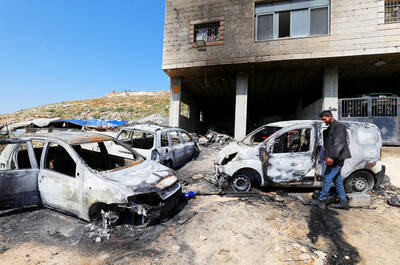
RAMPAGE: A Palestinian man was left dead after dozens of Israeli settlers searching for a missing 14-year-old boy stormed a village in the Israeli-occupied West Bank US President Joe Biden on Friday said he expected Iran to attack Israel “sooner, rather than later” and warned Tehran not to proceed. Asked by reporters about his message to Iran, Biden simply said: “Don’t,” underscoring Washington’s commitment to defend Israel. “We are devoted to the defense of Israel. We will support Israel. We will help defend Israel and Iran will not succeed,” he said. Biden said he would not divulge secure information, but said his expectation was that an attack could come “sooner, rather than later.” Israel braced on Friday for an attack by Iran or its proxies as warnings grew of

A prominent Christian leader has allegedly been stabbed at the altar during a Mass yesterday in southwest Sydney. Bishop Mar Mari Emmanuel was saying Mass at Christ The Good Shepherd Church in Wakeley just after 7pm when a man approached him at the altar and allegedly stabbed toward his head multiple times. A live stream of the Mass shows the congregation swarm forward toward Emmanuel before it was cut off. The church leader gained prominence during the COVID-19 pandemic, amassing a large online following, Officers attached to Fairfield City police area command attended a location on Welcome Street, Wakeley following reports a number


 RSS
RSS