


Cambodia's national assembly yesterday ratified a law allowing a UN-backed trial of surviving Khmer Rouge leaders to go ahead, clearing a crucial hurdle for a tribunal whose next challenge is raising funds.
The law ratifies an agreement between the UN and government which outlines procedures on trying the aging associates of Pol Pot, whose ultra-Maoist 1975-79 regime left up to 2 million people dead.

PHOTO: EPA
It had been delayed by a year-long political crisis that hamstrung parliament but was finally resolved in July.
"The national assembly has agreed to ratify the agreement between Cambodia and the United Nations on the law to try Khmer Rouge leaders for crimes committed under the Democratic Kampuchea regime," assembly president Prince Norodom Ranariddh told the session after an open vote.
The 107 lawmakers attending the 123-seat assembly voted unanimously in favor of the ratification, including lawmakers from the opposition, after just three hours of debate.
The law must still be approved by the Senate, the Constitutional Council and King Norodom Siha-nouk, formalities which are likely to take a few weeks.
"What we were waiting for has been achieved today," Prime Minister Hun Sen told reporters, adding that some 26 amendments to domestic laws also required for the tribunal to get underway would be passed today.
"The whole agreement has been ratified," he added. "Even though we need to do more amendments to go with this agreement, everything will be finished tomorrow."
Hun Sen said that the first day of the tribunal would be a national holiday and its proceedings would be televised. He did not say how quickly he expected the tribunal to begin.
"Even though there have been comments [on the tribunal], what is real is what happened today at our national assembly," he said, in a likely reference to critics who claimed the government has been delaying the process.
Youk Chhang, director of the Documentation Centre of Cambodia which has been accumulating evidence of atrocities, said the law's passage gave victims "some hope that justice can be provided."
"The government has finally shown that they are serious about achieving justice for those who died under the Khmer Rouge regime," Youk said, noting that he expected it would still be at least eight months before a tribunal begins.
The UN and Cambodia both approved the historic tribunal agreement in June last year after four years of negotiations.
Attention is now focused on funding, which is yet to be finalized. An initial UN estimate put the cost for three-year proceedings that will try fewer than a dozen ex-leaders at around US$55 million, but donors balked and the figure is still being thrashed out.
UN Secretary-General Kofi Annan is expected to report shortly on the budget for the trial, with donors such as Japan and France waiting for the figure before announcing their contributions.
According to several independent surveys, 80 percent of Cambodians back the trial to bring to justice those whose atrocities have deeply scarred a nation.
Surviving Khmer Rouge leaders, now mostly in their seventies, have been cited for trial by scholars of genocide and crimes against humanity. Only two are in detention with others living freely in the country, including Brother No. 2 Nuon Chea.
Khmer Rouge supremo Pol Pot died in 1998.

Republican US lawmakers on Friday criticized US President Joe Biden’s administration after sanctioned Chinese telecoms equipment giant Huawei unveiled a laptop this week powered by an Intel artificial intelligence (AI) chip. The US placed Huawei on a trade restriction list in 2019 for contravening Iran sanctions, part of a broader effort to hobble Beijing’s technological advances. Placement on the list means the company’s suppliers have to seek a special, difficult-to-obtain license before shipping to it. One such license, issued by then-US president Donald Trump’s administration, has allowed Intel to ship central processors to Huawei for use in laptops since 2020. China hardliners
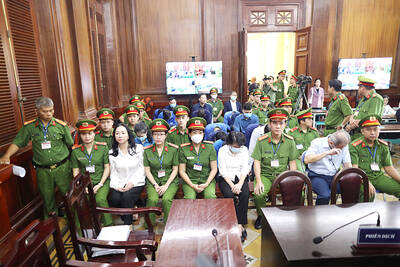
A top Vietnamese property tycoon was on Thursday sentenced to death in one of the biggest corruption cases in history, with an estimated US$27 billion in damages. A panel of three hand-picked jurors and two judges rejected all defense arguments by Truong My Lan, chair of major developer Van Thinh Phat, who was found guilty of swindling cash from Saigon Commercial Bank (SCB) over a decade. “The defendant’s actions ... eroded people’s trust in the leadership of the [Communist] Party and state,” read the verdict at the trial in Ho Chi Minh City. After the five-week trial, 85 others were also sentenced on

‘DELUSIONAL’: Targeting the families of Hamas’ leaders would not push the group to change its position or to give up its demands for Palestinians, Ismail Haniyeh said Israeli aircraft on Wednesday killed three sons of Hamas’ top political leader in the Gaza Strip, striking high-stakes targets at a time when Israel is holding delicate ceasefire negotiations with the militant group. Hamas said four of the leader’s grandchildren were also killed. Ismail Haniyeh’s sons are among the highest-profile figures to be killed in the war so far. Israel said they were Hamas operatives, and Haniyeh accused Israel of acting in “the spirit of revenge and murder.” The deaths threatened to strain the internationally mediated ceasefire talks, which appeared to gain steam in recent days even as the sides remain far
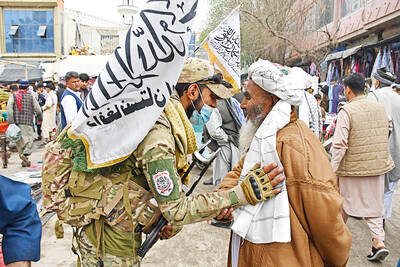
The Taliban’s reclusive supreme leader made a rare public appearance yesterday, an Afghan government spokesman said, leading thousands of worshipers in prayers marking Eid al-Fitr. Hibatullah Akhundzada has made only a handful of public appearances since inheriting the leadership of the Taliban in 2016 and leading the movement back to power with the withdrawal of US forces in 2021. Taliban government spokesman Zabihullah Mujahid said prayer in the largest mosque in Kandahar was “performed under the leadership of the supreme leader.” In a statement on X, he said the early-morning service “was attended by thousands of compatriots” in the southern province considered the


 RSS
RSS