


Amid one of the greatest military spending increases in history, the Pentagon is starved for cash.
The US will spend more than US$500 billion on national security in the fiscal year that began yesterday. That represents a high-water mark, and it is creating boom times in the armaments industry.
Yet the military says it has run US$1 billion a month short over the last year paying for the basics of war in Iraq: troops, equipment, spare parts and training.
The disparity between spending on the arsenals of the future and the armies of today is great, and growing.
The Pentagon will spend US$144 billion in the coming year researching and building weapons for future wars, another record and twice the annual costs of wars in Iraq and Afghanistan by most independent estimates.
The Pentagon says it has 77 major weapons programs under development. They have a collective price tag of US$1.3 trillion. That is nearly twice what they were supposed to cost, and 11 times the yearly bill for operating and maintaining the US military.
But when it comes to fighting the wars, the money has not flowed as freely.
"We probably cannot afford every weapon system" in development, President George W. Bush said in August 2001. "This administration is going to have to winnow them down."
Would Bush and Secretary of Defense Donald Rumsfeld rebuild the arsenal they had or skip forward to the next generation of weapons?
"On Sept. 10, 2001, Rumsfeld faced a totally invidious choice," said Gordon Adams, who oversaw national security spending at the Office of Management and Budget in the Clinton administration.
"He had to choose between the present and the future, and he knew it. The Pentagon planning system was in a crunch. The budget was in severe stress," Adams said.
But the attacks of Sept. 11 "completely changed the planning horizon for defense," Adams said. "The floodgates opened. Everything was a priority."
Why is there plenty of money available for the weapons of the future, but not enough for the troops at war today? Because, military experts say, one thing did not change after Sept. 11 -- the way the Pentagon and Congress pay for wars.
"We pay for war with supplementals," or special requests to Congress, said Lieutenant Colonel Rose-Ann Lynch, a Pentagon public affairs officer. "We do not budget for war. That's the way we do it, and that's the way we've been doing it for years."
Despite the record increases in weapons spending, the military, according to the Government Accountability Office, still faced shortfalls of more than US$12 billion over the last year for the myriad nuts and bolts of war: supporting troops, buying spare parts and maintaining equipment.
When the war-fighting money runs dry, the Pentagon taps into operations accounts and seeks tens of billions in "emergency" funds, spending them as fast as they are approved by Congress, sometimes faster.
"The military has been underreporting the actual costs of war in Iraq," Adams said.
As a consequence, he said, the Pentagon is led to "raiding the operations and maintenance accounts -- which is mortgaging the future."

‘IN A DIFFERENT PLACE’: The envoy first visited Shanghai, where he attended a Chinese basketball playoff match, and is to meet top officials in Beijing tomorrow US Secretary of State Antony Blinken yesterday arrived in China on his second visit in a year as the US ramps up pressure on its rival over its support for Russia while also seeking to manage tensions with Beijing. The US diplomat tomorrow is to meet China’s top brass in Beijing, where he is also expected to plead for restraint as Taiwan inaugurates president-elect William Lai (賴清德), and to raise US concerns on Chinese trade practices. However, Blinken is also seeking to stabilize ties, with tensions between the world’s two largest economies easing since his previous visit in June last year. At the
Nearly half of China’s major cities are suffering “moderate to severe” levels of subsidence, putting millions of people at risk of flooding, especially as sea levels rise, according to a study of nationwide satellite data released yesterday. The authors of the paper, published by the journal Science, found that 45 percent of China’s urban land was sinking faster than 3mm per year, with 16 percent at more than 10mm per year, driven not only by declining water tables, but also the sheer weight of the built environment. With China’s urban population already in excess of 900 million people, “even a small portion

UNSETTLING IMAGES: The scene took place in front of TV crews covering the Trump trial, with a CNN anchor calling it an ‘emotional and unbelievably disturbing moment’ A man who doused himself in an accelerant and set himself on fire outside the courthouse where former US president Donald Trump is on trial has died, police said yesterday. The New York City Police Department (NYPD) said the man was declared dead by staff at an area hospital. The man was in Collect Pond Park at about 1:30pm on Friday when he took out pamphlets espousing conspiracy theories, tossed them around, then doused himself in an accelerant and set himself on fire, officials and witnesses said. A large number of police officers were nearby when it happened. Some officers and bystanders rushed
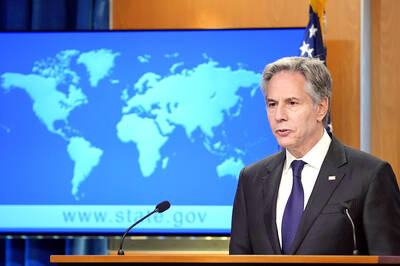
Beijing is continuing to commit genocide and crimes against humanity against Uyghurs and other Muslim minorities in its western Xinjiang province, U.S. Secretary of State Antony Blinken said in a report published on Monday, ahead of his planned visit to China this week. The State Department’s annual human rights report, which documents abuses recorded all over the world during the previous calendar year, repeated language from previous years on the treatment of Muslims in Xinjiang, but the publication raises the issue ahead of delicate talks, including on the war in Ukraine and global trade, between the top U.S. diplomat and Chinese


 RSS
RSS