


Indonesians appear to have used their first direct vote for president to remove the incumbent -- a defining moment in the country's transition to democracy that will force future leaders to listen the demands of the people, analysts predicted yesterday.
President Megawati Sukarnoputri, who was supported by a large swathe of the political elite, was almost certain to be beaten in Monday's elections by former general Susilo Bambang Yudhoyono, according to polls and official counts.
The significance of the election lies not so much in Megawati's replacement -- who critics note has few reform credentials -- but the fact that the electorate used its newfound power to boot out an increasingly unpopular leader, observers said yesterday.
"The phrase `the sovereignty of the people' used to only exist on paper in Indonesia," said Thamrin Amal Tomagola, a political observer from the University of Indonesia. "From now on, leaders will have to reckon with the people."
Monday's vote was a key step in Indonesia's transition to democracy following the downfall in 1998 of ex-dictator Suharto amid nationwide riots after 32-years of despotic rule.
"The fact that this was ... peaceful and transparent is amazing progress for Indonesia," said Greg Barton from Australia's Deakin University. "The people voted for change, which they were not going to get from Megawati."
During the Suharto years and in elections in 1999, lawmakers voting as an electoral college choose the president. Direct elections have been a key demand of the country's reform movement.
Megawati's party won the most votes in the 1999 elections, but lawmakers chose moderate Islamic cleric Abdurrahman Wahid as president and installed her as his deputy. Megawati, the daughter of the country's founding father Sukarno, got the presidency in 2001 after parliament impeached Wahid for incompetence.
But Megawati's was quickly perceived as uncaring and as having abandoned her reform agenda. The incumbent saw her popularity with millions of impoverished Indonesians who formed the core of her voter base plummet during the past three years.
In a widely criticized attempt to curry support for her re-election bid, she even formed a "National Coalition" with the Golkar party, the corrupt former political vehicle of Suharto, and five other smaller parties.
The move seemingly backfired, with many of her supporters convinced she had abandoned any pretense at reform.
"Genuine accountability is new for Indonesia," said Douglas Ramage, the head of the Asia Foundation in Indonesia. Megawati was "basically punished for not delivering enough on reform."
Yudhoyono declined to make deals with political parties ahead of the vote, claiming instead to have formed "a people's coalition."
He will now be under intense pressure to deliver on his pre-election promise of better security, more jobs and an end to the county's rampant graft.
"Remember what I am saying now,'' the 55-year-old said during a televised debate last week. "And keep an eye on me for the next five years."

Republican US lawmakers on Friday criticized US President Joe Biden’s administration after sanctioned Chinese telecoms equipment giant Huawei unveiled a laptop this week powered by an Intel artificial intelligence (AI) chip. The US placed Huawei on a trade restriction list in 2019 for contravening Iran sanctions, part of a broader effort to hobble Beijing’s technological advances. Placement on the list means the company’s suppliers have to seek a special, difficult-to-obtain license before shipping to it. One such license, issued by then-US president Donald Trump’s administration, has allowed Intel to ship central processors to Huawei for use in laptops since 2020. China hardliners
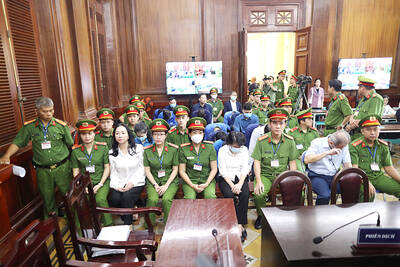
A top Vietnamese property tycoon was on Thursday sentenced to death in one of the biggest corruption cases in history, with an estimated US$27 billion in damages. A panel of three hand-picked jurors and two judges rejected all defense arguments by Truong My Lan, chair of major developer Van Thinh Phat, who was found guilty of swindling cash from Saigon Commercial Bank (SCB) over a decade. “The defendant’s actions ... eroded people’s trust in the leadership of the [Communist] Party and state,” read the verdict at the trial in Ho Chi Minh City. After the five-week trial, 85 others were also sentenced on

‘DELUSIONAL’: Targeting the families of Hamas’ leaders would not push the group to change its position or to give up its demands for Palestinians, Ismail Haniyeh said Israeli aircraft on Wednesday killed three sons of Hamas’ top political leader in the Gaza Strip, striking high-stakes targets at a time when Israel is holding delicate ceasefire negotiations with the militant group. Hamas said four of the leader’s grandchildren were also killed. Ismail Haniyeh’s sons are among the highest-profile figures to be killed in the war so far. Israel said they were Hamas operatives, and Haniyeh accused Israel of acting in “the spirit of revenge and murder.” The deaths threatened to strain the internationally mediated ceasefire talks, which appeared to gain steam in recent days even as the sides remain far

The Taliban’s reclusive supreme leader made a rare public appearance yesterday, an Afghan government spokesman said, leading thousands of worshipers in prayers marking Eid al-Fitr. Hibatullah Akhundzada has made only a handful of public appearances since inheriting the leadership of the Taliban in 2016 and leading the movement back to power with the withdrawal of US forces in 2021. Taliban government spokesman Zabihullah Mujahid said prayer in the largest mosque in Kandahar was “performed under the leadership of the supreme leader.” In a statement on X, he said the early-morning service “was attended by thousands of compatriots” in the southern province considered the


 RSS
RSS