


Too tiny to appear on most maps, this tropical island of snorkelers and sugar cane farmers, of turquoise waters and red soil flecked with white coral, may appear on the agendas of President George W. Bush and Prime Minister Junichiro Koizumi when they meet today on the sidelines of the UN General Assembly in New York.
Shimoji Shima, population 75 and less than 10.4km2, has something the militaries of the US and Japan desperately want: a 3,000m concrete runway, about halfway between Okinawa and Taiwan. In the 256km island chain of the Southern Ryukyus, the runway is the only one capable of safely handling a fully loaded F-15C fighter jet.
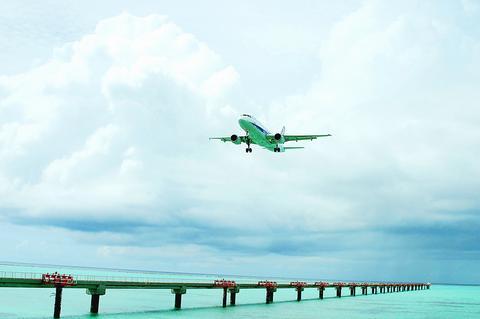
PHOTO: THE NEW YORK TIMES
The US is worried about Chinese saber-rattling over Taiwan and rising sentiment against US bases on Okinawa's main island. In a sign of the times, US Air Force commanders canceled an air show at Kadena Air Base last Wednesday, and called in the Japanese police on Thursday when protesters started shoving Marine guards at Marine Corps Air Station Futenma.
Japan is worried about a long-running border dispute with China that has left the confines of diplomacy for the open waters of the East China Sea. Six months ago, a boatload of Chinese citizens disembarked on one of the Senkakus, an island group 200km northwest of here that is claimed by both Japan and China. A Japanese Coast Guard ship arrived, and the protesters were detained and sent back to China.
But the economic prize behind the obscure island dispute came into sharp focus last month as China started laying a 465.5km gas pipeline from Shanghai to Chun-xiao, a huge undersea gas reservoir that is believed to straddle both nations' claims. Without waiting for the dispute to be settled, a Chinese-led international consortium started this summer to build drilling rigs. It intends to produce next year from an 22,100km2 field estimated to hold up to 250 billion cubic meters of gas, enough gas to meet all of China's needs for seven years at current consumption rates.
Furious, Shoichi Nakagawa, Japan's minister of economy, trade and industry, flew over the field on June 23 to inspect the Chinese gas complex. Although the Chinese are drilling in uncontested Chinese waters, the Japanese believe that the Chinese will suck up Japanese gas. From Beijing and Tokyo, diplomats have been trading such words as "regrettable" and "provocation."
In this environment, high-level US and Japanese discussions were held in Tokyo last week about opening Shimoji Shima's civilian airstrip to military use -- largely maritime patrols and joint training drills -- by US and Japanese pilots.
"There is determination of the top leadership in the defense agency to move forward on Shimoji," said a Washington-based US military expert who talked to principals from both countries. "It would help if Bush would say to Koizumi next week, `We really need this, can you make it happen?'"
But as news of the talks started to leak out last week, it drew Okinawan opposition. With many Okinawans committed to shifting their economy from military spending to ecological tourism, they voiced strong opposition to the idea of US war planes using the strip here, which was originally built to train Japanese commercial jet pilots.
"Okinawan people had an awful experience during the war and are very much sensitive about such a issue," said Yasuto Hamakawa, a taxi driver, referring to heavy civilian losses during World War II.

Republican US lawmakers on Friday criticized US President Joe Biden’s administration after sanctioned Chinese telecoms equipment giant Huawei unveiled a laptop this week powered by an Intel artificial intelligence (AI) chip. The US placed Huawei on a trade restriction list in 2019 for contravening Iran sanctions, part of a broader effort to hobble Beijing’s technological advances. Placement on the list means the company’s suppliers have to seek a special, difficult-to-obtain license before shipping to it. One such license, issued by then-US president Donald Trump’s administration, has allowed Intel to ship central processors to Huawei for use in laptops since 2020. China hardliners

Conjoined twins Lori and George Schappell, who pursued separate careers, interests and relationships during lives that defied medical expectations, died this month in Pennsylvania, funeral home officials said. They were 62. The twins, listed by Guinness World Records as the oldest living conjoined twins, died on April 7 at the Hospital of the University of Pennsylvania, obituaries posted by Leibensperger Funeral Homes of Hamburg said. The cause of death was not detailed. “When we were born, the doctors didn’t think we’d make 30, but we proved them wrong,” Lori said in an interview when they turned 50, the Philadelphia Inquirer reported. The
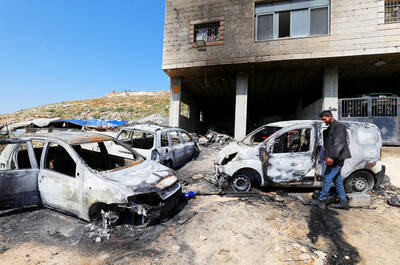
RAMPAGE: A Palestinian man was left dead after dozens of Israeli settlers searching for a missing 14-year-old boy stormed a village in the Israeli-occupied West Bank US President Joe Biden on Friday said he expected Iran to attack Israel “sooner, rather than later” and warned Tehran not to proceed. Asked by reporters about his message to Iran, Biden simply said: “Don’t,” underscoring Washington’s commitment to defend Israel. “We are devoted to the defense of Israel. We will support Israel. We will help defend Israel and Iran will not succeed,” he said. Biden said he would not divulge secure information, but said his expectation was that an attack could come “sooner, rather than later.” Israel braced on Friday for an attack by Iran or its proxies as warnings grew of

A prominent Christian leader has allegedly been stabbed at the altar during a Mass yesterday in southwest Sydney. Bishop Mar Mari Emmanuel was saying Mass at Christ The Good Shepherd Church in Wakeley just after 7pm when a man approached him at the altar and allegedly stabbed toward his head multiple times. A live stream of the Mass shows the congregation swarm forward toward Emmanuel before it was cut off. The church leader gained prominence during the COVID-19 pandemic, amassing a large online following, Officers attached to Fairfield City police area command attended a location on Welcome Street, Wakeley following reports a number


 RSS
RSS