


President Hu Jintao's (胡錦濤) new status as commander of China's military should strengthen efforts to fight corruption and control a surging economy, forcing resistant lower-level officials to recognize Hu as their undisputed leader, analysts said yesterday.
Former president Jiang Zemin's (江澤民) decision to hand over his last post as military chief on Sunday, almost two years after Hu succeeded him as Communist Party leader, ended tensions over control that had let local officials resist pressure to cut spending and carry out painful reforms, the analysts said.
"This is a very significant event," said Kenneth Lieberthal, a China specialist at the Brookings Institution in Washington.
"Hu really has the future in his hands at this moment," he said.
The consolidation of China's top party and military posts in Hu's control is expected to give him and Premier Wen Jiabao (溫家寶) a freer hand to act as they wrestle with huge challenges ranging from rural poverty to fighting rampant corruption that is undermining public confidence in the leadership.
It also could help a government austerity campaign aimed at cooling off an economy that is growing by more than 9 percent a year, threatening to ignite politically dangerous inflation and weaken the fragile banking industry.
Despite repeated orders from Beijing, local officials have balked at orders to cancel major construction and other big spending projects -- austerity moves that could cost local jobs and reduce opportunities to line their pockets. Hu and Wen reportedly have been forced to visit Shanghai and other areas to compel obedience in person.
"As long as there was the impression that there was political infighting at the top, there was a reason for local officials who didn't like the changes to hold out in hopes of getting a different option," Lieberthal said.
But now, he said, "at lower levels it will be seen that the wave of the future is the Hu Jintao leadership, and that should tighten discipline."
Despite his new military status, Hu,61, is the weakest leader of the communist era, surrounded by potential rivals in a consensus-based party leadership. He shares its ruling nine-member Standing Committee with at least five Jiang allies.
But the end of uncertainty over the military post could help the methodical, diplomatic Hu to solidify his political alliances and push out Jiang's proteges, said Joseph Cheng (鄭宇碩), a political scientist at the City University of Hong Kong.
"In the next party congress," a meeting due in 2007 to decide the party's political plans and leadership, "there could be a major shake-up," Cheng said.
Hu's new authority also should help anti-graft efforts by discouraging lower-level officials from trying to protect corrupt colleagues and others, he said.
"There will be less resistance," Cheng said.
Several times, Hu has been rumored to be preparing major political reform speeches, only to deliver bland restatements of party policy -- a suggestion that he didn't feel his position was strong enough to launch any bold initiatives.
Hu has talked vaguely about promoting "socialist democracy," but that isn't expected to include opposition politics or free elections.
"Now people expect Hu Jintao to act," Cheng said.
"If he cannot come up with a political reform program, there will be disappointment," Cheng said.

Republican US lawmakers on Friday criticized US President Joe Biden’s administration after sanctioned Chinese telecoms equipment giant Huawei unveiled a laptop this week powered by an Intel artificial intelligence (AI) chip. The US placed Huawei on a trade restriction list in 2019 for contravening Iran sanctions, part of a broader effort to hobble Beijing’s technological advances. Placement on the list means the company’s suppliers have to seek a special, difficult-to-obtain license before shipping to it. One such license, issued by then-US president Donald Trump’s administration, has allowed Intel to ship central processors to Huawei for use in laptops since 2020. China hardliners
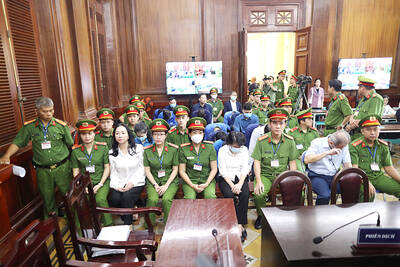
A top Vietnamese property tycoon was on Thursday sentenced to death in one of the biggest corruption cases in history, with an estimated US$27 billion in damages. A panel of three hand-picked jurors and two judges rejected all defense arguments by Truong My Lan, chair of major developer Van Thinh Phat, who was found guilty of swindling cash from Saigon Commercial Bank (SCB) over a decade. “The defendant’s actions ... eroded people’s trust in the leadership of the [Communist] Party and state,” read the verdict at the trial in Ho Chi Minh City. After the five-week trial, 85 others were also sentenced on

Conjoined twins Lori and George Schappell, who pursued separate careers, interests and relationships during lives that defied medical expectations, died this month in Pennsylvania, funeral home officials said. They were 62. The twins, listed by Guinness World Records as the oldest living conjoined twins, died on April 7 at the Hospital of the University of Pennsylvania, obituaries posted by Leibensperger Funeral Homes of Hamburg said. The cause of death was not detailed. “When we were born, the doctors didn’t think we’d make 30, but we proved them wrong,” Lori said in an interview when they turned 50, the Philadelphia Inquirer reported. The
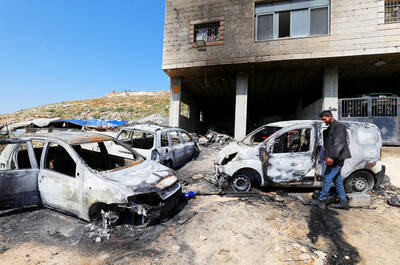
RAMPAGE: A Palestinian man was left dead after dozens of Israeli settlers searching for a missing 14-year-old boy stormed a village in the Israeli-occupied West Bank US President Joe Biden on Friday said he expected Iran to attack Israel “sooner, rather than later” and warned Tehran not to proceed. Asked by reporters about his message to Iran, Biden simply said: “Don’t,” underscoring Washington’s commitment to defend Israel. “We are devoted to the defense of Israel. We will support Israel. We will help defend Israel and Iran will not succeed,” he said. Biden said he would not divulge secure information, but said his expectation was that an attack could come “sooner, rather than later.” Israel braced on Friday for an attack by Iran or its proxies as warnings grew of


 RSS
RSS